Some links on this page are affiliate links. If you buy through them, Dubspot may earn a commission at no extra cost to you. It never affects our scores or what we recommend — read our policy.
Imaginando TV3: Acid Basslines That Write Themselves
Imaginando TV3 is a TB-303-style acid synth with a one-click pattern generator, now with a redesigned interface. Specs, pricing, and how it compares to Acid V.
M
Marcus Feld
August 25, 2026 · 7 min read
See full specs, price, and alternatives in the plugin database →
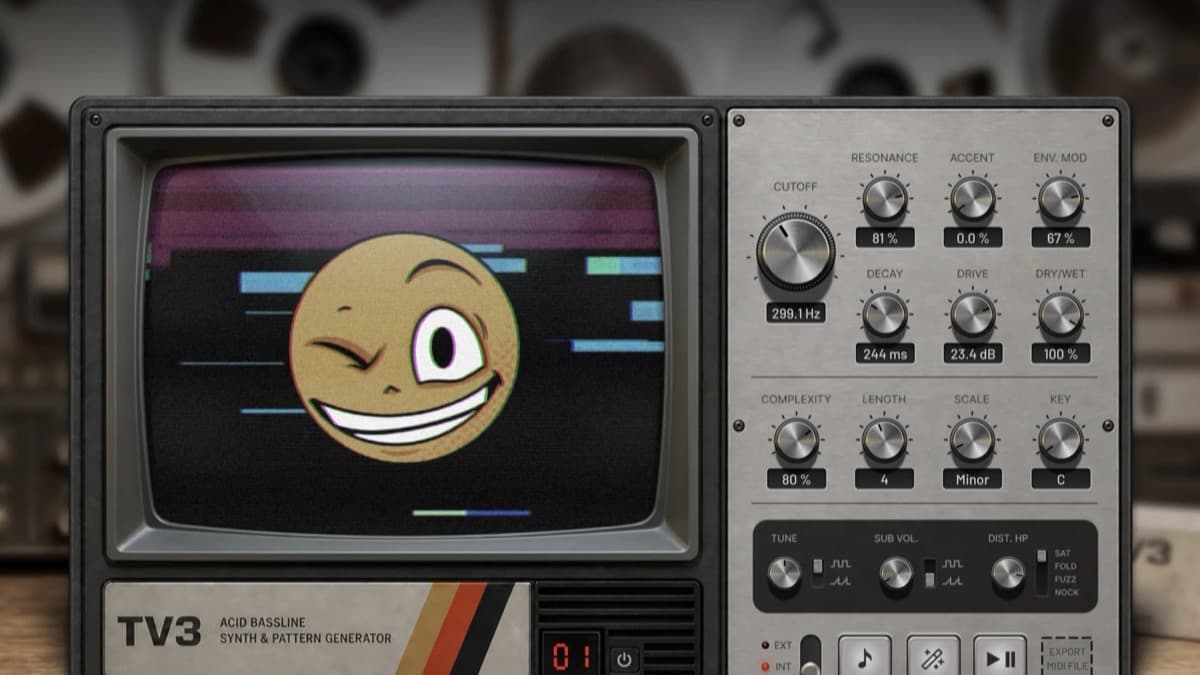
Imaginando's TV3 is a TB-303-style acid synthesizer built around one idea: get out of your way and make basslines fast. The instrument pairs a classic acid voice with a one-click pattern generator, and the 1.1.0 update brings a redesigned interface and a dedicated sequence editor. It is a small, sharply focused plugin that does the squelchy 303 sound and little else, which is exactly the point.
At a glance: €39 for desktop (VST, VST3, AU, standalone), with iOS and Android sold separately. Two oscillators, a 24 dB/octave resonant low-pass filter, four distortion modes, and a pattern generator that rolls out acid sequences you can drag into your DAW as MIDI. It runs on macOS, Windows, iOS, and Android.
What is Imaginando TV3?
TV3 is a software recreation of the Roland TB-303 Bass Line, the 1982 synth that accidentally invented acid house. The 303's resonant, sliding, distorted bass became a genre in its own right, and TV3 chases that sound with a modern workflow bolted on. Where the original was famously awkward to program, TV3 leans on generation and drag-and-drop to make the sound accessible.
It is a single-purpose instrument, and Imaginando is honest about that. The product's own brief is to be an acid bassline synth and pattern generator that stays out of your way. There is no attempt to be a do-everything synth. That focus is a feature: TV3 loads fast, makes one sound extremely well, and hands the result to your DAW.
The other distinguishing trait is reach. TV3 exists on desktop, iOS, and Android from a shared design, so a bassline you sketch on a phone behaves the same way in your studio DAW.
What TV3 does, feature by feature
The acid voice
TV3 runs two oscillators: a main oscillator offering square or sawtooth waves and a sub voice for weight underneath. Those feed a 24 dB/octave low-pass filter with cutoff and resonance, the heart of the 303 sound. An envelope section with accent and decay drives the filter to get that signature squelch and the sharp, accented notes that define an acid line.
Four distortion modes
Distortion is not optional in acid; it is the sound. TV3 provides four distortion modes, described by Imaginando as saturation, saturated wavefolding, fuzz, and "nock", with a high-pass filter in the distortion path to keep the low end controlled as you push the drive. That range covers everything from gentle warmth to full screaming acid.
The one-click pattern generator
This is TV3's signature. Instead of programming every step by hand, you press a button and the generator creates an acid sequence for you. You can set the length, key, scale, and complexity, and the generator works within 21 scales including major, minor, modes, and pentatonics. If a line is close but not perfect, you re-roll or edit it. Imaginando frames the randomizer as an "Acid Boy" that rolls dice across parameters on request.
Drag-and-drop MIDI export
Any generated or edited pattern can be dragged out of TV3 as a MIDI file, straight into your DAW. That is a genuinely useful workflow: you can generate a bassline in TV3, drop the MIDI onto another instrument, and keep the notes while changing the sound. It turns TV3 into an idea machine as much as a synth.
What is new in 1.1.0
Version 1.1.0 rebuilds the interface with a more realistic, skeuomorphic look and adds a dedicated sequence editor, giving you hands-on control over the steps the generator produces. It is an update aimed squarely at making the pattern workflow faster and more visual.
Imaginando TV3 specifications
| Spec | Detail |
|---|---|
| Product | Imaginando TV3 |
| Type | TB-303-style acid bass synthesizer |
| Oscillators | Two (main: square/saw, plus sub) |
| Filter | 24 dB/octave resonant low-pass |
| Envelope | Accent and decay |
| Distortion | Four modes, with high-pass in the drive path |
| Sequencer | One-click pattern generator, 21 scales, editable steps |
| Export | Drag-and-drop MIDI to DAW |
| Formats | VST, VST3, AU, standalone (desktop); AUv3 + standalone (iOS); standalone (Android) |
| Platforms | macOS 12+, Windows 10+, iOS 17+, Android 9+ |
| Price | €39 desktop; iOS and Android sold separately |
| Latest version | 1.1.0 (redesigned UI + sequence editor) |
TV3 vs Arturia Acid V
The obvious software rival is Arturia's Acid V, a deeper 303 emulation. They aim at the same sound from different angles.
| Imaginando TV3 | Arturia Acid V | |
|---|---|---|
| Price | €39 desktop | $149 |
| Voice | TB-303-style, two oscillators | TB-303 model with extended modes |
| Pattern generation | One-click generator, 21 scales | Sequencer with generative options |
| Effects | Four distortion modes | Multiple built-in effects |
| Platforms | Desktop + iOS + Android | Desktop only |
| Best for | Fast acid lines, cross-platform | Deep acid sound design in the studio |
Which to pick. Choose TV3 if you want authentic acid lines quickly, value the pattern generator and MIDI export, and work across desktop and mobile. Choose Acid V if you want a deeper, effects-rich 303 with more sound-shaping and modulation for detailed studio work. TV3 is the faster, cheaper, more portable route; Acid V is the deeper one.
Who TV3 is for
Consider it if you make acid, techno, or any style that leans on 303 basslines, and you want to generate lines fast rather than program every step. The generator plus MIDI export is a quick idea engine.
Consider it if you produce on more than one device. The same TV3 runs on desktop, iOS, and Android, so your workflow follows you.
Skip it if you want a broad, multi-purpose synth. TV3 is deliberately a one-sound instrument, and if you already own a 303 emulation you like, it may not add enough.
How much does TV3 cost?
The desktop plugin is €39 for VST, VST3, AU, and standalone, and it is often discounted at retail, with TV3 on Plugin Boutique listed lower than the direct price. A rent-to-own option and a bundle with other Imaginando plugins are available, and students and teachers get 50% off. The iOS app is a paid App Store download, while the Android app is free to install with an in-app purchase to unlock the engine. Imaginando has also run limited-time offers making the desktop version free through December 1, so check the official page for current pricing. A free desktop demo lets you run the full synth in your DAW before buying.
FAQ
Is TV3 a real TB-303 emulation?
TV3 is a TB-303-style acid synth. It recreates the classic 303 voice, the resonant filter, accented envelope, and distortion, with a modern pattern generator on top, rather than claiming to be a component-level model of the original hardware.
Does the desktop licence include the mobile app?
No. Desktop and mobile are sold separately. The iOS app is a paid download, and the Android app is a free install with an in-app purchase to unlock the synth.
Can TV3 generate patterns automatically?
Yes. That is its headline feature. A one-click pattern generator creates acid sequences you can drag into your DAW as MIDI, with control over length, key, scale, and complexity.
What are the system requirements?
macOS 12 or later, Windows 10 or later, iOS 17 or later, and Android 9 or later.
The bottom line
TV3 is a focused acid machine that trades breadth for speed. Two oscillators, a resonant 303-style filter, and four distortion modes cover the sound, and the one-click pattern generator plus MIDI export make it faster to get a usable bassline than almost anything else in the category. The 1.1.0 redesign and sequence editor sharpen that workflow further. It will not replace your main synth, and it is not meant to. As the quickest, most portable way to make acid lines that write themselves, it earns its place.