Dawesome Abyss II Rebuilds the Colour-Engine Synth
Dawesome Abyss II is an $89 intro colour-engine synth with sample-to-colour palettes, 400+ presets, and a 90-day trial. Specs, comparisons, and who it is for.
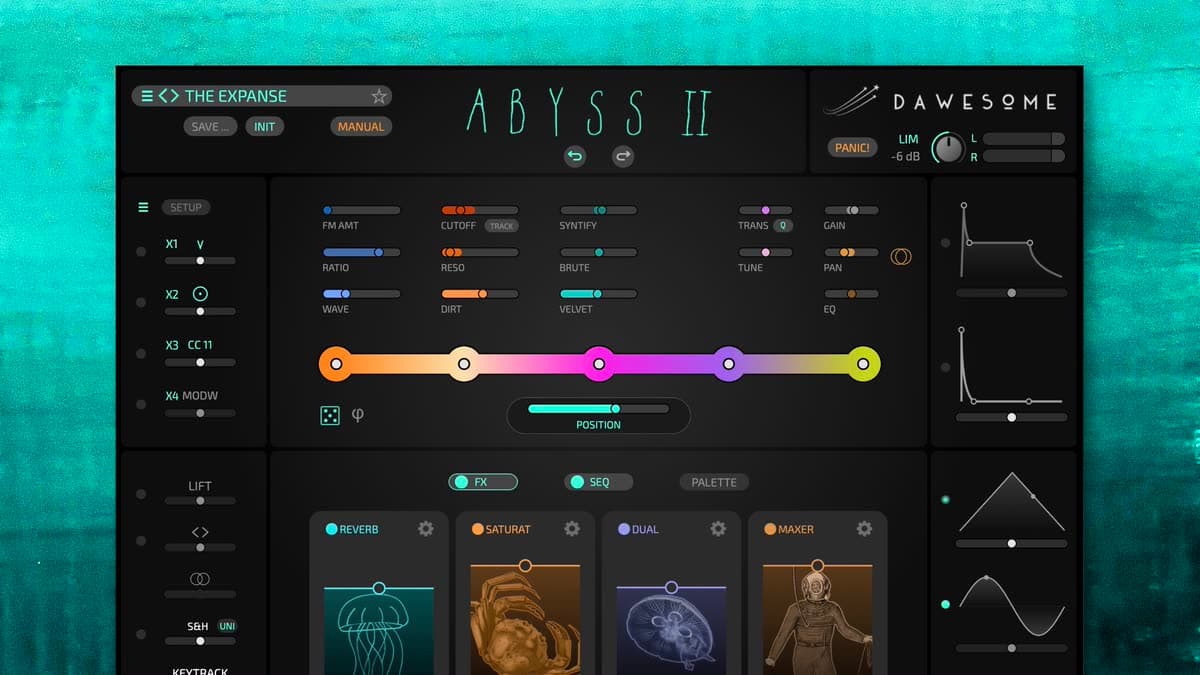
Dawesome released Abyss II on 20 August 2026, and it replaces Abyss 1 rather than patching it. The instrument is built around tone colours dropped onto a gradient bar, not oscillators, operators, or algorithms. Street price at the Tracktion store is $89 intro / $149 regular, and the Abyss 1 upgrade is $45 intro / $75 regular. This is a first look at official specs and manufacturer demos. We have not used it in a session.
At a glance: $89 intro, $149 regular. Abyss 1 upgrade $45 intro, $75 regular. 90-day unlimited trial. AU, VST3, and AAX on macOS 10.13+ (Intel and Apple Silicon); VST3 and AAX on Windows 10/11, 64-bit. 400+ presets. Sold by Tracktion and on the official Abyss page.
What Abyss II is, and what it is not
Abyss II is a cinematic soft synth with an unusual front end. Instead of tuning oscillators against each other, you place tone colours along a gradient bar. Position on that bar becomes the single control that evolves the patch over time. The vocabulary is the one producers already use for timbre — warm, cold, dark, brilliant, silky, lush — and Dawesome treats it as the interface rather than as description.
Peter V, the mathematician who founded Dawesome, has built the whole line around that idea. His official bio frames the engine as machine learning applied to sound design: analyse the spectrum, then map similar-sounding material near each other so a move across the gradient sounds like a move, not a jump. The tagline on both storefronts is "a synth for musicians, not engineers." Blunt, and a fair summary of what the panel actually asks of you.
That is a different job from Novum, Dawesome's spectral and granular instrument, which builds a playable instrument out of one recording. It is also a different job from Minimal Audio Lucid. Lucid is an insert effect that granulates audio already sitting on the track. Abyss II is the thing you play.
If you want a multi-engine workstation with wavetables, a sampler, and a conventional modulation matrix, look at Pigments 6 or Current 2. Abyss II sells a narrower idea. Keep the sound moving by painting, then drop your own audio onto the same gradient when the factory palettes run out of the colour you wanted.
Dawesome's own film is the cleanest overview of that pitch:
The colour engine, sample-to-colour, and palettes
Tone colours on a gradient
The gradient is the instrument. Official copy asks you to stop checking whether a setting is correct and start asking whether a colour combination is interesting. That is a workflow claim, and it is easy to test in an afternoon. The practical result is one Position control that morphs the patch, instead of a stack of oscillators you have to keep in tune with each other.
Sample-to-colour extraction
This is the headline addition in II. Drop a sample onto the gradient and Abyss II pulls spectral tone-colours out of it. A phone recording, a vocal snippet, or the thump of a guitar cable becoming a colour you can position and move — those are the examples Dawesome uses on its own page. Official copy quotes a musician who says they are still trying to find a sample that does not end up as an interesting sound. Treat that as a demo claim, not our session.
Custom palettes
Palettes extend the same intake to bulk. Point Abyss II at audio files or a whole folder and it builds an organic tone-colour palette from the contents. That is how the instrument eats your recordings without turning into a sampler. You are not mapping audio across a keyboard. You are converting it into colours the gradient already knows how to play.
The official "From Trash To Cinematic" film is the sample-to-colour demo:
Presets, FX, and the rest of the II list
The library
Abyss II ships 400+ presets: more than 200 entirely new, more than 200 upgraded from Abyss 1. V1 patches import by drag-and-drop or batch transfer, so an existing Abyss folder is not stranded. The new browser adds tags and favourites, and expansion packs sit on the official feature list. The factory set is a starting catalogue, not a ceiling.
Modular FX
Four free slots and 20 custom-designed modules. Official screenshots put FX on its own tab beside SEQ and PALETTE. That is a small rack, not a mixing chain. Use it to finish the colour, then bounce and treat the audio properly downstream.
BRUTE, VELVET, and SYNTIFY
These three are the new tone-shaping controls on the main panel, listed by Dawesome as warmth, aggressiveness, and tone. They sit next to cutoff, resonance, dirt, and a simple EQ rather than behind a submenu. If Abyss 1 ever felt like a mood you could not steer, these knobs are the published answer to that complaint.
Motion and Wave Drag-Out
The poly-rhythmic sequencer runs independent step counts per lane, so motion drifts against itself instead of locking to one repeating bar. Wave Drag-Out renders the notes you just played and lets you drag that audio into the DAW, or back into Abyss II as new source material. It is a sketch-to-audio path, and it pairs neatly with sample-to-colour.
Everything else on the II list
Undo/redo, a mono-synth mode, larger LFO and ADSR editing areas, modulatable ADSRs, a slow ADSR mode, a randomizer, and a high-contrast accessibility mode. Full MPE is listed on both the Dawesome and Tracktion pages. Official copy also calls the engine light on CPU, which we have not measured.
The factory preset film is the fastest way to hear the library before you install the trial:
The written spec is the Abyss 2 user manual hosted by Tracktion.
Abyss II specifications
| Spec | Official detail |
|---|---|
| Developer | Dawesome (Peter V), sold via Tracktion and dawesomemusic.com |
| Type | Colour-engine cinematic instrument |
| Intro price | $89 |
| Regular price | $149 |
| Upgrade from Abyss 1 | $45 intro / $75 regular |
| Trial | 90-day unlimited; Mac and Windows installers on the Dawesome page need no email or registration |
| Formats | AU, VST3, AAX on macOS; VST3, AAX on Windows |
| macOS | 10.13+, 64-bit Intel or Apple Silicon |
| Windows | 10 / 11, 64-bit |
| Presets | 400+ (200+ new, 200+ upgraded from v1) |
| Engine | Tone-colour gradient; sample-to-colour extraction; custom palettes from files or folders |
| FX | 4 slots, 20 modules |
| Motion | Poly-rhythmic sequencer with independent step counts |
| Tone controls | BRUTE, VELVET, SYNTIFY |
| MPE | Full MPE |
| Import | Abyss 1 presets by drag-and-drop or batch transfer |
| Also new in II | Undo/redo, mono mode, tagged preset browser, expansion packs, larger LFO/ADSR editors, modulatable ADSRs, slow ADSR, randomizer, high-contrast mode, Wave Drag-Out |
| Manual | abyss2-manual.pdf |
| Available | 20 August 2026 |
Abyss II vs Novum vs Pigments 6
Novum is the other Dawesome instrument in our catalogue. Pigments 6 is the multi-engine default plenty of producers already own. Prices in the middle column come from our own plugin cards.
| Abyss II | Dawesome Novum | Arturia Pigments 6 | |
|---|---|---|---|
| Job | Colour-engine cinematic instrument | Spectral / granular instrument from one sample | Multi-engine flagship synth |
| Street / list | $89 intro / $149 at Tracktion | See the Novum card | $199 on our Pigments 6 card |
| Front end | Tone colours on a gradient | Spectral import plus granular playback | Wavetable, VA, sample, granular |
| Sample use | Sample-to-colour and folder palettes | Build the whole instrument from one recording | Sample engine among several |
| FX | 4 slots / 20 modules | Instrument FX | Full Pigments FX rack |
| Formats | AU, VST3, AAX | AU, VST3, AAX | AU, VST3, AAX |
| Reach for it when | You want evolving cinematic colour without patching | You want to morph one recording into an instrument | You want one synth that covers most jobs |
Which to pick. Choose Abyss II if the sound in your head is a moving colour field and you will genuinely drop your own recordings onto the bar. Choose Novum if the starting point is one sample you want to tear into grains and spectra. Choose Pigments if you need wavetable editing, a conventional matrix, and a library that already covers bass, leads, and keys. Abyss II and Novum happily share a session, and neither one replaces Lucid, which lives in the granular-effects lane.
Omnisphere 3 is the larger cinematic workstation if the job calls for tens of thousands of patches and a deep FX rack. Different budget, different install size. Current 2 is the cheaper multi-engine alternative if you already follow Minimal Audio's content drops.
If you want the vocabulary behind timbre, filtering, and why colour language turns up on a synth panel at all, start with our audio effects overview.
Who Abyss II is for
Consider it if you write pads, scores, and evolving beds, and you would rather move one colour than balance six oscillators. The 90-day trial is the honest filter here. Mac and Windows installers on the official page ask for no email and no account.
Consider it if you own Abyss 1 and still open it. The $45 intro upgrade plus v1 preset import is the cheap path forward, and $75 is the number once the intro ends.
Skip it if you want a granular effect on a vocal that is already recorded. That is Lucid's job, not Abyss II's.
Skip it if you need a subtractive bass synth with one VCO and a ladder filter. Start with Audio Damage AD-202 if that is closer to the sound you are after.
Skip it if you need wavetable drawing, a modular patch cord rack, or a 20,000-patch cinematic library. Pigments, Phase Plant, and Omnisphere still own those lanes.
How much Abyss II costs
$89 intro, $149 regular at Tracktion. The Abyss 1 upgrade is $45 intro, $75 regular on the same store.
The trial is 90 days and unlimited. Mac and Windows installers on the official Abyss page need no email.
The plugin card lives at /plugins/dawesome-abyss-ii.
FAQ
Is Abyss II a new synth or an Abyss 1 update?
A new instrument with a paid upgrade path, and v1 presets import into it. The published II list adds sample-to-colour extraction, custom palettes, the four-slot FX rack, BRUTE / VELVET / SYNTIFY, Wave Drag-Out, mono mode, and the tagged browser.
Abyss II vs Lucid, which one?
Lucid is a granular insert effect. Abyss II is a playable colour-engine synth. Buy Lucid to process a track you already recorded. Buy Abyss II to play a part. They do not overlap, and the detail is in our Lucid first look.
Abyss II vs Novum?
Novum builds an instrument out of one sample using spectral and granular tools. Abyss II turns samples into colours on a gradient and plays the result as a cinematic synth. Same developer, different job. See the Novum card.
What are the system requirements?
macOS 10.13 or later on 64-bit Intel or Apple Silicon, running AU, VST3, or AAX. Windows 10 or 11, 64-bit, running VST3 or AAX. Confirm any RAM or CPU floor in the manual.
Is there a demo?
Yes. Tracktion lists a 90-day unlimited trial, and Dawesome posts Mac and Windows trial installers directly with no registration.
The bottom line
Abyss II is Dawesome's colour-engine cinematic synth, rebuilt around sample-to-colour extraction, a 400-preset library, and a four-slot FX rack. $89 is the intro at Tracktion. $149 is the regular price. Abyss 1 owners pay $45 while the upgrade intro runs.
This is a first look, not a scored review. We have not lived with the gradient, the palettes, or the sequencer. Download the 90-day trial, drop your messiest recording onto the bar, and find out whether Position does the work a modulation matrix usually does. The live storefronts are Tracktion and dawesomemusic.com/plugins/abyss.