Some links on this page are affiliate links. If you buy through them, Dubspot may earn a commission at no extra cost to you. It never affects our scores or what we recommend — read our policy.
Butterlamp Tilichu: Mac Wavetable With Sentence-to-Patch
Butterlamp Tilichu is a Mac-only wavetable synth with granular and spectral engines and a sentence-to-patch generator. $99 one-time, 14-day trial, 400+ presets.
P
Priya Raman
August 27, 2026 · 10 min read
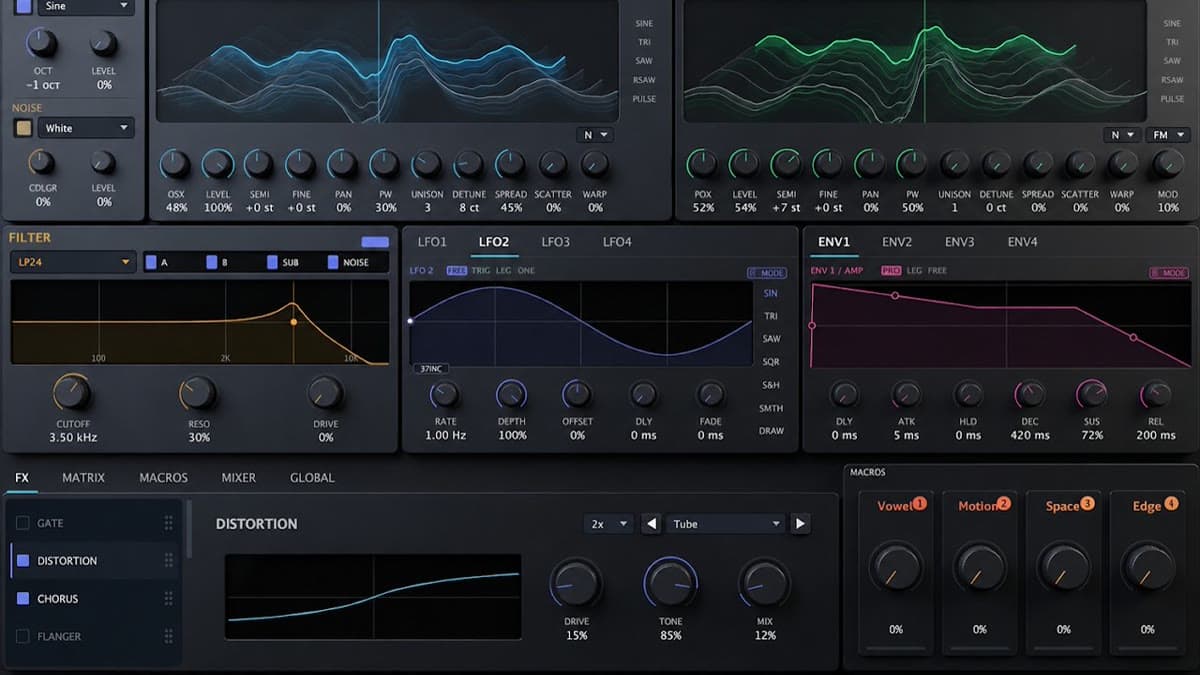
Butterlamp Audio shipped Tilichu as a hands-on wavetable synth with a sentence-to-patch generator on top. Two morphing oscillators, a granular and spectral source engine, a 32-slot modulation matrix, and a twelve-effect rack sit in one instrument. It is macOS only. Windows is coming. The license is $99, three machines, no iLok. This is a first look at the shipping feature set. We have not used it in a session.
At a glance: $99 one-time. VST3, AU, and standalone on macOS 12+, 64-bit. Windows coming. 3 machines. No iLok. 14-day trial with periodic demo noise. 400+ factory presets. Serum 2 and Vital import. Buy it from Butterlamp Audio.
What Tilichu is
Tilichu is a wavetable workstation that still expects you to turn knobs. The AI generator is a starting pistol, not the instrument. Type a sentence, get oscillators, filter, envelopes, modulation, and macros, then edit everything. Nothing is locked.
That is a different pitch from a text-to-music generator. Tilichu stays a synth. The sentence becomes a preset you own and reshape. For a plugin that literally plays the words you type, see TELEPRINTER from 23audio.
It sits in a crowded wavetable lane. Serum 2 is the five-engine standard at $249. Vital is the free-to-serious spectral wavetable, with a $25 paid tier. Pigments is Arturia's multi-engine alternative. Tilichu's differentiators are the combined granular/spectral source, the sentence generator, Mac-first shipping, and a $99 one-time price.
It is Mac-only today. VST3, AU, and standalone, macOS 12+, 64-bit. If you work on Windows, this is not your synth yet. Butterlamp says Windows is coming. Do not buy it for a Windows session.
Dual wavetable oscillators
Two independent oscillators morph across 256-frame wavetables. Unison, warp, and phase scatter are on the oscillators, not buried in a second page. A live 2D / 3D / edit display shows the table while you move.
The GUI also exposes a sub oscillator and a noise generator per the shipping interface: sine sub with octave offset, white noise, plus the usual semitone, fine, pan, unison, detune, spread, scatter, and warp. Frequency modulation between oscillators is on the panel. That is a complete analog-adjacent voice around the wavetable core: sub for weight, noise for chiff, FM for bite.
256 frames is a deep table. Morphing across that many frames is how you get a pad that changes vowel without a sampler. Unison and scatter are how a single table becomes a supersaw or a detuned choir.
This is the classic craft half of the product. If you never touch the AI generator, Tilichu still has to work as a knob-by-knob wavetable. That is the claim. The 14-day trial is how you test it.
Granular, spectral, and sample source
You can swap the oscillator band for a full-width source engine and audition the same patch four ways without leaving it: wavetable, sample, granular, spectral.
Sample. Loop region, crossfade, keytracking. Ordinary playback when you want the file intact.
Granular. Grain cloud with spray, density, pitch, and per-grain stereo width. Scatter a vocal or a chord into a texture that still follows the keyboard.
Spectral. Bake the spectrum, then flex it. A 7-node flex curve, formant shift, and frequency shift. Freeze a one-shot to lock a texture in place.
That source section is why Tilichu is not only "another wavetable with a chat box." Serum 2 already has granular and spectral engines. Vital already warps spectra. Tilichu puts those sources next to the wavetable oscillators in a compact layout and lets you jump between them on one patch.
Load any sample. Play it as grains or as a baked spectrum. Then route the matrix at it. That is the sound-design loop Butterlamp is selling: start from a table or a file, reshape, modulate.
Modulation matrix and macros
Four LFOs, four envelopes, and four macros feed a 32-slot matrix. Depth is bipolar. Curves are shapeable. Assignment is drag-from-source. The matrix drives the synth and the effects rack.
32 slots is enough for a serious patch and short of a modular rabbit hole. FabFilter-style matrices go deeper. Tilichu is aiming at "route anything to anything" without a second monitor of dots.
The four macros ship as performance controls. On the factory GUI they show as named sliders — vowel, space, edge, and the like — sitting at the bottom of the instrument. That is the playable layer after the generator or the factory bank has built the patch.
LFOs and envelopes are conventional and visible: rate, depth, offset, delay, fade on the LFO; ADSR on the envelopes. Four of each. If you come from Serum or Vital, you already know this grammar.
MIDI-learn sits on any control. Undo and redo cover every edit. Preset import and export are in the box.
Effects rack
Twelve reorderable effects, each modulatable from the matrix:
Distortion, EQ, compressor, chorus, flanger, phaser, delay, reverb, convolution, multiband, widener, and limiter.
The shipping UI also shows a gate in the rack list. Distortion includes a transfer display and a tube-style mode with drive, tone, and mix. The point is not the brand names. The point is that the rack is in the instrument, reorderable, and on the same modulation system as the oscillators.
A wavetable synth without a usable effects rack forces you to build a chain in the DAW before the preset feels finished. Tilichu wants the factory bank and the sentence generator to land as complete starting patches, macros included.
Sentence-to-patch generator
Type a description. Get a full preset: oscillators, filter, envelopes, modulation, and macros. Then edit.
Butterlamp's own example is "warm analog pad that slowly opens up." The generator is a launchpad. It is not a locked AI voice. Every parameter stays editable.
Use it when you would rather start from an idea than an init patch. Ignore it when you already know the table and the routing. The synth has to survive both workflows. If the generator only makes pretty-but-uneditable blobs, the knob-by-knob half is the product. If it makes editable, musical starting points, it earns the $99.
We have not prompted it. The 14-day trial is the test: write three sentences you would actually use, then see whether the results are faster than browsing 400 factory presets.
Tilichu specifications
| Spec | Detail |
|---|---|
| Type | Wavetable synth with granular/spectral source and sentence-to-patch generator |
| Oscillators | 2× wavetable, 256 frames; unison, warp, phase scatter; sub + noise |
| Sources | Sample, granular (spray/density/pitch/width), spectral (7-node flex, formant, freq shift) |
| Modulation | 4 LFOs, 4 envelopes, 4 macros, 32-slot bipolar matrix with curves |
| Effects | 12 reorderable, matrix-modulatable |
| Polyphony | Up to 64 voices |
| Presets | 400+ factory; Serum 2 and Vital import |
| Formats | VST3 (64-bit), AU (macOS), standalone (macOS) |
| System | macOS 12+ , 64-bit; Windows coming |
| License | $99 one-time; 3 machines; no iLok; no subscription |
| Trial | 14 days, full plugin, periodic demo noise |
| Engine | Low-latency, 64-bit; Butterlamp lists low CPU |
Tilichu vs Serum 2 and Vital
| Tilichu | Serum 2 | Vital | |
|---|---|---|---|
| Job | Wavetable + granular/spectral + sentence generator | Five-engine wavetable flagship | Spectral-warping wavetable |
| Sentence-to-patch | Yes | No | Text-to-wavetable, not a full-patch sentence generator |
| Import | Serum 2 and Vital patches | Serum ecosystem | Vital banks |
| Platforms | macOS only (Windows coming) | Windows and macOS | Windows, macOS, Linux |
| Formats | VST3, AU, standalone | VST3, AU, AAX | VST, VST3, AU, LV2, standalone |
| License | $99, 3 machines, no iLok | $249 on our Serum 2 card | Free / $25 on our Vital card |
| Factory | 400+ presets | 626+ presets, 288 tables | Sparse on the free tier |
| Buy from | Butterlamp | Xfer Records | vital.audio |
Which to pick. Choose Tilichu when you are on a Mac, you want a $99 wavetable with granular and spectral sources, and you will actually try the sentence generator. Choose Serum 2 when you need the current industry default, AAX, Windows, and a huge existing preset economy. Choose Vital when you want the engine for free, or cheap, on any desktop OS including Linux.
Pigments remains the other multi-engine alternative if you already live in Arturia's ecosystem. Ultra is a different multi-engine experiment. Tilichu is smaller, Mac-first, and priced like a boutique instrument, not a flagship.
A $99 Mac synth will not replace Serum if your sessions are built on Serum presets and wavetable packs. The import path is the bridge. We have not tested a Serum 2 bank through Tilichu. That is the first trial job if you already own Xfer's synth.
Who Tilichu is for
Consider it if you produce on a Mac and you want a wavetable with granular and spectral sources at $99.
Consider it if a sentence-to-patch generator that stays fully editable sounds useful, not gimmicky.
Consider it if three machines, no iLok, and a one-time Stripe checkout match how you license tools.
Consider it if you already own Serum 2 or Vital and you want those patches in a smaller, Mac-native instrument.
Skip it if you need Windows today. Tilichu is Mac-only. Windows is coming; it is not here.
Skip it if you need AAX. The shipping formats are VST3, AU, and standalone.
Skip it if you already have Serum 2 and you are happy. $99 is not a free experiment, and the overlap is real.
Skip it if you wanted a Windows-and-Linux free synth. That is Vital.
Skip it if periodic demo noise in the 14-day trial will keep you from judging the engine. The paid plugin is clean; the trial is not silent.
How much Tilichu costs
$99 one-time. Every engine, the full factory bank, VST3, AU, and standalone on macOS. Three machines. No subscription. No iLok.
Checkout is Stripe on butterlampaudio.com. Direct from the manufacturer.
The trial is 14 days and full-featured, with periodic noise in the demo. Everything else is unlocked. Download it from the same site.
The plugin card lives at /plugins/butterlamp-tilichu. If you are still choosing a wavetable, start with our Serum 2 piece and the Vital card, then decide whether a Mac-only $99 third synth earns a slot.
FAQ
Is Tilichu available on Windows?
Not yet. macOS 12+ only, VST3, AU, and standalone. Butterlamp lists Windows as coming.
Does it need iLok?
No. Three machine activations. No subscription.
Can it load Serum 2 and Vital patches?
Yes. Import is part of the shipping feature set, alongside 400+ factory presets. Confirm on your own banks in the 14-day trial.
Is the AI generator a separate subscription?
No. It is in the $99 license. Generated parameters stay editable.
What are the system requirements?
macOS 12 or newer, 64-bit. VST3, AU, standalone. Up to 64 voices. Butterlamp describes the engine as low-latency and low-CPU. We have not measured it.
The bottom line
Tilichu is a $99 Mac wavetable with granular and spectral sources and a sentence-to-patch generator that stays editable. VST3, AU, standalone. Three machines. No iLok. Windows is not available yet.
This is a first look, not a scored review. We have not prompted the generator or imported a Serum 2 bank. Download the 14-day trial, write one sentence you would actually use, and see whether the result is a patch you would keep editing. The live storefront is butterlampaudio.com.