AcusMagic Sonicrama V2 Draws Chladni Figures Live
AcusMagic Sonicrama V2 pairs wavetable synthesis, per-key meta-tuning, and a live GPU cymatics plate. Launch €89, regular €129, direct from AcusMagic.
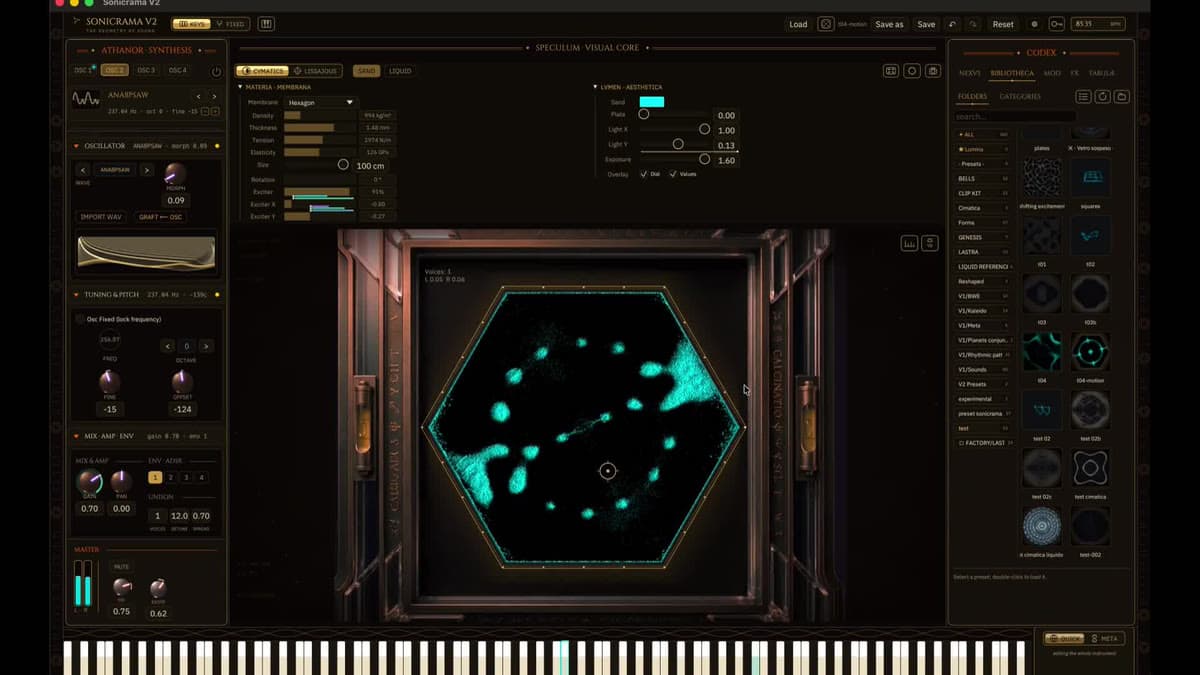
On 13 September 2026, AcusMagic released Sonicrama V2, a wavetable instrument that computes a vibrating plate from the notes you play. The launch price is €89. The regular price on the same page is €129. It is sold direct. Plugin Boutique, Thomann, and Best Service do not list it.
At a glance: €89 launch / €129 regular. AU, VST3, CLAP, and standalone. macOS 11 or later, Universal. Windows 10 (21H2) or 11, 64-bit, with a DirectX 12 GPU. Four oscillators, per-key meta-tuning, .scl / .tun import, and a 400,000-particle plate. This is a first look at the official instrument page and AcusMagic's own videos. We have not used it in a session.
What is Sonicrama V2?
Most wavetable synths hand you a sound and a preset browser. Sonicrama V2 hands you a keyboard you can rebuild, then draws the physics of whatever you played. AcusMagic's line for it is blunt: the sound and the figure are the same object, computed together, in real time.
The synth side is familiar enough to open on day one. Four oscillators, unison up to seven voices, eleven filters, four Bézier envelopes, a modulation matrix, and your own WAV wavetables. The part that is not familiar is the keyboard. Any of the 128 keys can carry its own frequency, waveform, morph position, gain, pan, phase, stereo delay, and binaural pair. Keys you leave alone follow the patch. Keys you edit become a different instrument. AcusMagic calls that meta-tuning.
Under the pitch, each oscillator can hold its own tuning table. You can import and export Scala (.scl) and AnaMark (.tun) files, and you can set a free root. A held chord can swap from Pythagorean to meantone to equal temperament without retriggering. That is the ambient and drone case: the interval is the piece, and the piece does not have to be 12-tone equal.
What the oscillators and the keyboard do
A normal patch spreads one timbre across the range and lets the scale do the rest. Meta-tuning breaks that assumption on purpose.
- Per-key instruments. A bell on a low key, a drone in the middle, and a binaural pair three octaves up can live in one patch. You play them with one hand. This is not a keyswitch and not a layer. The key you edited is the only key that moved.
- Four oscillators with their own tables. Frequency, waveform, morph, gain, pan, phase, stereo delay, and a binaural pair are available per key. Each oscillator can also keep a separate tuning table, so one voice can sit in equal temperament while another sits in a just scale.
- Scale files.
.scland.tunimport and export, plus a free root. If you already keep a library of scales, you are not redrawing them by ear inside the plugin. - Unison and filters. Unison goes to seven voices. Eleven filters and four Bézier envelopes sit behind a modulation matrix, and the exciter that drives the plate can follow LFOs, velocity, and key position. Custom WAV wavetables mean the partials hitting the plate are yours, not a factory saw.
- Hot-swap while a note is held. Official clips swap the tuning table under a sustained chord. Nothing retriggers. For drone work, that is the move: the beating changes because the interval changed, not because you played again.
Leave the scales alone and it still plays as a wavetable synth. The tuning system is why the instrument exists.
The plate is a solver, not a visualizer
The GPU engine solves the modal equation of a vibrating plate. Sand uses Bessel mode shapes. Liquid uses Faraday-wave dispersion. About 400,000 particles are driven by your audio, live, at up to 60 frames a second. AcusMagic is explicit about what is exact and what is a lens, and that honesty belongs in the spec, not in a footnote.
On the sand plate, modal frequencies and spatial scale are physically exact. There is no zoom and no fit. Mode shapes are analytic, so a larger render is more detail from the same physics, not a blown-up texture. AcusMagic says those modes were cross-checked against published Chladni-plate measurements, and the plugin's own tooltips declare the lenses while you work.
On the liquid plate, spatial frequency is log-compressed above roughly 40 cycles. Real Faraday cells at audio rates are millimetric, and a 1:1 picture would be unreadable. The liquid field is 512 points. It is rendered at full size rather than simulated at a higher grid, because the pattern has a characteristic wavelength and nothing above it to recover. Non-circular plates use an averaged effective radius, because their true eigenvalues are not Bessel functions.
A third view, Lissajous, draws the raw geometry of two oscillators. Two temperaments on the same chord draw two different curves. You can see the tuning.
Export is the other half of the feature. You record, keep playing, and a background thread writes an MP4 later: square, up to 4096×4096, 30 or 60 fps, with the audio already inside the file. PNG stills use the same sizes. AcusMagic says the render is reproducible down to the grain. The demo exports too, with a small engraved signature. The licensed copy does not add that mark.
Sonicrama V2 specifications
| Spec | Detail |
|---|---|
| Released | 13 September 2026 |
| Price | €89 launch, €129 regular, direct from AcusMagic |
| Synthesis | Four oscillators, unison ×7, eleven filters, four Bézier envelopes, modulation matrix, custom WAV wavetables |
| Tuning | 128-key meta-tuning, .scl / .tun import and export, free root, a tuning table per oscillator |
| Plate | GPU modal solver, Bessel sand figures, Faraday liquid, Lissajous, about 400,000 particles |
| Export | MP4 up to 4096×4096, 30 or 60 fps, audio embedded; PNG stills at the same sizes |
| Formats | AU (Mac only), VST3, CLAP, standalone |
| macOS | 11 or later, Universal binary (Apple Silicon and Intel) |
| Windows | 10 (21H2 or later) or 11, 64-bit, DirectX 12 GPU |
| Hosts | Logic, Ableton, Bitwig, Reaper, and other hosts of those formats |
| Licence | Perpetual, up to 3 machines, one at a time, offline after activation |
| Demo | Never expires; 15-minute sessions; exports carry a signature; presets cannot be saved |
| Retailers | Not listed at Plugin Boutique, Thomann, or Best Service |
Integrated graphics are supported. AcusMagic's own tip for a laptop is Options, then CYMATICS, then 30 FPS. Windows N editions need Microsoft's Media Feature Pack before video export works. The Windows installer is not code-signed yet, so SmartScreen can ask you to choose More info, then Run anyway. Update the GPU driver before the first launch. An old driver is the failure AcusMagic names first.
Sonicrama V2 vs Serum 2 and Vital
Serum 2 is the production wavetable most sessions are already built around. Vital is the spectral wavetable you can open for free. Sonicrama V2 is not trying to replace either preset library. It is a tuning-and-picture instrument that happens to be a wavetable synth.
| Sonicrama V2 | Serum 2 | Vital | |
|---|---|---|---|
| Price | €89 launch / €129 regular | $249 on the Serum 2 card | Free basic tier, $25 on the Vital card |
| Engine | Four wavetable oscillators, unison ×7, eleven filters | Five oscillator engines, clips, arp, deep FX | Spectral warping wavetable, visual modulation |
| Keyboard | Each of 128 keys can be its own instrument | One patch across the keyboard | One patch across the keyboard |
| Scales | .scl / .tun, free root, per-oscillator tables | Not the reason you buy it | Not the reason you buy it |
| Picture | Live plate solver plus offline 4K video of the same take | Wavetable and modulation display | Wavetable and modulation display |
| Platforms | macOS 11+, Windows 10/11 with DX12 | macOS and Windows | macOS, Windows, and Linux |
| Formats | AU, VST3, CLAP, standalone | VST3, AU, AAX | VST3, AU, and more on the Vital card |
| Reach for it when | The scale and the figure are the piece | You need a full production wavetable | You want that depth without paying $249 |
Which to pick. Buy Serum 2 when the job is bass, leads, and a preset culture your collaborators already know. Stay on Vital when the budget is the constraint and Linux matters. Buy Sonicrama V2 when you want a just third you can hear land, a different timbre on one key, and a video of that note that is the plate's own figure. Pigments 6 is the multi-engine flagship at $199 if per-key scales are not the brief.
Who Sonicrama V2 is for
Consider it if you write ambient, drone, or anything where the timbre and the interval are the piece. Meta-tuning and hot-swapped scales are the feature, not a hidden preference.
Consider it if you release your own music and you have to make the picture. The 4K export is the same take, rendered later, with audio inside the file.
Consider it if you want to learn scales by ear. Official clips put the same chord in two temperaments, and a just third against an equal one, so the beating is the lesson.
Skip it if you want four thousand presets and a browser. AcusMagic says that on the product page. This is not that synth.
Skip it if your Windows machine has no DirectX 12 GPU, or you need AAX in Pro Tools. AU, VST3, and CLAP are the formats. AAX is not among them.
Skip it if you need a retail checkout. The licence is AcusMagic direct. Card statements show ZAPLAB, the company that takes payment.
How much does Sonicrama V2 cost?
The product page shows a launch price of €89 against a regular €129. There is no Plugin Boutique, Thomann, or Best Service SKU to stamp, so the buy link is the official page: Sonicrama V2 at AcusMagic.
One perpetual licence activates on up to three machines, used one at a time. Any mix of Macs and PCs is allowed. After activation the copy works offline. AcusMagic says the licence is resellable. Activation is once per machine, in the browser. You do not type a password into the plugin.
The demo does not expire. Sessions last 15 minutes, then you reopen to continue. The demo includes four oscillators, the tuning system, the physics engine, and 4K export. Exported clips from the demo carry a small engraved signature, and presets cannot be saved. If you buy and change your mind, AcusMagic offers 14 days, no questions.
FAQ
What is meta-tuning in Sonicrama V2?
Every one of the 128 keys can override the patch: pitch, waveform, morph, gain, pan, phase, delay offset, and binaural pair. Untouched keys follow the defaults. Edited keys become their own small instrument. That is how one patch holds a bell at the bottom and a drone in the middle.
Does Sonicrama V2 require microtuning knowledge?
No. Leave the scales alone and it plays as a wavetable synth. The .scl and .tun import, the free root, and the per-oscillator tables are there when you want a just third or a harmonic-series scale. You do not have to start there.
Is the cymatics display physically accurate?
On the sand plate, AcusMagic says modal frequencies and spatial scale are exact, with the lenses declared in the tooltips. The liquid plate log-compresses spatial frequency above about 40 cycles so the picture stays readable, and non-circular plates use an averaged radius. It is a modal solver driven by your audio, and the page tells you which parts are a lens.
What are the system requirements?
macOS 11 or later, Universal, with AU, VST3, CLAP, and standalone. Windows 10 version 21H2 or later, or Windows 11, 64-bit, with a DirectX 12 graphics card, in VST3, CLAP, and standalone. AU is Mac only. A current GPU driver matters more than a discrete card. Integrated graphics are supported.
Sonicrama V2 vs Serum 2?
Serum 2 is the $249 production wavetable with five engines and a preset culture. Sonicrama V2 is an €89 launch instrument whose difference is per-key meta-tuning, scale files, and a GPU plate you can export at up to 4K. Buy Serum when the session needs a standard sound-design synth. Buy Sonicrama when the scale and the figure are the reason you opened the plugin.