Some links on this page are affiliate links. If you buy through them, Dubspot may earn a commission at no extra cost to you. It never affects our scores or what we recommend — read our policy.
W.A. Production Supra: Hybrid Granular Mono Synth
W.A. Production Supra is a monophonic hybrid granular synth: six DSP stages, twin macros, dual randomizers. Intro $14.90 against $59.90. AU, AAX, VST3.
E
Elena Marsh
September 11, 2026 · 8 min read
Black Friday 2026W.A. Production Black Friday 2026: dates and deals →
W.A. Production is selling Supra as a monophonic hybrid granular synthesizer. The intro is $14.90 against a $59.90 list. Formats on the product header are AU, AAX, and VST3. A demo is on the same page. The listing is also live at Plugin Boutique.
At a glance: $14.90 intro / $59.90 list. Six sequential DSP stages. Twin macros. Dual randomizers. Built with Algebra Within and darkInteger. Windows 8+, macOS 10.13+. Factory presets, PDF manual, and an official tutorial video.
This is a first look at the shipping plugin and the official product page. We have not run Supra in a session yet.
What Supra is
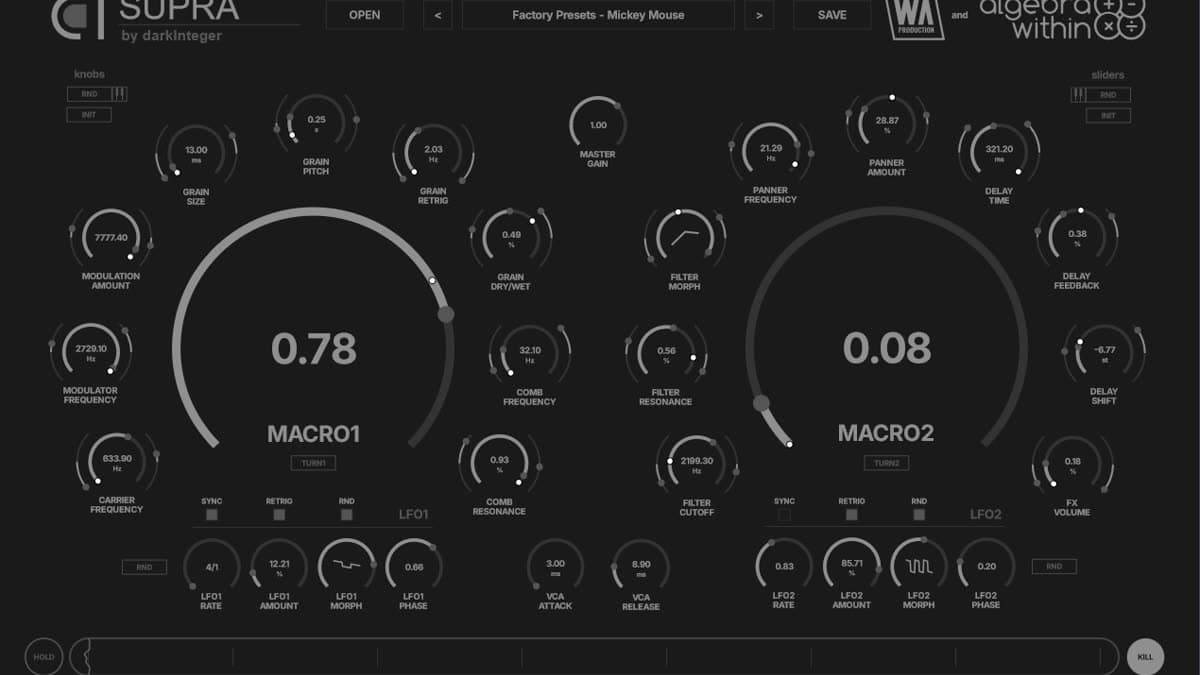
Supra is a one-page mono synth that runs a carrier through six named stages and ends in a pitch-shifting feedback delay. W.A. Production's pitch is the hardware habit: a little drift, a little dirt, then a granular engine that turns that carrier into a cloud. The official line is that a polished preset-and-layer workflow can sound finished and still feel sterile. Supra is the attempt to put the unstable part back.
The build credit is specific. Algebra Within is an independent Hungarian company and record label. darkInteger is a psytrance producer, DJ, and DSP programmer tied to that label. The GUI even prints both names on the header. This is a collab instrument, not a W.A. preset pack hanging on a generic oscillator.
It sits next to granular tools we already cover, with a narrower voice count. Graindad is a granular effect you put on audio you already recorded. Portal is the same idea with a more cinematic rack. GRNi is an instrument, and it is polyphonic. Supra is monophonic on purpose: one voice, six stages, two macros that steer the whole chain.
The official sound list is the brief: sine drops, FM growls, bells, sirens, chiptune warbles, ambient clouds, granular destruction, sub-bass pitch drops, and laser leads. Factory presets are the fast path. The one-page layout is the other.
Six DSP stages
The official chain is sequential. A simple carrier goes in. A delay with a pitch shifter in the feedback loop comes out.
1. Analog-drifted carrier. A triangle oscillator runs through an asymmetric diode wave-shaping network. A dual-sine generator adds pitch drift. Carrier frequency offsets the oscillator between 1 and 3,000 Hz. That is the vintage-circuit part: a triangle that is already a little crooked before FM or grains touch it.
2. FM modulator. A high-frequency sine applies linear FM to the carrier. Frequency runs 0.1 to 3,000 Hz. Modulation amount is the depth. Light settings add metal. Hard settings grow sidebands into snarls. This is the growl and bell stage.
3. Click-free granular capture. The dry carrier writes into a circular buffer. Grains trigger and crossfade through a sample-accurate window envelope. Grain dry/wet blends the carrier with the cloud. Grain size runs 10 ms to 1,000 ms. Grain pitch is a 0.1× to 4× playback ratio. Grain retrigger sets spawn rate from 0.1 Hz to 20 Hz. Official copy calls the capture click-free, which is the claim you test on fast randomizer moves.
4. State-variable filter. The blended granular / dry signal hits a morphing SVF. Cutoff runs 20 Hz to 10 kHz. Resonance is its own dial. Filter morph sweeps continuously through low-pass, band-pass, and high-pass. No mode switch that jumps.
5. Comb filter and dynamics. A high-resonance comb adds metallic, physical-modeling-style string texture. Tune it from 10 Hz to 4 kHz. A feedback compressor tames filter-tail peaks. That is the stage that turns a growl into something that rings.
6. Pitch-shifting delay. Stereo auto-pan, then a delay with a pitch shifter inside the feedback loop. Delay time, feedback, and shift are first-class. Official copy: cascading, meandering trails. This is the shimmer and the siren hang.
The order is the architecture. You do not patch the granular engine in front of the carrier. You do not put the delay before the comb. Macros exist because the chain is fixed and long.
Twin macros and dual randomizers
Two master macro hubs sit in the middle of the GUI. Each primary knob has an M1 and M2 depth slider. One macro turn can brighten the filter, move grain size, and push the feedback delay at once. Customizable dual LFOs can drive those macros, or you can ride them by hand. The official phrase is "indirect modulation matrix": LFOs are not locked to one parameter. They push the hubs.
The dual randomizer is the performance half. Official copy: glitch-free, safe to hit in real time. Note-triggered randomization can also vary LFO waveform, speed, and depth. That is how a held note keeps changing without you redrawing the patch. Hold and Kill sit on the bottom bar for the obvious live moves.
If you only ever load factory presets, the macros are still the instrument. The six stages are what the macros are steering.
Supra specifications
| Spec | Detail |
|---|---|
| Type | Monophonic hybrid granular synthesizer |
| Stages | Carrier, FM, granular capture, SVF, comb + compressor, pitch-shifting delay |
| Modulation | Twin macros (M1 / M2) with per-knob depths, dual LFOs |
| Random | Dual randomizer, note-triggered option, glitch-free claim |
| Collab | Algebra Within + darkInteger |
| Formats | AU, AAX, VST3 |
| System | Windows 8+, macOS 10.13+ |
| Extras | Factory presets, PDF manual, official tutorial, demo |
| Price | $14.90 intro / $59.90 list |
Supra vs Graindad, Portal, and GRNi
| Supra | Graindad | Portal | GRNi | |
|---|---|---|---|---|
| Role | Mono instrument | Granular FX | Granular FX | Granular instrument |
| Polyphony | Monophonic | Host audio | Host audio | Polyphonic |
| Extra engines | Triangle + FM + comb + delay | Buffer FX | Multi-FX rack | Grain instrument |
| Price | $14.90 intro / $59.90 | Sugar Bytes street | Output street | $34.99 launch / $44.99 |
| Formats | AU, AAX, VST3 | VST, VST3, AU, AAX | VST, VST3, AU, AAX | VST3, AU |
Pick Supra when you want a playable mono voice that starts as a drifted triangle and ends as a pitched delay, with grains in the middle. Pick Graindad or Portal when the source is a vocal, a drum loop, or a pad you already recorded. Pick GRNi when you want a grain instrument that can chord. Current 2 is the other hybrid on this desk, and it is a much larger wavetable-and-sample instrument.
$14.90 is the reason the comparison is not only about depth. You are not buying a flagship granular studio. You are buying a one-page mono synth with a six-stage chain.
Who Supra is for
Supra suits producers who want a dedicated mono lead / bass / FX voice with grains and a pitch-shifting delay, and who will actually turn the macros. It also suits anyone who wants a cheap intro on a new W.A. instrument and is willing to start from factory presets. The demo is the reason to try it before the intro window moves.
Skip it if you needed a polyphonic granular synth. Skip it if your granular work is all on recorded audio. Skip it if you wanted a deep modular environment. This is one page and one voice.
Psytrance, bass music, and cinematic one-shots are the obvious homes. The official list already says so. A house stab or a techno siren will fit the same chain.
How much does Supra cost?
The intro is $14.90. The list price is $59.90. Both figures are on the W.A. Production product page and on Plugin Boutique.
Formats are AU, AAX, and VST3. System requirements are Windows 8+ and macOS 10.13+. A demo is available from the official page. A PDF manual and the tutorial video ship with the product.
W.A. also offers a shop bundle discount of up to 40% if you add more titles at checkout. That is a cart extra, not a second list price.
FAQ
What is W.A. Production Supra?
A monophonic hybrid granular synthesizer. A drifted triangle carrier runs through FM, a granular engine, a morphing filter, a comb, and a pitch-shifting delay. Two macros steer the chain.
How much does Supra cost?
$14.90 intro against a $59.90 list, with a demo on the official page.
Who made Supra?
W.A. Production built it with Algebra Within and darkInteger.
Is Supra polyphonic?
No. It is monophonic. The complexity is in the six-stage chain and the macros, not in voice count.
What formats does Supra support?
AU, AAX, and VST3. Windows 8+ and macOS 10.13+.
Verdict
Supra is a cheap intro on a one-page mono synth with a real chain: drifted triangle, FM, grains, SVF, comb, pitched delay. Twin macros and a dual randomizer are the performance layer. $14.90 against $59.90. It will not replace Graindad on a vocal, and it will not replace a polyphonic grain instrument. If you want a mono voice that can snarl, cloud, and trail, this is the W.A. title for that job.