Some links on this page are affiliate links. If you buy through them, Dubspot may earn a commission at no extra cost to you. It never affects our scores or what we recommend — read our policy.
Inside Continuum: Dual Delay That Cross-Feeds Into Reverb
United Plugins Continuum by JMG Sound is a dual delay with Tape, BBD and Digital engines that cross-feed into reverb. $15 at Plugin Boutique through 30 Sep.
M
Marcus Feld
August 27, 2026 · 11 min read
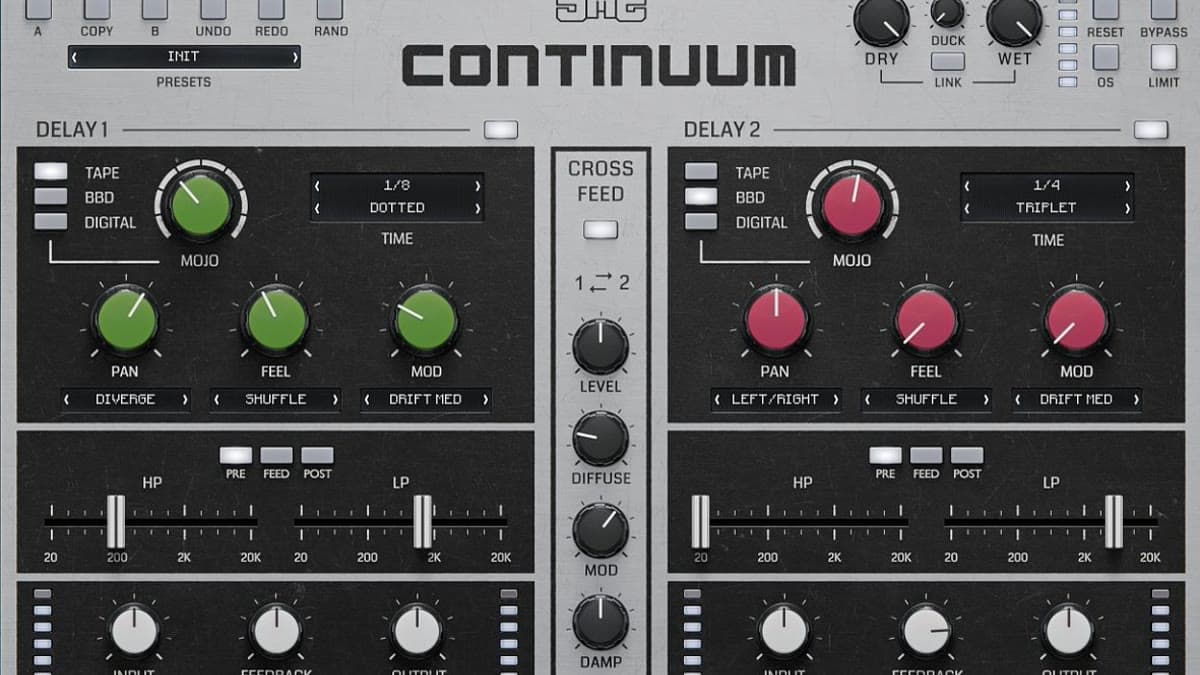
United Plugins shipped Continuum by JMG Sound on 24 August 2026. It is a dual-engine delay with three hardware-modeled characters — Tape, BBD, and Digital — and a central cross-feed that can smear those repeats into a diffuse reverb. The pitch is "modern brain, vintage heart." This is a first look at the shipping feature set. We have not used it in a session.
At a glance: $15 at Plugin Boutique through 30 September 2026, then $79. United Plugins lists €15 intro / €79, or $17 / $92 on the USD store. VST, VST3, AU, AAX. macOS and Windows. No iLok. 15-day trial. Buy it from Plugin Boutique or United Plugins.
What Continuum is
Most delays repeat. Continuum is built to let two delays talk to each other, then turn that conversation into space. Two identical units sit left and right. Each can be Tape, BBD, or Digital. A Cross Feed network routes Delay 1 into Delay 2 and back. Diffuse inserts all-pass filters into that loop and smears the taps into a bloom.
It is not a convolution hall. It is not a simple ping-pong. It is a delay that can become a reverb without loading a second plugin.
For a dedicated echo box we already trust, see Valhalla Delay. For a BBD-colored delay that is not trying to become a hall, see Colour Copy. FabFilter Timeless 3 is the deeper, more expensive modulation delay.
Continuum's brief is cheaper and more specific: two vintage-flavored engines, twelve pan modes, a feel section, and a cross-feed that is the feature, not a hidden routing trick.
Dual delay engines
Why two units? So you can run different configurations at once. One side can be a dotted-eighth Tape. The other can be a quarter-note triplet BBD. They can stay independent, or they can feed each other.
Each engine is identical. Switching models is instant. That matters when you are auditioning character on a vocal or a guitar and you do not want to rebuild the patch.
Tape, BBD, Digital, and Mojo
Three characters, one Mojo knob that exaggerates the circuit instead of adding a generic drive.
Tape. Mojo pushes the virtual tape into analog distortion, wow and flutter, and tape noise. That is the warm, unstable repeat.
BBD. Mojo drops the bucket-brigade clock rate. Repeats go dark, noisy, and degraded. That is the analog echo that loses highs as it recirculates.
Digital. Sample rate and bit depth step down into bit-crushed territory, with vintage imaging filters. That is the early digital rack, not a clean 24-bit delay.
Mojo is the control that decides whether the model is a hint or a costume. Leave it low for a polite character delay. Push it when the repeat should be an instrument.
Filters in three positions
Each unit has dedicated high-pass and low-pass filters with three placements:
- Pre shapes the signal before it hits the delay, so the feedback loop stays full-bodied.
- Feed sits inside the loop, so each repeat gets darker or thinner.
- Post cleans the output after Mojo has done its damage.
That routing is the difference between a delay that ages and a delay that just gets quieter. Pre keeps the recirculation fat. Feed is the classic analog-echo darkening. Post is damage control when Digital or Tape gets ugly.
Cross-feed into reverb
This is the center column, and it is the product.
Activating Cross Feed routes Delay 1 into Delay 2 and Delay 2 into Delay 1. The two engines build on each other. Different times and different models stop being two parallel echoes and start being a network.
Diffuse inserts specialized all-pass filters into that feedback. Hard taps smear. Staccato echoes become a blooming, reverb-like space. That is how Continuum claims the jump from delay to wash without a separate reverb algorithm.
Mod in the feed section swirls the tail. Damp shapes high and low frequencies as the wash decays.
You can keep Cross Feed off and treat Continuum as two independent delays. You can turn it on and treat it as a small-space generator. The useful middle is a rhythmic delay that blooms on the long feedback instead of staying as discrete taps.
If you already own a hall you like, Continuum does not replace it. It replaces the delay-into-reverb-send stack when you want those two jobs in one insert. Valhalla FutureVerb is a different, dedicated reverb purchase.
Pan, Feel, and Mod
Twelve spatial pan modes
The Pan section is not a left-right balance. Twelve modes cover traditional placement, mid/side, a Haas-style offset, and multiple ping-pong styles. Orbit spins repeats in a 3D circle. Converge, Diverge, Fade In, and Fade Out change stereo width on each successive echo.
Feel — groove in the repeats
Feel breaks the robotic grid.
- Shuffle applies swing.
- Odd and Even accent alternate repeats.
- Groove settings add syncopated volume variation.
- Early and Late shift repeats ahead of or behind the grid.
Early is the urgent pocket. Late is the lazy one. A vocal delay that sits late can feel like a singer leaning back.
Time modulation
The Mod section on each engine controls pitch and time modulation depth. Three LFO styles, each at slow, medium, and fast:
- Sine — classic vibrato sweep.
- Drift — analog-style instability.
- Rand — smooth true-random movement that keeps tails evolving.
Drift on Tape is the obvious patch. Rand on Digital is the weird one.
Input, output, ducking, and the rest
The input knob has a clean center. Turn it right to drive a preamp for analog-style saturation. Turn it left to starve the delay: new audio stops entering, and existing repeats keep ringing. That starve move is a performance control. It is how you freeze a tail without a dedicated looper.
Output sets wet level without breaking the feedback gain structure. Automatic ducking pulls delays out of the way of dry transients. A link function gives you one-knob dry/wet.
House features: license-file activation, no iLok, scalable GUI, click-free bypass, sleep-on-silence, 64-bit processing at any sample rate including 192 kHz, free-for-life updates, and a 15-day unlimited trial through UnitedPluginsManager.
A RAND button generates a balanced combination of delay, spatial, and modulation settings. It is an idea starter.
Continuum specifications
| Spec | Detail |
|---|---|
| Type | Dual-engine delay with cross-feed diffuse reverb |
| Engines | Two identical units; Tape, BBD, or Digital each |
| Character | Mojo exaggerates each model's circuit |
| Cross Feed | 1↔2 routing; Diffuse all-pass; Mod; Damp |
| Pan | 12 spatial modes including Orbit, Haas, M/S, ping-pong, Converge/Diverge |
| Feel | Shuffle, Odd/Even, Groove, Early/Late |
| Time mod | Sine, Drift, Rand; slow / medium / fast |
| Filters | HP and LP per engine; Pre, Feed, or Post |
| Formats | VST, VST3, AU, AAX |
| Platforms | macOS and Windows |
| Authorization | License file; no iLok, no dongle, no always-on internet |
| Trial | 15 days, unlimited, via UnitedPluginsManager |
| Processing | 64-bit; any sample rate including 192 kHz+ |
| Price | $15 PB through 30 September 2026, then $79; official €15 / €79 or $17 / $92 |
Continuum vs Valhalla Delay and Colour Copy
| Continuum | Valhalla Delay | Colour Copy | |
|---|---|---|---|
| Job | Dual delay → diffuse reverb | Multi-mode delay | BBD-style delay |
| Dual engines | Yes, cross-fed | Modes in one unit | One BBD path |
| Built-in reverb bloom | Diffuse in the feed loop | Delay modes, not this network | No |
| Vintage models | Tape, BBD, Digital + Mojo | Tape / digital / BBD-style modes | BBD color |
| Street / list | $15 intro / $79 | $50 on our Valhalla Delay card | €69 on our Colour Copy card |
| Formats | VST, VST3, AU, AAX | VST3, AU, AAX | VST3, AU, AAX, CLAP |
| License | No iLok | Valhalla account | u-he |
| Buy from | Plugin Boutique | Valhalla DSP | u-he / Best Service |
Which to pick. Choose Continuum when you want two character delays that can turn into a wash, and $15 through 30 September makes the trial a low-risk test. Choose Valhalla Delay when you want a proven multi-mode echo and you already trust that ecosystem. Choose Colour Copy when you want u-he's BBD delay and you do not need a second engine or a diffuse network.
Timeless 3 at $149 is the deeper modulation laboratory. Continuum is not trying to be that matrix. It is trying to be a playground you finish setting up in a minute.
Who Continuum is for
Consider it if you want one insert that can be a dual character delay and a small blooming space.
Consider it if Tape, BBD, and Digital on two engines, with Mojo, matches how you actually write delays.
Consider it if no iLok and a 15-day unlimited trial matter.
Consider it if $15 through 30 September 2026 is the price that gets it on a vocal bus this week.
Skip it if you already own Valhalla Delay or Timeless 3 and you are happy. Continuum is a different routing idea, not a mandatory upgrade.
Skip it if you only need a clean quarter-note slap. Stock delay will do it.
Skip it if you wanted a true algorithmic or convolution hall. This bloom comes from smeared delay taps.
Skip it if a photorealistic dual-engine GUI feels like too much panel for a send.
How much Continuum costs
$15 at Plugin Boutique through 30 September 2026, then $79. That is the live street price, 81% off.
United Plugins is running the same window at €15 intro / €79 regular, and $17 / $92 on the USD product page. Same plugin. Pick the checkout you already use.
The 15-day trial is unlimited: no saving limits, no noise bursts. Download it through UnitedPluginsManager from unitedplugins.com/Continuum.
Activation is a license file. Use it on all of your machines as long as you are the user. No iLok. Updates stay free.
The plugin card lives at /plugins/united-plugins-continuum. If you are building a delay drawer from scratch, our best reverb plugins guide is the space side of this conversation; Continuum sits on the line between the two categories.
FAQ
Is Continuum a reverb or a delay?
It is a dual delay. Cross Feed plus Diffuse turns those taps into a reverb-like wash. It does not replace a dedicated hall.
Continuum vs Valhalla Delay?
Valhalla Delay is a multi-mode echo at $50. Continuum is two engines with a cross-feed network, on sale for $15 through 30 September. If you want proven modes and a small footprint, stay with Valhalla. If you want two models talking to each other, try Continuum.
Do I need iLok?
No. License file. No dongle. No always-on internet.
What are the system requirements?
VST, VST3, AU, and AAX on macOS and Windows. 64-bit processing. United Plugins lists compatibility with the usual major DAWs.
How long is the intro price?
Through 30 September 2026. $15 at Plugin Boutique, €15 at United Plugins, then the regular $79 / €79 (USD store $92).
The bottom line
Continuum is a dual character delay that can cross-feed into a diffuse bloom. Tape, BBD, and Digital, with Mojo, twelve pan modes, and a 15-day trial. $15 at Plugin Boutique through 30 September 2026.
This is a first look, not a scored review. We have not parked it on a vocal send or a guitar solo. Download the trial, turn Cross Feed on, raise Diffuse, and hear whether the wash replaces a delay-plus-reverb stack. The live storefronts are Plugin Boutique and unitedplugins.com/Continuum.