Thenatan DIAL Puts Your Track on the Radio
Thenatan DIAL is a radio-signal plugin with seven stations, four radio models, and zero latency. The intro price is $12 until 16 October 2026, then $50.
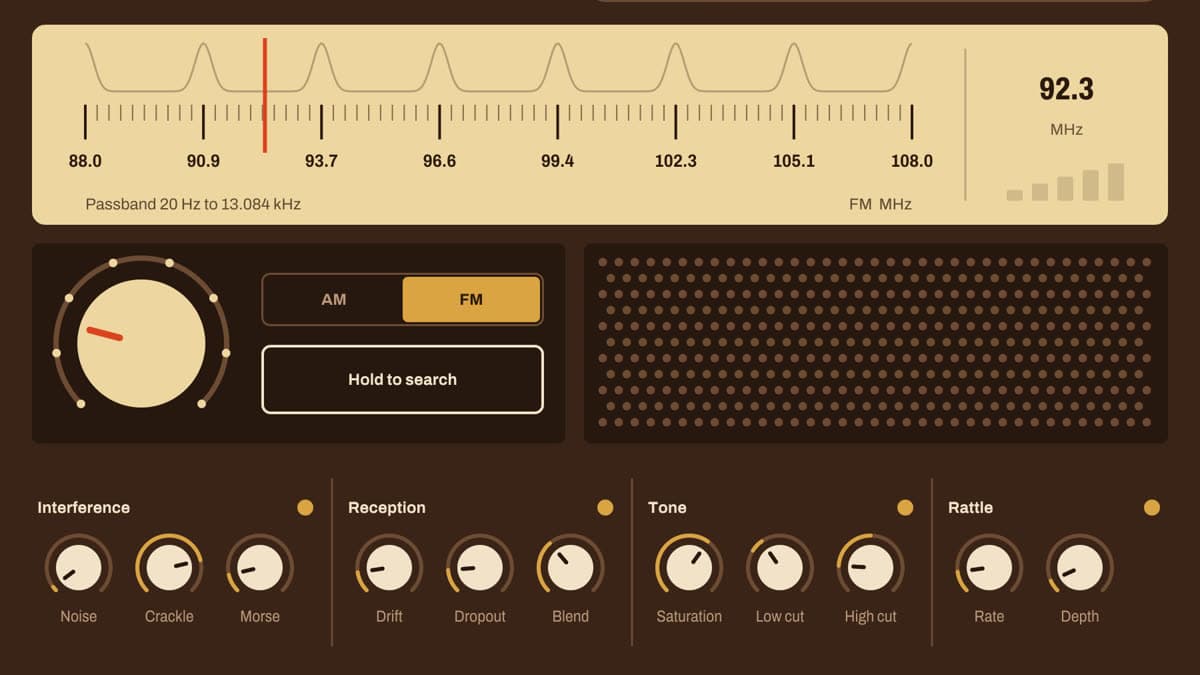
Thenatan has released DIAL, a radio-signal designer that puts a track, loop, vocal, or melody through a broadcast chain. The Thenatan store lists it at $12 until 16 October 2026, then $50. Plugin Boutique shows the same two prices, $12.00 from $50.00, 76% off until 15 October 2026. Park the needle on a station and the source comes through. Drift off and it sinks into static.
At a glance: $12 intro, $50 list. Store end date 16 October 2026. Plugin Boutique end date 15 October 2026. Windows VST and VST3. Mac AU, VST, and VST3. 64-bit. No AAX. Serial number, no iLok. Zero latency. Seven stations, four radio models, 64 presets.
What DIAL is for
DIAL is a radio you play. Thenatan's line is direct: it doesn't add a lo-fi filter, it puts the music on the air. The signal path is six processors in one chain, each in its own block, and bypassing a block stops that block from using CPU.
The intended sources are the ones printed on the page. A beat that should sound like 3 a.m. talk radio. A vocal coming through a kitchen counter set. A melody turned into a numbers station. A dial sweep used as a transition. The genres listed are lo-fi hip-hop, trap, boom bap, R&B, ambient, cinematic work, and sound design.
That's a narrower job than a general vintage-color suite. Super VHS stacks six one-knob modules aimed at tape, sample-rate grit, pitch drift, and wash. RC-20 Retro Color scales noise, wobble, degrade, and space from one Magnitude control. DIAL's organizing idea is reception. You tune in, you lose the station, and the hiss follows the needle.
The workflow Thenatan describes is short. Insert it, pick a radio, and move the dial. There are no tabs. Mix and Output sit on the master. Every sound control is automatable, including the model and the tuning dial itself. Zero latency is there so you can track and perform through it.
Seven stations, then four radios
The tuner is a dial with seven stations and a needle you park. On a station, the source reads as the broadcast. Off the station, it falls into static. Hold SEARCH and the dial hops the band at random. That's the sweep you automate into a drop or a scene change. Unlike a drawn filter cutoff, it doesn't land in the same place every time.
AM and FM are the band switch. AM collapses the signal into narrow, gritty mono. FM is the wide, clean stereo side. Thenatan puts that flip on the front panel as a performance move. A vocal that should sound like a telephone wants AM. A sample that should still have width wants FM, then a small drift off the station so the edges fray.
Four radios change the voicing, the band, the drive, and the interface skin. Thenatan names them Warm Tube, Transistor, Shortwave, and Cheap Speaker. Each one is modelled on a real radio, inside and out. Pick a different radio and the plugin changes sound and look together. Warm Tube is the rounded broadcast. Transistor is the tighter consumer set. Shortwave is the distant, unstable band. Cheap Speaker is the small cabinet. The choice works like picking a receiver off a shelf.
Interference, reception, tone, and rattle
Noise, Crackle, and Morse sit in the air around the broadcast. Noise is the hiss that swells when you leave the station and settles when you find it. Crackle is pops that don't tick like a metronome. Morse is tone pips bleeding in from another station, which is the numbers-station move. Thenatan ties all three to the tuning, so they behave like interference instead of a noise loop parked under the track.
Drift wanders the tuning. Dropout fades the signal at random. Blend sets how much of that reception failure you hear. Drift is the slow "the station won't sit still" motion. Dropout is the cut, useful when a transition should fail rather than fade. Blend is the mix between a locked broadcast and a broken one, so a verse can stay intelligible while the chorus loses the signal.
Saturation is level-matched, so it adds warmth and grit without simply making the loop louder. Low Cut and High Cut trim each radio's band, so the Cheap Speaker can be narrower than the Warm Tube without a second EQ in front. Every block has its own bypass, and that bypass stops the processing.
Rattle is the speaker cabinet. Two detuned wobbles beat like a loose panel, and the grille on screen shakes with them. It's the last stage of "this came out of a radio," after the tuner and the interference have done their work. A little rattle sells a vocal in a room. A lot of rattle is a broken set, which belongs in the Broken Signal presets rather than on every drum bus.
64 presets across eight categories
The factory set is 64 presets in eight groups: Clean Broadcast, Warm Lofi, Late Night AM, Shortwave, Broken Signal, Kitchen Radio, Textures, and FX & Transitions. Thenatan describes them as hand-tuned, from a clear station to a collapsed signal, ready to drop on a track.
Use the names as a map. Clean Broadcast and Warm Lofi are the musical settings, where the source should still read as the sample or the vocal. Late Night AM and Kitchen Radio are the narrow, domestic ones. Shortwave and Broken Signal are the unstable ones. Textures and FX & Transitions are the moves you automate: a sweep, a dropout, a pre-drop failure. Load one, then ride the dial, Blend, and the radio model.
The page also lists the jobs those presets are aimed at: lo-fi beats, vintage vocals, radio intros, dial sweeps, AM telephone effects, dusty samples, broken signals, ambient beds, transitions, pre-drop effects, and nostalgia sound design.
Thenatan DIAL specifications
| Spec | Detail |
|---|---|
| Price | $12 intro / $50 list |
| Store end date | 16 October 2026, then $50 on the Thenatan store |
| Plugin Boutique | $12.00 from $50.00, 76% off until 15 October 2026 |
| Type | Radio-signal designer. Six processors in one path |
| Tuner | Seven stations. SEARCH hops the band. AM narrow mono, FM wide stereo |
| Radios | Warm Tube, Transistor, Shortwave, Cheap Speaker |
| Interference | Noise, Crackle, Morse |
| Reception | Drift, Dropout, Blend |
| Tone | Level-matched Saturation, Low Cut, High Cut |
| Speaker | Rattle: two detuned wobbles, animated grille |
| Presets | 64, in eight categories |
| Latency | Zero. Lightweight, instant load |
| Automation | Every sound control, including Model and the tuning dial |
| Master | Dry/wet Mix and Output. Resizable interface. No tabs |
| Bypass | Per block, and bypass stops that block's processing |
| Channels | Mono and stereo |
| Windows | 7 or later, 64-bit. VST and VST3 |
| macOS | Native Apple Silicon (M1 and up). AU, VST, and VST3, 64-bit |
| DAWs listed | FL Studio, Logic, Ableton Live, Cubase, Reaper, Studio One |
| Not included | AAX. The store prints "No Pro Tools (no AAX)" |
| Activation | Serial number. No iLok, no dongle |
| Download | The store lists one file, 61.0 MB |
| Buy | DIAL at Plugin Boutique or the Thenatan store |
DIAL vs Super VHS vs RC-20
The shopping comparison is other lo-fi color tools, because that's the cart DIAL shows up in. The processing differs. Super VHS and RC-20 degrade and color a source. DIAL tunes it.
| Thenatan DIAL | Baby Audio Super VHS | XLN RC-20 Retro Color | |
|---|---|---|---|
| Price | $12 until 15 Oct at Plugin Boutique, until 16 Oct on the Thenatan store. $50 after | $69 on Best Service | Six-module vintage suite. Details on the RC-20 card |
| Core idea | Broadcast chain: tune in, lose the station | Six one-knob modules for VHS-style grit | Magnitude scales noise, wobble, degrade, and space |
| Signature move | Seven-station dial, AM/FM, four radio models | Static, Heat, Shape, Magic, Drift, Wash | One slider for the whole color |
| Speaker / cabinet | Rattle, two detuned wobbles | Drift is pitch wobble, not a cabinet | Wobble and flutter |
| AAX | No | Yes, on the Super VHS card | Yes, on the RC-20 card |
| Latency | Zero | Light enough for ordinary inserts | Ordinary insert |
| Reach for it when | The part should sound like a radio, including the moments it fails | You want fast VHS grit on drums, vocals, or a bus | You want a general vintage haze and you do not need a tuner |
Which to pick. Choose DIAL when the note in the session is a receiver. "Put the loop on a shortwave set and let it drop out before the chorus" is the dial, Dropout, and a radio model. Choose Super VHS when you want six musical lo-fi flavors and an AAX build, at the $69 Best Service lists today. Choose RC-20 when the assignment is vintage texture without a station to tune. Magnitude plus the modules is the faster general color, including on sources that shouldn't sound like a broadcast. If the only goal is tape warmth or vinyl noise, keep the tool you have. DIAL handles the radio job those tools approximate with a band-pass and a noise layer.
Who DIAL is for
Use it if you make lo-fi hip-hop, boom bap, trap, ambient, or cinematic cues and you want the source to arrive through a radio. The seven stations and SEARCH are the reason to open it, because a static filter preset cannot hop the band.
Use it if you need transitions and pre-drop effects that fail on purpose. Dropout, Drift, and Morse are built for that, and they automate with the dial.
Use it if you track through effects. Zero latency, a resizable window, and a serial with no iLok keep it on a live vocal or a performed filter sweep.
Skip it if you work in Pro Tools. There is no AAX build. The store says so in the spec line.
Skip it if you wanted a subtle tape knob for every channel. Saturation is in the chain, and it's level-matched, but the plugin is organized around reception. A full-time coloring suite is the closer tool for "a little vintage on the drum bus" with nothing else going on.
Skip it if you need the effect to repair or tune a source. DIAL only puts audio on the air. It doesn't clean, pitch, or balance a mix.
How much DIAL costs
$12 is the intro price. $50 is the list. On the Thenatan store the intro runs until 16 October 2026, and the page says that on October 16 DIAL goes back to $50. Plugin Boutique prints $12.00 from $50.00, 76% off, until 15 October 2026. The two end dates are one day apart. If you're buying on the 15th, check which shop you're in.
Buy it at Plugin Boutique or from Thenatan. Activation is a serial. There is no iLok and no dongle. The store lists the download as one 61.0 MB file.
The short spec lives on the DIAL plugin card. Thenatan's other recent effect, the growl designer, is a different processor with a different job. It is on the GRRR card if the session needs a beat-reactive bass monster rather than a radio.
FAQ
Is DIAL a lo-fi filter?
No. Thenatan's product page says it doesn't add a lo-fi filter. The path is a tuner with seven stations, an AM/FM band switch, four radio models, interference, reception controls, level-matched saturation, and speaker rattle. A band-pass plus noise can suggest a radio. DIAL is built so the hiss follows the needle.
Does DIAL run in Pro Tools?
No. Formats are VST and VST3 on Windows, and AU, VST, and VST3 on Mac, all 64-bit. The store prints "No Pro Tools (no AAX)."
What is the difference between the four radios?
Warm Tube, Transistor, Shortwave, and Cheap Speaker each change voicing, band, drive, and the interface skin. Thenatan says each model is based on a real radio. Switching model is a sound change, and the model control automates.
DIAL vs Super VHS?
Super VHS is six one-knob modules for VHS-style grit, and Best Service lists it at $69, with AAX on the plugin card. DIAL is a tuning dial, four receivers, and reception failure, at $12 until the intro ends, with no AAX. Use Super VHS for general lo-fi color. Use DIAL when the part should sound tuned in or lost.
What are the system requirements?
Windows 7 or later, 64-bit, in VST and VST3. macOS with native Apple Silicon from M1 up, in AU, VST, and VST3. Mono and stereo. Zero latency. The DAWs named on the store page are FL Studio, Logic, Ableton Live, Cubase, Reaper, and Studio One. Activation is a serial number, with no iLok.