SoundGhost Orbit Pans Low, Mid, and High on Their Own
SoundGhost Orbit is a 3-band spectral stereo sculptor with independent Position, Width, and Volume per band. Current price is £29 against £39. VST3 and AU.
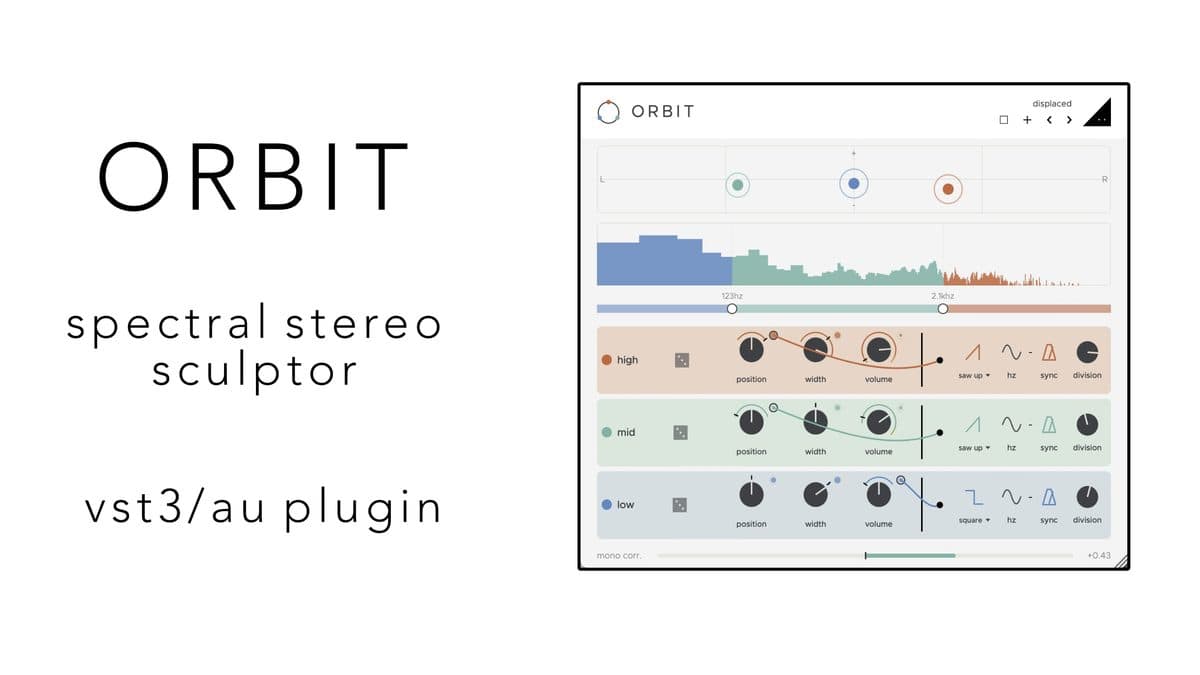
SoundGhost sells Orbit as a 3-band spectral stereo sculptor. Two crossovers split the signal into Low, Mid, and High. Each band has its own Position, Width, and Volume, and each of those three controls has its own modulator. The current price is £29 against a £39 regular.
At a glance: £29 current / £39 regular. VST3 on Windows and Mac. AU on Mac. No AAX. macOS 10.12+ with native Apple Silicon. Windows 10+ 64-bit. Buy it from soundghost.net.
This is a first look at the shipping plugin and the official product page. We have not run Orbit in a session yet.
What Orbit is
Orbit is an autopanner that also widens and ducks by frequency. The low end can sit still while the mids swing and the highs breathe. Or the opposite. Nothing in the three rows is locked to anything else.
That is a different job from a single-band auto-panner. Pancake 2 draws one pan shape and locks it to the host. PanMan is a classic Soundtoys panner with styles and rhythms. Nolvra IMAGER is a three-band width tool that prints fold-down loss and leaves the image still. Orbit puts motion on Position, Width, and Volume at once, then lets you aim that motion at a band.
SoundGhost's other live plugins sit next to it: Jumble, Signa, and Ekko. Orbit is the stereo mover. The shop line on the homepage is "move their audio in time and space."
Three bands, two crossovers
Two draggable crossover points cut the signal into Low, Mid, and High. Each band is its own voice. Send the low end one way and the highs the other. Narrow a band to mono. Blow one wide open. The official note is that nothing here is locked together, so the audio can move in more than one direction at once.
The official GUI puts a live spectrum under a stereo field. The two crossover handles sit on that spectrum. On the official window they land near 123 Hz and 2.1 kHz. Those are starting points, not fixed splits. Drag them until the kick stays put and the hat starts to travel.
A dice sits on each row. Click it and that band gets a new set of Position, Width, and Volume values, plus new modulators. Reset sits next to it. The randomise is per band, so you can roll the highs and leave the low end alone.
Position, Width, Volume, and nine shapes
Every band's Position, Width, and Volume gets its own modulator. The official count is nine shapes, including a live envelope follower. Named shapes on the product page are sine, triangle, square, and random. The factory window also shows a saw. Click any cable input to edit that modulator. Apply the depth with the mod ring around the knob.
Run free in Hz or lock to the host. The synced range runs from 1/64 stutters to 8-bar sweeps. Push the amount ring far enough and the shape saturates. The ring turns orange. SoundGhost calls that analogue character: overdriven shapes, not a second distortion module.
The envelope follower is the reactive option. It reads how loud that band actually gets, then writes the motion from the signal instead of from a clock. Use it when a pad swell should open the width, or when a snare should kick the mid Position.
MIDI control and automation are supported. The window resizes. Factory presets ship with a custom preset slot.
Stereo field, spectrum, and mono fold-down
The top of the window is a live stereo field. Three dots sit on the L to R line, one per band. You watch them drift while you write. Under that, the spectrum shows where the crossovers sit and how much energy each band is carrying.
A mono correlation meter runs along the bottom. It is a constant reference for how well the result will hold if you fold to mono. Orbit will let you write a wide, moving image. The meter is there so you can see when that image starts to cancel.
That pair of views is the reason Orbit is a sculptor and not only a panner. You are not guessing whether the low end left the centre. You can see it.
Where it sits in a session
Orbit wants audio that already has a centre and some width to spend. Pads, synth lines, hats, a stereo guitar, a bus that feels glued. Put it on a static part you would otherwise ride with a pan automation clip and a widener.
It is less useful as a mastering imager. If the job is a still, three-band width read with a fold-down number, Nolvra IMAGER is the other current three-band width tool on this desk. If the job is a whole rhythmic FX rack, ShaperBox 3 will do more than Orbit will ever claim. Unusable Quadrant Modulator is a different motion plugin: a modulator, not a stereo split.
The official spec is 50 MB of disk and 4 GB of RAM with a modern CPU recommended. There is no sample library.
Sold direct. There is no Plugin Boutique listing.
Orbit specifications
| Spec | Detail |
|---|---|
| Type | 3-band spectral stereo sculptor / autopanner |
| Bands | Low, Mid, High with 2 draggable crossovers |
| Per band | Independent Position, Width, Volume |
| Modulation | 9 shapes per control, including a live envelope follower |
| Sync | Free rate in Hz, or host tempo from 1/64 to 8 bars |
| Views | Live stereo field, spectrum, mono correlation meter |
| Extras | Per-band randomise and reset, presets, MIDI, resizable window |
| Disk / RAM | 50 MB+, 4 GB+ recommended |
| Formats | VST3 (Windows + Mac), AU (Mac). No AAX |
| System | macOS 10.12+ (Apple Silicon native), Windows 10+ 64-bit |
| Price | £29 current / £39 regular |
Orbit vs Pancake 2 and PanMan
| Orbit | Pancake 2 | PanMan | |
|---|---|---|---|
| Job | 3-band stereo sculptor | Single-band auto-panner | Styled auto-panner |
| Bands | Low / Mid / High | One | One |
| Width and Volume | Yes, per band | Pan focused | Pan focused |
| Envelope follower | Yes, per control | Host-synced shapes | Rhythm and style modes |
| Price | £29 / £39 | Free | $99 |
| Formats | VST3, AU | VST3, AU, AAX | VST3, AU, AAX |
Pick Orbit when the low end must stay put and the highs need to move, or when width and volume should travel with the pan. Pick Pancake 2 when you want one free, tempo-locked pan shape. Pick PanMan when you want a Soundtoys panner with AAX and a style list. Pick Nolvra IMAGER when you want a still three-band width read, not motion. Pick ShaperBox 3 when pan is one module in an eleven-processor rack.
£29 is a specialist price. You are not buying a multi-effect flagship.
Who Orbit is for
Orbit suits producers who already draw pan automation and want that move split by frequency. It also suits anyone who wants a pad, a hat, or a synth line to drift without a second widener and a third volume LFO. The per-band dice is the fast path for sound design.
Skip it if you needed AAX or Pro Tools. Skip it if you wanted a still imager with a fold-down number and no motion. Skip it if a free one-band panner already does the job. Skip it if the whole point was a sequenced multi-effect.
The current price is the reason to decide now. £29 against £39.
How much does Orbit cost?
Orbit is £29 current against a £39 regular on soundghost.net/product/orbit. One-time. The homepage calls it an introductory sale.
Formats are VST3 on Windows and Mac, and AU on Mac. Pro Tools and AAX are not supported. macOS 10.12+ with native Apple Silicon. Windows 10+ 64-bit.
Sold direct. There is no Plugin Boutique or Thomann listing.
FAQ
What is SoundGhost Orbit?
A 3-band spectral stereo sculptor. Two crossovers split Low, Mid, and High. Each band has its own Position, Width, and Volume, each with a modulator.
How much does Orbit cost?
£29 current against £39 regular, sold direct from SoundGhost.
Does Orbit work in Pro Tools?
No. Formats are VST3 and AU. AAX is not supported.
Orbit vs Pancake 2?
Pancake 2 is a free, single-band auto-panner. Orbit splits the signal into three bands and modulates Position, Width, and Volume on each one.
What are the system requirements?
macOS 10.12+ with native Apple Silicon. Windows 10+ 64-bit. 50 MB of disk. 4 GB of RAM and a modern CPU recommended.
Verdict
Orbit is a stereo mover you aim by frequency. Low, Mid, and High each get Position, Width, Volume, and a modulator. Nine shapes, including a live envelope follower. A stereo field, a spectrum, and a mono correlation meter sit on the same window. £29 against £39. It will not replace ShaperBox as a rhythmic FX rack, and it will not open in Pro Tools. If the job is a three-band image that actually moves, this is the SoundGhost plugin for that sentence.