Some links on this page are affiliate links. If you buy through them, Dubspot may earn a commission at no extra cost to you. It never affects our scores or what we recommend — read our policy.
Safari Audio PolyRex Review: A $40 Juno in Your DAW
Safari Audio PolyRex is a $39.99 Juno-106-style polysynth with 8 voices, a mod matrix, and a built-in FX engine. Full specs, pricing, and how it stacks up.
M
Marcus Feld
October 1, 2026 · 8 min read
See full specs, price, and alternatives in the plugin database →
Safari Audio released PolyRex on its store and through Plugin Boutique, pitching it as a fun, immediate take on the early-80s Japanese polysynth sound. It's the developer's third virtual instrument, after Cubby and Super Chunk, and it leans hard into one specific voice: the lush, chorused warmth that made the Roland Juno series a studio staple. At $39.99 it undercuts the established Juno emulations by a wide margin.
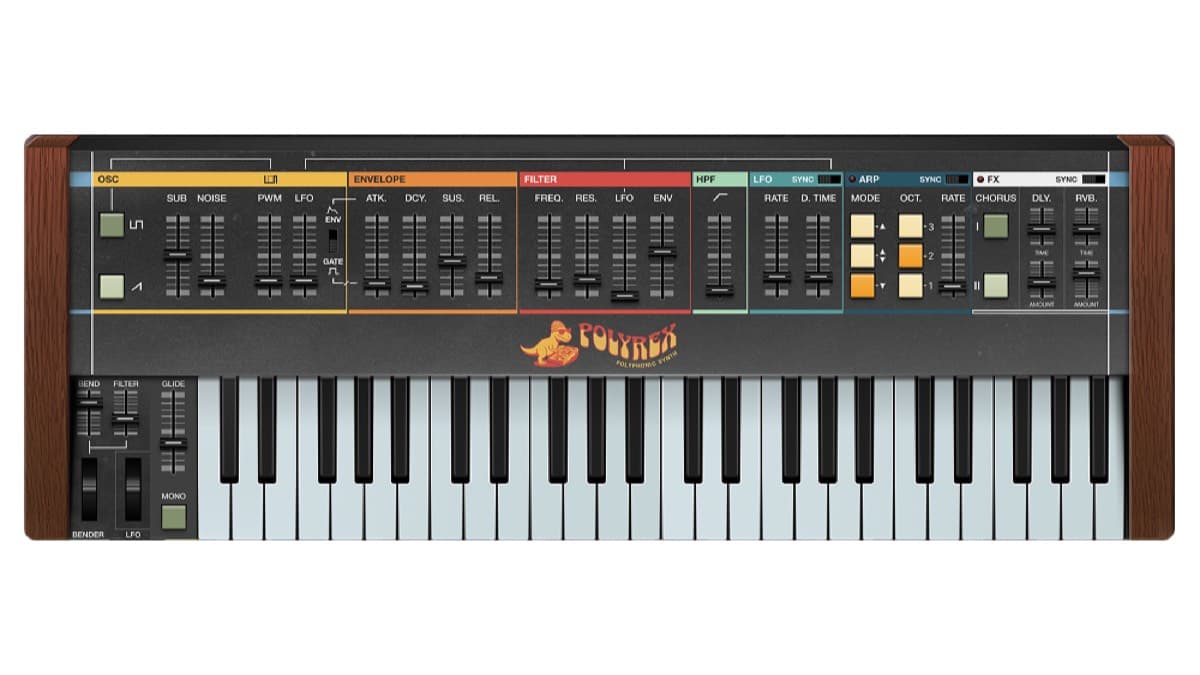
At a glance: $39.99, perpetual license with free updates. An eight-voice virtual-analog polysynth with a single core oscillator, sub and noise, a resonant filter, a full ADSR, an arpeggiator, a modulation matrix, and a built-in FX engine. VST3, AU, and AAX on macOS; VST3 and AAX on Windows.
What is PolyRex?
PolyRex is a software recreation of the classic early-80s polyphonic synthesizer, built around the Juno-106 blueprint. That means a deliberately simple signal path: one oscillator per voice, a sub oscillator for weight, a resonant low-pass filter, and a chorus that does most of the heavy lifting on the final sound. Roland built the original Juno-106 to be affordable and easy to play, and that same philosophy runs through PolyRex. You're not meant to spend an hour building a patch here. Pull up a sound, play a chord, and move on.
Safari Audio describes the engine as using discrete VCO and VCF behavior with a Safari FX engine on the output. The result sits in the same lane as TAL-U-NO-LX and the Juno mode in u-he Diva, but at a lower price and with a narrower, more focused feature set. Think of it as a tool built for one sound rather than a modular playground.
What PolyRex does, feature by feature
A single oscillator with sub and noise
The core of each voice is one oscillator with pulse-width modulation, backed by a sub oscillator and a noise generator. The PWM control is the key to the moving, animated tone that defines this class of synth. As the pulse width shifts, the harmonic content breathes, which is why these pads never sound static. The sub oscillator adds low-end body that keeps basses and chords grounded, and the noise generator feeds air, texture, and percussive grit into the mix.
The resonant filter and high-pass
PolyRex pairs a resonant low-pass filter with a separate high-pass filter. The low-pass is the main tone shaper, with the smooth, musical cutoff sweep you expect from this heritage. The high-pass lets you thin out the low end for brighter, retro string and keyboard sounds without reaching for an EQ. Together they cover most of the tonal range you need for classic pads, plucks, and leads.
ADSR, LFO, arpeggiator, and glide
A full ADSR envelope shapes amplitude and filter movement, with a gate mode for simpler, organ-style response. The LFO section adds motion and drift, with rate and delay controls so modulation can fade in rather than arrive all at once, plus a dedicated LFO pitch modulation path for that slightly unstable vintage character. A built-in arpeggiator with octave and rate controls turns held chords into instant rhythmic parts, and glide smooths pitch between notes for expressive lead lines and basses.
The modulation matrix and Safari FX engine
PolyRex reaches past a pure Juno clone with its modulation matrix, which routes sources to targets for movement the original hardware never offered. The onboard Safari FX engine then finishes the sound with chorus, delay, and spring reverb. The chorus matters most here, since so much of the Juno sound comes from its chorus. You get that plus two space effects without inserting anything after it.
PolyRex specifications
| Spec | Detail |
|---|---|
| Type | Virtual-analog polysynth (Juno-106 inspired) |
| Polyphony | 8 voices |
| Oscillators | One core oscillator with PWM, plus sub oscillator and noise |
| Filters | Resonant low-pass, separate high-pass |
| Envelope | Full ADSR with gate mode |
| Modulation | LFO section (rate, delay), LFO pitch mod, modulation matrix |
| Performance | Built-in arpeggiator, glide |
| Effects | Chorus, delay, spring reverb (Safari FX engine) |
| Formats | VST3, AU, AAX (macOS); VST3, AAX (Windows) |
| System | macOS 10.15 or later (11+ recommended), Windows 8 or later, 64-bit |
| Memory | 4 GB RAM minimum, 8 GB recommended |
| License | Perpetual, free updates |
| Price | $39.99 |
PolyRex vs TAL-U-NO-LX
The obvious comparison is TAL-U-NO-LX, the emulation most producers treat as the reference Juno-106 plugin. The two aim at the same sound but make different trade-offs.
| PolyRex | TAL-U-NO-LX | |
|---|---|---|
| Price | $39.99 | Around €70 |
| Modeling | Juno-106 character with a Safari FX engine | Detailed Juno-106/60 component modeling |
| Oscillator | Single core oscillator, PWM, sub, noise | Juno-style oscillator with saw and pulse, sub |
| Extras | Modulation matrix, arpeggiator, glide | Arpeggiator, MPE, extensive factory presets |
| Formats | VST3, AU, AAX | VST3, AU, AAX, standalone |
| Best pick | Fastest, cheapest route to the classic sound | The definitive, detailed Juno reference |
TAL-U-NO-LX is the more exacting recreation, with deeper modeling and a standalone app. It remains the pick when you want the closest thing to the hardware. PolyRex is the budget route to the same neighborhood, and the modulation matrix gives it a little more sound-design range than the original ever had. If you want a second opinion, the Juno mode inside u-he Diva is excellent, though Diva costs far more and aims at modeling the entire analog era rather than one instrument.
Who PolyRex is for
PolyRex suits producers who want the 80s synth-pop, synthwave, and lo-fi palette without a steep learning curve or a big outlay. Beginners get an approachable one-screen synth that sounds good immediately. Working producers get a fast, light insert for pads, chord stabs, and warm basses when a track needs that specific chorused glow. If you are building out a vintage toolkit, it also pairs naturally with heavier analog emulations like Repro-5 when you need a Prophet-style voice alongside your Juno.
Skip it if you want deep, multi-oscillator modeling, component-level editing, or a standalone app, since PolyRex is deliberately narrow. Owners of a flagship Juno emulation will find it a lighter take rather than an upgrade.
How much does PolyRex cost?
PolyRex is $39.99 for a perpetual license with free updates, sold direct from Safari Audio and through Plugin Boutique. That is a one-time purchase with no subscription, and it covers both the macOS and Windows builds. A demo is available so you can try the sound before buying. For more no-cost and low-cost options in the same space, see our roundup of the best free synth VSTs of 2026 and browse the full plugin database.
FAQ
Is PolyRex a Juno-106 emulation?
In spirit, yes. PolyRex is built around the early-80s Juno blueprint: a single oscillator with PWM, a sub oscillator, a resonant filter, and a defining chorus. It captures the character rather than claiming to be a circuit-exact clone of one specific unit.
PolyRex vs TAL-U-NO-LX, which should I buy?
Buy PolyRex for the fastest, cheapest path to the classic chorused polysynth sound, with a modulation matrix and onboard FX. Choose TAL-U-NO-LX when you want the most detailed Juno modeling and a standalone app, and you do not mind paying more for it.
What are the PolyRex system requirements?
PolyRex runs on macOS 10.15 or later, with macOS 11 or later recommended, and on Windows 8 or later. It needs a 64-bit host, 4 GB of RAM minimum, and 8 GB recommended. It installs as VST3, AU, and AAX on macOS, and VST3 and AAX on Windows.
Does PolyRex come with presets and a demo?
Yes. PolyRex ships with a factory preset bank built around classic pads, basses, and keys, and Safari Audio offers a demo version so you can audition the sound before committing.
Verdict
PolyRex does one thing and does it well. It delivers the lush, chorused Juno sound with minimal fuss, and the modulation matrix and built-in FX engine give it just enough extra range to stay interesting past the first few presets. It isn't trying to be the deepest or most accurate analog emulation, and the single-oscillator engine makes that clear. For $39.99, though, it's an easy recommendation for anyone chasing that specific vintage warmth. Pair it with the picks in our best free synth VSTs of 2026 and the wider plugin database when a session needs more than one flavor of analog.