PolyChrome NanoPitch Adds Width in 25-Cent Steps
PolyChrome DSP NanoPitch pairs two detune voices at ±25 cents with slapback, a detunable delay, chorus, and flanger. The intro price is $59, sold direct.
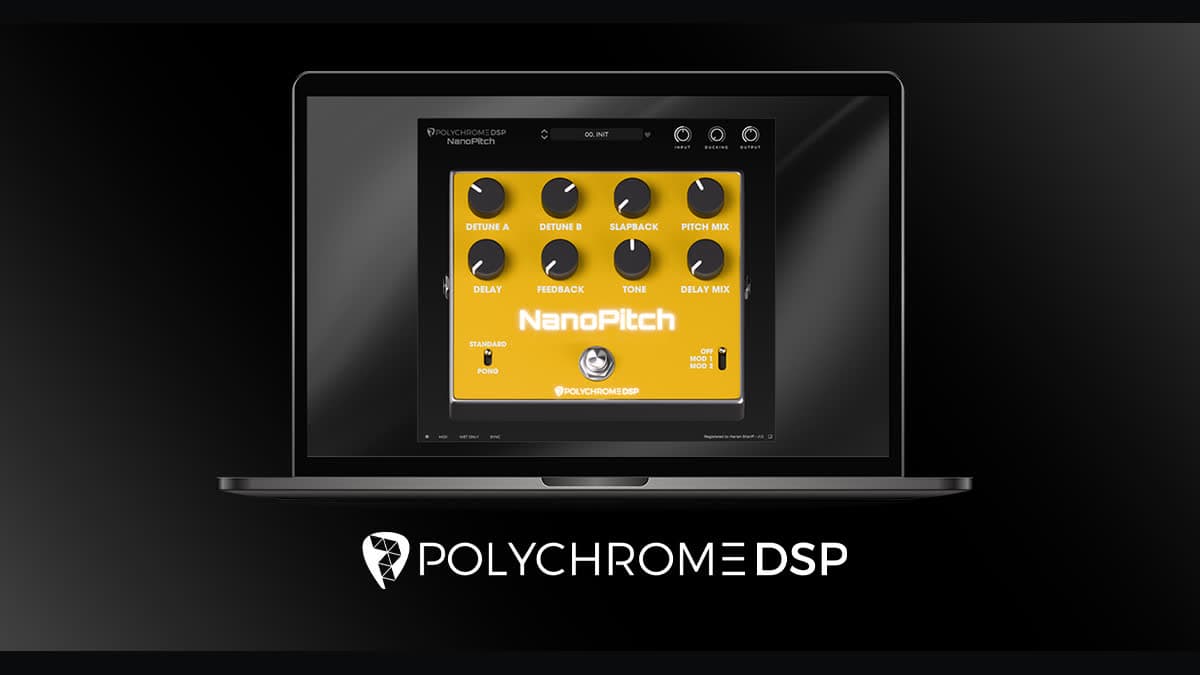
PolyChrome DSP has released NanoPitch, a micro-pitch effect that thickens guitars, vocals, synths, and drums with two detune voices, a slapback, and a delay you can leave in tune or pull off pitch. The page shows $59 intro, struck through from $79. Formats are VST2, VST3, AU, AAX, and CLAP, with no iLok. This is a first look from the NanoPitch page and PolyChrome's own video. We have not used it in a session.
At a glance: $59 intro / $79 list, direct from PolyChrome DSP. Detune A and Detune B each run from −25 to +25 cents. Slapback is 20–100 ms. Delay syncs to the host, with Standard and stereo Pong modes, and the repeats can be detuned. MOD 1 is a vintage chorus into the detune. MOD 2 is a vintage flanger. macOS 11 or later on Apple silicon. Windows 7 or later, 64-bit.
What NanoPitch is
Classic records got a lot of size from a few cents of pitch and a short delay, not from a full harmonizer rack. PolyChrome points at that tradition in the product copy: detuned guitar doubles, a snare with a short throw, drums that feel larger than the kit. NanoPitch is the small version of that idea. Two voices, a dedicated slapback, a delay section with its own mix, and two modulation modes that borrow chorus and flanger colours.
Center position on either detune voice is no pitch change. Turn left for up to 25 cents flat. Turn right for up to 25 cents sharp. Twenty-five cents is a quarter of a semitone. That is thickening and width, not a harmony. A third up, a fifth, or an octave is a different plugin.
The layout splits into two mixes on purpose. Pitch Mix sets the detune-plus-slapback block. Delay Mix sets the echo block. You can thicken without echoing, echo without thickening, or run both. Wet Only is there for an aux or a send, so the dry signal stays on the channel and the plugin returns only the effect.
Detune, slapback, and the delay
Detune A and Detune B are independent. A common width move is to pull one voice a few cents down and the other a few cents up, so the center stays near the dry pitch and the sides pick up the shift. Nothing on the page locks them to be equal and opposite. You can park both flat, both sharp, or one hard at the 25-cent stop if the part wants to lean.
Slapback is its own echo, 20 to 100 ms. At zero it is out of the circuit, not a very quiet delay. That range is the short room and the "just behind the hit" slap, not a musical repeat you play against. Pitch Mix is the level of this whole detune-and-slap block.
Delay is the longer echo. Time is free-running, or Sync follows the DAW tempo. Two modes are named: Standard, and a stereo Pong that bounces repeats across the image. Feedback sets how many repeats you get and how long they last. Tone darkens the repeats to the left and brightens them to the right, which is how you keep a long feedback tail from turning into hiss. Delay Mix is independent of Pitch Mix, so a send can be mostly slap and a little echo, or the reverse.
PolyChrome's line on the delay is that you can detune the dry signal, detune the repeats, or blend both. The repeats do not have to be a straight copy of the input pitch. That is the difference between a slap that only duplicates and a tail that drifts.
MOD 1 blends a vintage chorus into the detune. MOD 2 brings in a vintage flanger, which PolyChrome describes as the more pronounced swirl. They sit on top of the micro-pitch rather than replacing it. If you only want chorus, a dedicated chorus still has more voice-count and analog-model controls. NanoPitch's chorus and flanger are there so the cents of detune are not the only motion.
Presets load while you play. Right-click a control to MIDI-map it, including to a pedal. The page calls that control Harmony in the MIDI section. The demo disables saving and deleting presets, and it resets the plugin state to the default when the project loads.
NanoPitch specifications
| Spec | Detail |
|---|---|
| Price | $59 intro / $79 list, direct from PolyChrome DSP |
| Type | Dual micro-pitch, slapback, detunable delay, chorus, flanger |
| Detune | Voice A and Voice B, each −25 to +25 cents. Center is unchanged |
| Slapback | 20–100 ms. Zero disengages it |
| Delay | Free time or DAW sync. Standard and stereo Pong. Feedback and tone |
| Mix | Separate Pitch Mix and Delay Mix. Wet Only for aux sends |
| Modulation | MOD 1 vintage chorus into the detune. MOD 2 vintage flanger |
| MIDI | Right-click to map controls |
| Presets | Load while playing. Demo cannot save or delete them |
| macOS | 11.0 or later, Apple M1 or higher, 4 GB RAM, 1024×768 |
| macOS formats | VST2, VST3, AU, CLAP, and AAX in Pro Tools 12 or later |
| Windows | 7 64-bit or later, 4 GB RAM, 1024×768 |
| Windows CPU | Intel i7 13th gen or higher, as printed on the NanoPitch page |
| Windows formats | VST2, VST3, CLAP, and AAX in Pro Tools 12 or later |
| Copy protection | No iLok |
| Demo | 3 seconds of silence every minute. State resets on load. No preset save or delete |
| Buy | NanoPitch at PolyChrome DSP |
The Windows CPU line is worth reading twice. PolyChrome prints Intel i7 13th gen or higher for this plugin. That is a steep floor for a cents-wide effect, and it is the requirement on the page. macOS is listed as Apple silicon, M1 or later. An Intel Mac is not in the NanoPitch requirements block.
NanoPitch vs MicroShift vs Thorus XT
Soundtoys MicroShift is three knobs of pitch-and-delay width. UVI Thorus XT is a chorus, digital plus bucket-brigade, with two to eight voices. NanoPitch sits between a doubler and a small multi-effect.
| NanoPitch | MicroShift | Thorus XT | |
|---|---|---|---|
| Price | $59 intro / $79 list | $99 | $79 regular on the Thorus card |
| Main job | Dual ±25¢ voices, slapback, detuned delay, chorus, flanger | Stereo width from three classic doubling modes | Chorus: digital Thorus plus analog BBD, 2–8 voices |
| Detune range | 25 cents each way, two voices | Detune plus delay and focus. Not a 25-cent readout | Modulation depth, not a cent-calibrated doubler |
| Delay | Slapback 20–100 ms, plus sync delay with Pong | Short delay as part of the width, not a feedback echo | No slapback or tempo delay |
| Formats | VST2, VST3, AU, AAX, CLAP | AAX, VST 2, VST 3, AU | VST3, AU, AAX, standalone |
| Systems | macOS 11+ Apple silicon. Windows 7+ with a 13th-gen i7 listed | macOS 10.15+, Windows 10+ | macOS and Windows, including Apple silicon |
| Reach for it when | You want cents, a slap, and a tail in one insert | You want width in three knobs and you already trust those algorithms | You want a chorus and you do not need a delay |
Which to pick. Choose NanoPitch when the part needs a few cents, a slap, and maybe a tempo-synced tail, and you do not want to open a harmonizer for a quarter-tone. Choose MicroShift when the only goal is mono-friendly width and you want the H3000 and AMS-style modes with almost no controls. The Eventide H3000 Factory card is the large rack those algorithms come from, at a very different price and scope. Choose Thorus XT when the sound you want is chorus, two engines, and up to eight voices. The Thorus XT piece is that plugin. NanoPitch's MOD 1 will get you motion. It will not replace a chorus you bought for the chorus.
Who NanoPitch is for
Consider it if guitars, vocals, or synths need to feel wider and you keep overshooting with a full pitch shifter. Twenty-five cents is a hard stop, which is the point.
Consider it if you like a slap on snares and vocals and you also want the repeats to drift in pitch. Separate mixes mean the slap can be loud and the feedback tail quiet.
Consider it if you run sends. Wet Only, host sync, and a right-click MIDI map are the aux-friendly parts.
Skip it if you need a musical interval: thirds, fifths, octaves, or a whammy pedal. The range ends at a quarter-semitone.
Skip it if your Mac is Intel. The NanoPitch requirements list Apple M1 or later.
Skip it if your Windows machine is older than the printed i7 13th-gen line. Do not assume a light effect will ignore that line. It is the requirement PolyChrome published.
Skip it if you need an iLok-based studio licence or a Plugin Boutique checkout. Sales are direct, and the copy protection is explicitly not iLok.
How much does NanoPitch cost?
$59 intro, $79 list, from PolyChrome DSP. There is no Plugin Boutique, Thomann, or Best Service listing. The demo is the full effect with three limits: three seconds of silence every minute, no saving or deleting presets, and the state resets to default when the plugin loads.
That demo is enough to hear whether ±25 cents and a 20–100 ms slap are the width you wanted, before the silence becomes the annoying part. The plugin card holds the short spec for the finder.
FAQ
How far can NanoPitch detune?
Each of the two voices moves from −25 cents to +25 cents. The center of the knob is no pitch change. That is a quarter of a semitone at the extreme, which thickens and widens. It does not play a harmony.
NanoPitch vs Soundtoys MicroShift?
MicroShift is a width plugin with delay, detune, and focus, priced at $99, built around three classic doubling voicings. NanoPitch adds a second explicit detune voice with a cent range, a disengageable slapback, a syncable delay with Pong and tone, and chorus and flanger modes, at $59 intro. Pick MicroShift for the few-knob doubler. Pick NanoPitch when you also want the slap and the tail.
Does the delay follow the session tempo?
Yes, when Sync is on. Feedback and Tone still shape the repeats. Standard and stereo Pong are the two modes on the page. Pitch Mix and Delay Mix stay separate, and Wet Only is the send mode.
Will it run on an Intel Mac or in Pro Tools?
Pro Tools 12 or later is listed, with AAX on both platforms. macOS itself is listed as 11.0 or later on Apple M1 or higher. Intel Macs are not in that block. Windows is 7 or later, 64-bit, and the printed CPU is an Intel i7 13th gen or higher.
Is there an iLok or a retailer licence?
No iLok. PolyChrome sells NanoPitch direct. The demo's limits are the silence every minute, disabled preset save and delete, and a reset to the default state on load.