Some links on this page are affiliate links. If you buy through them, Dubspot may earn a commission at no extra cost to you. It never affects our scores or what we recommend — read our policy.
Osterhouse Ripple Viola: Two-Note Viola Phrases for $59
Osterhouse Sounds Ripple Viola turns chords into tempo-synced two-note viola slurs: 516 phrases, three articulations, VST3/AU/AAX. $59 intro, specs and rivals.
E
Elena Marsh
October 26, 2026 · 8 min read
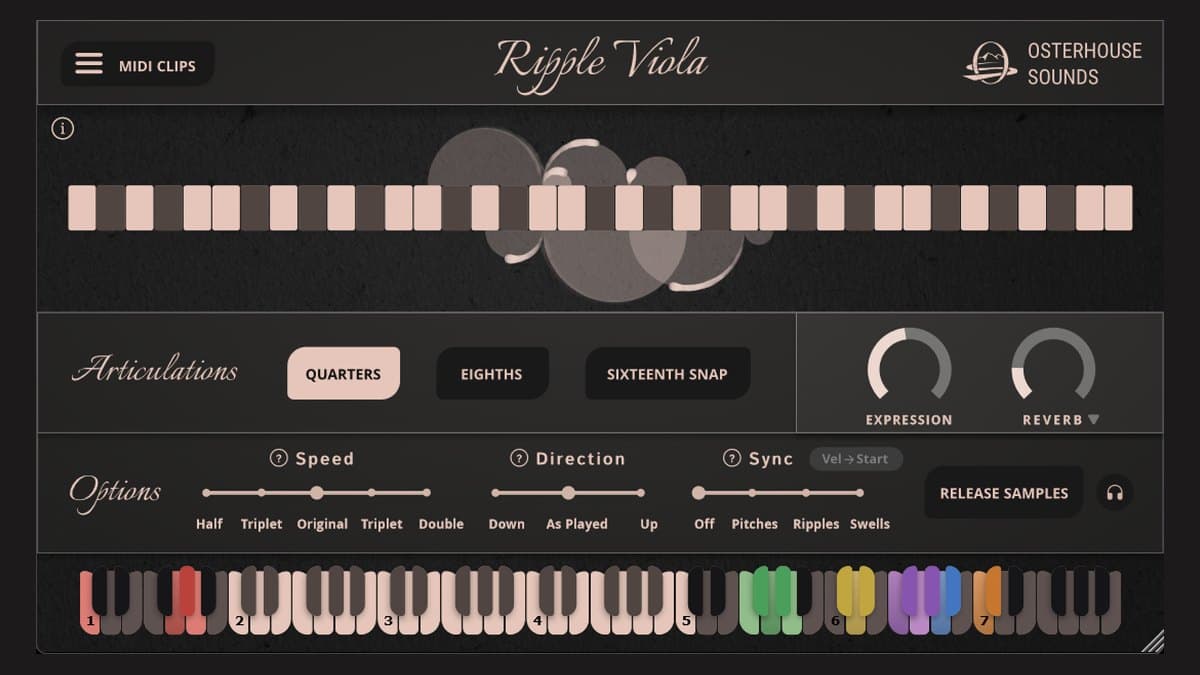
Osterhouse Sounds has released Ripple Viola, a string instrument built around one playing technique: the two-note slur. Overlap two notes on your keyboard and it plays a recorded viola phrase that moves between them in a single bow stroke, locked to your project tempo. Play a chord and you get a cascade of overlapping phrases that follow the harmony. It runs as a standalone VST3, AU and AAX plugin, with no Kontakt required, and costs $59 at launch, down from $79.
At a glance: three articulations (Quarters, Eighths and Sixteenth Snap), 516 ripple phrases and 152 release samples, recorded dry with three reverbs, 258 MB download. Speed, Direction and Sync controls, automatic release samples, Expression and Reverb knobs, and a built-in browser of MIDI clips you can drag into your DAW. Windows 10 and 11, macOS 10.13 and later. $59 intro (regular $79), or $99 with Ripple Cello (regular $158).
What is Ripple Viola?
Most string libraries give you articulations: sustains, staccatos, legato transitions and so on, and you build phrases from them note by note. Osterhouse Sounds takes the opposite approach. Its libraries capture one specific way of playing an instrument and map it to the keyboard so the phrase comes out whole, with the bowing and dynamics that would be lost if two separate notes were stitched together.
Ripple Viola applies that idea to the viola, following Ripple Cello. Each sample is a swell. At the start, the second note of the slur is barely audible, almost a ghost note. As the swell grows, the movement between the two pitches becomes clearer. Because the phrases are recorded at 110 BPM and time-stretched to your session, they sit in the groove without any editing. The result is the kind of restless, rhythmic string texture you hear in modern-classical and ambient film scores, played from a few held chords.
If you write for picture, Ripple Viola is a texture tool rather than a full section. It sits well on top of the broader orchestral libraries we have covered this autumn, such as IK Sinphonica Maestosa Strings.
How Ripple Viola plays
Overlap two notes to trigger a ripple. Hold one note and play a second while it sounds, and the plugin plays a slur between them. The order matters: play the higher note second and the ripple rises, play the lower note second and it falls.
Play chords for cascades. With a chord held, each overlapping pair triggers its own phrase. Move the chord and the ripples follow the new harmony. This is where the instrument comes alive, because a simple progression turns into moving, interlocking viola lines.
Three articulations. Quarters give slow, singing swells. Eighths are busier and more rhythmic. Sixteenth Snap is the most percussive, with a sharper attack that works as a pulse under a cue.
Speed. Half and Double options cover projects far from the 110 BPM recording tempo, and two triplet settings give you swung and 6/8-style phrasing from the same samples.
Direction. As Played follows your note order. Up and Down force every ripple the same way, which helps when you play chords quickly and want a consistent shape.
Sync. Off lets every ripple run independently. Switch it on (the panel offers Pitches, Ripples and Swells modes) and the plugin cuts into each new sample as it triggers, so overlapping phrases fall into step instead of drifting.
Release samples. When a ripple reaches its end, it crossfades into one of four release samples, picked automatically by where you were in the swell. That keeps phrase endings natural instead of chopped.
MIDI clip browser. A built-in idea bank of MIDI clips shows what the instrument does best. You can preview them in the plugin and drag them straight into your project.
Ripple Viola specifications
| Spec | Ripple Viola |
|---|---|
| Type | Phrase-based viola instrument (two-note slurs) |
| Articulations | Quarters, Eighths, Sixteenth Snap |
| Content | 516 ripple phrases, 152 release samples |
| Recording | 110 BPM, auto time-stretched to host tempo; recorded dry, 3 reverbs included |
| Controls | Speed, Direction, Sync, Release Samples, Expression, Reverb |
| Extras | MIDI clip browser with drag and drop |
| Download size | 258 MB |
| Formats | VST3, AU, AAX (no Kontakt needed) |
| Systems | Windows 10 and 11, macOS 10.13 and later |
| Tested hosts | Ableton Live, Cubase, Bitwig, Logic, GarageBand, Fender Studio, Pro Tools, REAPER, FL Studio |
| Price | $59 intro, $79 regular |
Ripple Viola vs Ripple Cello
The obvious comparison is the instrument it grew out of. Ripple Cello started as a Kontakt library and is now also available in the same plugin format as the viola.
| Ripple Viola | Ripple Cello (plugin) | Ripple Cello (Kontakt) | |
|---|---|---|---|
| Price | $59 intro ($79) direct | $59 sale ($79) direct | $79 at Plugin Boutique |
| Format | VST3, AU, AAX | VST3, AU, AAX | Full Kontakt 6.8 or later |
| Phrases | 516 + 152 releases | 692 + 152 releases | 684 samples |
| Download | 258 MB | 276 MB | n/a |
| Register | Mid, lighter and brighter | Low, warmer and heavier | Low |
| Best for | Upper-middle textures, motion over pads | Bass and middle movement | Kontakt users who want it inside their template |
Which one to pick: if your cues already have a low string bed, Ripple Viola is the better add, because it moves in the register where melodies and pads usually sit and cuts through without clouding the low end. If you want the instrument to carry the harmony on its own, start with the cello. The bundle at $99 is the best value while the intro lasts: between them the two instruments cover low and middle strings, and chords spread across both sound like a small, busy ensemble. Ripple Cello owners get a further 15 percent off the viola with the code RIPPLELOYALTY.
The Kontakt edition of Ripple Cello at Plugin Boutique only makes sense if you own the full version of Kontakt and want everything in one sampler. It does not run in the free Kontakt Player.
Who Ripple Viola is for
- Media composers who need fast, emotional string motion under a scene without programming every bow change.
- Ambient, neo-classical and lo-fi producers who want organic movement over synth pads or piano.
- Songwriters who want strings that sound played rather than programmed, from a handful of chords.
Who should skip it: anyone looking for a general-purpose viola. There are no sustains, staccatos or legato patches, only ripples. If you need a full string section with articulations, a library such as Westwood Trinity Strings or the VSL Vienna Essential Orchestra is the better buy. And because the phrases are fixed swells, very slow or very fast tempos rely on the Half and Double settings, which change the feel.
Price and availability
Ripple Viola is available now from Osterhouse Sounds at $59, down from $79. The Ripple Cello and Viola bundle is $99, down from $158, and Ripple Cello on its own is $59 (from $79). Owners of Ripple Cello get an extra 15 percent off with the loyalty code. The plugin installs as VST3, AU and AAX on Windows and macOS.
FAQ
How much is Ripple Viola?
$59 at launch from Osterhouse Sounds, regular price $79. The bundle with Ripple Cello is $99 during the intro period.
Does Ripple Viola need Kontakt?
No. It is a standalone VST3, AU and AAX plugin. Only the older Kontakt edition of Ripple Cello needs the full version of Kontakt.
What is a ripple?
A two-note slur recorded in one bow stroke as a swell. You trigger it by overlapping two notes on the keyboard, and the plugin plays the movement between them in time with your project.
Can I use it at any tempo?
Yes. The phrases were recorded at 110 BPM and time-stretch to your project. Half, Double and triplet speeds help when your tempo is far from 110.
Is Ripple Viola good for full string parts?
It is a texture instrument. Use it for motion and colour on top of a sustained string bed, not as your only string library.
Verdict
Ripple Viola does one thing and does it beautifully. Hold a chord and you get moving, breathing viola lines that would take a real player and a lot of editing to recreate. The limits are deliberate: no standard articulations and fixed swells. At $59, or $99 with the cello, it is an easy recommendation for anyone who writes cinematic or ambient music and wants strings with life in them.