Some links on this page are affiliate links. If you buy through them, Dubspot may earn a commission at no extra cost to you. It never affects our scores or what we recommend — read our policy.
Korg NTS-4 Review: A DIY Mixer for DAWless Rigs
Korg's NTS-4 is a $249 build-it-yourself performance mixer with per-channel send FX and a master FX engine. Full specs, price, and Volca Mix comparison.
E
Elena Marsh
July 12, 2026 · 7 min read
Black Friday 2026Korg Black Friday 2026: dates and deals →
Korg's NTS-4 is a compact, build-it-yourself performance mixer for hardware setups. It went on sale on July 10, 2026 for $249, and it slots into the Nu:Tekt line alongside the NTS-1 and NTS-3. The pitch is simple: give DAWless producers one small box that mixes their gear, adds effects, and sends the result to a computer over USB-C.
What is the Korg NTS-4?
The NTS-4 is the fourth Nu:Tekt kit, and it is the first that is a mixer rather than a synth or effect unit. Like the rest of the range, it ships as a DIY kit. There is no soldering involved, and Korg says the build takes only a few minutes.
It lands in a crowded corner of the market. Small hardware setups have always needed a hub to combine a couple of Volcas, a groovebox, and maybe a modular case. Most producers reach for a cheap DJ mixer or a Korg Volca Mix and accept the compromises. The NTS-4 is built specifically for that job, with per-channel effects and a computer connection those older options never had.
At 195 x 125 mm and 613 g, it is desk-friendly rather than pocket-sized. The steel top panel gives it a reassuring weight for something you build yourself.
What the Korg NTS-4 does, channel by channel
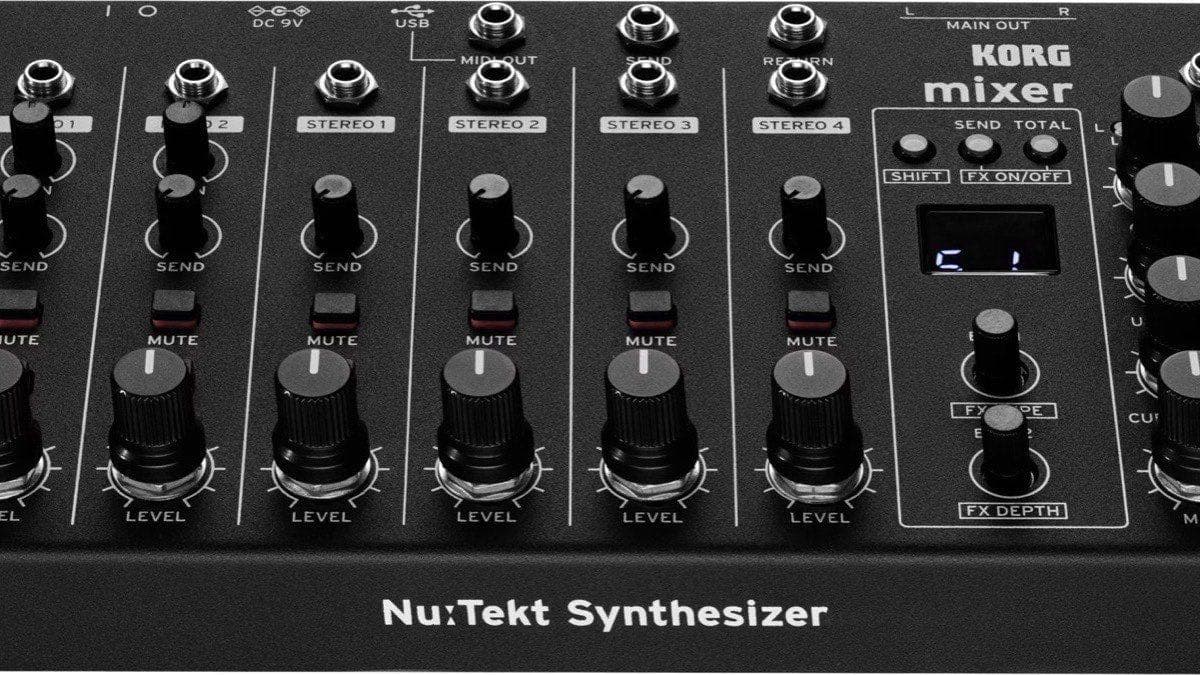
The NTS-4 handles six channels: four stereo minijack inputs and two mono minijack inputs. The two mono inputs accept Eurorack-level signals, and an internal attenuator switches them between line and modular levels. That is the detail that matters for anyone patching a modular case into the same mixer as their line-level boxes. If that case also needs MIDI from a DAW, the Squarp Core MIDI-to-CV module is the translation layer.
Each channel has its own CUE and MUTE buttons. You can preview a source in headphones before you bring it into the mix, then cut it cleanly on the beat. That is the core of a performance mixer, and it is here without any menu diving.
Send FX on every channel
Every channel carries a SEND FX control that feeds one of seven built-in effects: delay, ping-pong delay, two hall reverbs, two slap reverbs, and chorus. You dial in how much of each channel goes to the effect, which is exactly how you would run a send bus on a larger console. For a DAWless rig, it means space and movement without a separate reverb pedal on every synth.
A master FX engine on the main output
The MAIN output runs a separate TOTAL FX engine with ten options: low-pass filter, high-pass filter, isolator, flanger, phaser, decimator, drive, distortion, compressor, and limiter. This is the performance sweetener. A filter or isolator sweep across the whole mix is a staple live move, and the drive, compressor, and limiter stages help glue and level the output before it leaves the box.
USB-C audio and MIDI
The NTS-4 doubles as a USB-C audio interface, streaming the mix to a computer at 24-bit/48 kHz. It also carries USB MIDI and a dedicated MIDI OUT jack on a 3.5 mm TRS connector, so it can clock or drive other gear. A stereo SEND and RETURN pair lets you insert an external effect into the signal path, which extends the onboard FX with whatever pedals or units you already own.
Korg NTS-4 specifications
| Spec | Detail |
|---|---|
| Type | DIY performance mixer kit (Nu:Tekt) |
| Channels | 6 (4 stereo minijack, 2 mono minijack) |
| Mono inputs | Eurorack-compatible, switchable line/modular level |
| Send FX (per channel) | Delay, ping-pong delay, hall reverb A/B, slap reverb A/B, chorus |
| Master (Total) FX | LPF, HPF, isolator, flanger, phaser, decimator, drive, distortion, compressor, limiter |
| Main outputs | L/R on 6.3 mm (1/4") jacks |
| Other I/O | Headphone out, stereo SEND, RETURN (all 3.5 mm) |
| USB audio | USB-C, 24-bit/48 kHz |
| MIDI | USB MIDI plus MIDI OUT (3.5 mm TRS) |
| Display | 3-digit, 7-segment LED |
| Power | USB bus power or DC 9V adapter |
| Dimensions | 195 x 125 x 38 mm |
| Weight | 613 g |
| In the box | USB-C to Type-A cable, assembly instructions |
| Price | $249 / €219 / £189 / ¥32,000 |
Korg NTS-4 vs Korg Volca Mix
The obvious in-house comparison is the Volca Mix, Korg's long-standing three-channel mixer for the Volca range. The NTS-4 answers most of the Volca Mix's limitations.
| Korg NTS-4 | Korg Volca Mix | |
|---|---|---|
| Channels | 6 (4 stereo, 2 mono) | 3 (mono) |
| Onboard FX | Send FX per channel + 10 master FX | None (send/return only) |
| Eurorack input | Yes, switchable level | No |
| USB audio out | Yes, 24-bit/48 kHz | No |
| MIDI | USB MIDI + MIDI OUT | No |
| Format | DIY kit | Pre-built |
| Price | $249 | Around $135 |
The Volca Mix is cheaper and comes pre-assembled, and it still makes sense if you only run three Volcas and want the simplest possible box. The NTS-4 costs more, but the extra channels, the onboard effects, the Eurorack input, and the USB audio out make it a far more capable centerpiece. For most growing DAWless setups, the NTS-4 is the better long-term buy. If you are still assembling that setup, our guide to the best drum machines in 2026 covers the sound sources worth feeding into it.
Who the Korg NTS-4 is for
The NTS-4 is aimed squarely at DAWless and hybrid producers. If your studio is a cluster of Volcas, an Akai MPC, a groovebox, and a small modular case, this is the hub that ties them together and records the result in one pass. Performers will value the CUE, MUTE, and master-FX moves.
It is less suited to a traditional recording studio. There are no XLR inputs, no phantom power, and the minijack I/O means adapters for most quarter-inch and balanced gear. If you mainly mix inside a DAW and just want clean inputs, a standard audio interface is a better fit. And if you want a hands-on hardware instrument rather than a mixer, Korg's own phase8 acoustic synthesizer or the Korg Collection software scratch a different itch.
How much does the Korg NTS-4 cost?
The NTS-4 launched on July 10, 2026 at $249 in the US, €219 in Europe, £189 in the UK, and ¥32,000 in Japan. That price is for the DIY kit, which requires no soldering to assemble. There is no pre-built version; building it yourself is part of the Nu:Tekt concept.
Check Korg NTS-4 price at ThomannYou can browse more synths, mixers, and music gear at Plugin Boutique.
FAQ
Is the Korg NTS-4 hard to build?
No. Korg ships it as a no-solder kit, and the company says assembly takes only a few minutes. It is closer to snapping parts together than to electronics work, so no prior experience is needed.
Can the Korg NTS-4 record into a DAW?
Yes. It works as a USB-C audio interface and streams the full mix to a computer at 24-bit/48 kHz. It also sends USB MIDI, so it can clock or trigger software at the same time.
Does the NTS-4 work with Eurorack modular?
Yes. The two mono inputs accept Eurorack-level signals, and an internal attenuator switches them between line and modular levels. That lets you patch a modular case into the same mixer as your line-level gear.
Korg NTS-4 vs Volca Mix — which should I buy?
The Volca Mix is cheaper, pre-built, and fine for three Volcas. The NTS-4 adds three more channels, per-channel and master effects, a Eurorack input, and USB audio out. For a setup that is growing beyond a few boxes, the NTS-4 is the more future-proof choice.