Some links on this page are affiliate links. If you buy through them, Dubspot may earn a commission at no extra cost to you. It never affects our scores or what we recommend — read our policy.
Klevgrand Altitude Harmony: Tuning and Three Harmonies for $29.99
Klevgrand Altitude Harmony tunes vocals and stacks up to three in-key harmonies with four one-button effects. $29.99 intro, from $49.99. Specs, rivals and verdict.
M
Marcus Feld
October 27, 2026 · 8 min read
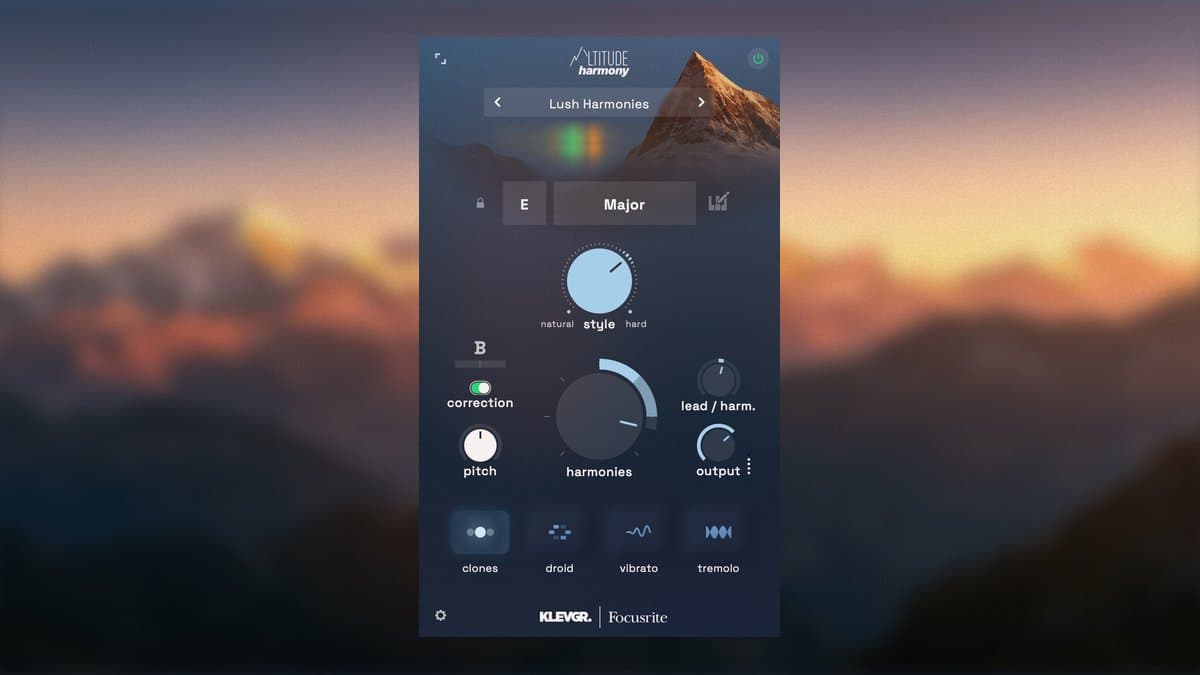
Klevgrand has released Altitude Harmony, a stripped-down vocal plugin that tunes a lead vocal and stacks up to three harmony voices above or below it. It is built on the engine of Klevgrand's full Altitude vocal processor, made together with Focusrite, and designed around four main controls with no menus to dig through. The intro price is $29.99, down from $49.99, for macOS and Windows.
At a glance: pitch correction from natural to hard-tuned with formants preserved; up to three in-scale harmony voices, above or below the lead; 15 scale presets plus a custom scale; four one-button effects (Clones, Droid, Vibrato, Tremolo); a zero-latency mode for tracking and live use. AU, VST, VST3 and AAX, 64-bit. $29.99 intro (regular $49.99), with an upgrade path to full Altitude.
What is Altitude Harmony?
Klevgrand launched Altitude in April 2026 as a full vocal performance station: pitch correction, smart harmonies, a MIDI-playable Play module and a deep modulation section, for $149.99. Altitude Harmony takes the same pitch engine and cuts the interface down to the decisions most people actually make on a vocal: which key, how hard to tune, how many harmonies, and whether to add an effect. Everything else happens underneath.
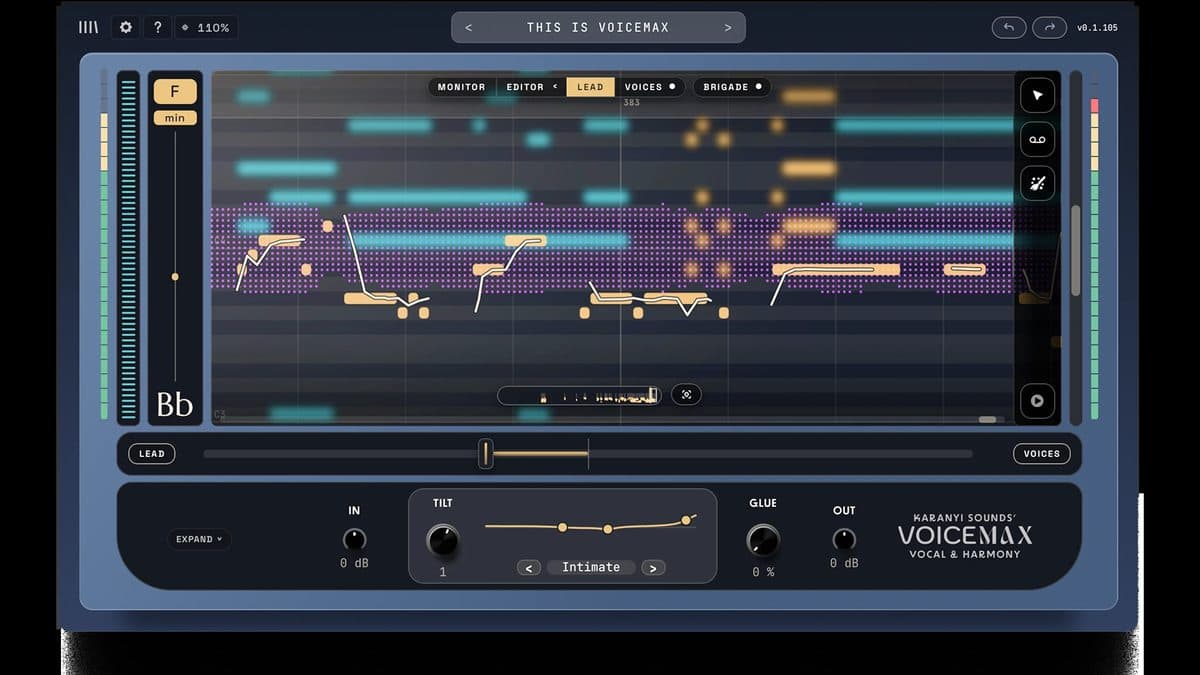
That puts it in a busy part of the market. Real-time tuners such as Waves Tune Real-Time and Universal Audio's Topline Vocal Tune correct pitch while the singer performs. Karanyi Sounds' Voicemax, which launched last week, adds live harmonies and piano-roll editors to that idea. Altitude Harmony is the simplest and cheapest of the group, and the only one built around harmonies from the first knob. It is a performance tool rather than an editor: there is no note-by-note correction.
What does Altitude Harmony do?
Scale. One scale setting drives both the tuning and the harmonies. Pick a root note and one of 15 presets, including Chromatic, Major, Minor, Pentatonic and Dorian, or click keys to build a custom scale. A scale lock keeps your scale in place while you browse presets, which saves resetting the key every time you try a new sound.
Style. This is the main tuning control. At the natural end, correction is gentle and slow enough to keep slides and vibrato. At the hard end, notes snap to pitch for the classic hard-tuned sound. Style also changes how human the harmonies sound and how the effects behave, so one knob moves the whole vocal from polished to robotic. Formant correction stays on throughout, which is what stops a shifted voice sounding like a chipmunk.
Harmonies. One knob sets how many harmony voices you get, up to three, and whether they stack above or below the lead. The voices land on scale steps two, four and six away from the lead, so they follow the key you set rather than fixed intervals. A Lead/Harm mix control balances the stack against the lead.
Pitch correction switch and Pitch. You can turn correction off and use Altitude Harmony purely as a harmonizer on a vocal you have already tuned elsewhere. The Pitch knob shifts every voice, harmonies included, in semitones, with fine-tuning when you hold Alt or Option.
Four effects. Clones adds a doubling effect with changing pitch, Droid gives each voice a robotic tone, Vibrato adds natural vibrato that fades in on each note, and Tremolo chops the signal in time with your DAW tempo, at double or half speed if you want. They apply to every voice at once and can be combined.
Settings. A detection range setting tells the plugin the singer's range, which improves accuracy and affects latency. The processing mode switches between Quality, which has slight latency, and Low latency, which has zero latency at the cost of some precision. Reference pitch moves A4 for music not tuned to 440 Hz.
Altitude Harmony specifications
| Spec | Detail |
|---|---|
| Type | Real-time vocal tuner and harmonizer |
| Harmony voices | Up to 3, above or below the lead, on scale steps 2, 4 and 6 |
| Scales | 15 presets (Chromatic, Major, Minor, Pentatonic, Dorian and more) plus custom |
| Tuning | Style control from natural to hard-tuned, formant-aware, on/off switch |
| Effects | Clones, Droid, Vibrato, Tremolo (tempo-synced) |
| Latency modes | Quality (slight latency), Low latency (zero latency) |
| Other controls | Pitch offset, Lead/Harm mix, output, reference pitch, detection range |
| Formats | AU, VST, VST3, AAX (64-bit) |
| Systems | macOS 10.13 or later (Intel or Apple Silicon), Windows 10 or later (64-bit) |
| Demo | Full version with occasional audio dropouts |
| Price | $29.99 intro, $49.99 regular |
Altitude Harmony vs Voicemax vs Waves Tune Real-Time
| Altitude Harmony | Karanyi Voicemax | Waves Tune Real-Time | Klevgrand Altitude | |
|---|---|---|---|---|
| Price (27 Oct) | $29.99 intro ($49.99) | €59 launch (€79) | $39.99 at Plugin Boutique to 1 Nov ($199 list) | $149.99 |
| Live tuning | Yes, Style knob | Yes, Tune Amount, Retune, Smoothing | Yes, natural to hard-quantized, MIDI-controllable | Yes |
| Harmonies | Up to 3 | Up to 4, plus 32-voice Brigade | None | Smart harmonies |
| Note editing | No | Lead and Harmony piano rolls | No | No, but MIDI-playable Play module |
| Extras | Clones, Droid, Vibrato, Tremolo | EQ, Push drive, Re-Pitch, Formant | Formant correction, vibrato handling | Deep modulation section |
| Latency | Zero-latency mode | Real-time | Ultra-low latency | Zero-latency live use |
Which to pick? If you mainly want to tune a lead fast and the harmonies are a bonus, Waves Tune Real-Time at $39.99 until 1 November adds MIDI control of the correction and a long track record on stage. If you want harmonies and the ability to fix individual notes afterwards, Karanyi Voicemax does more for €59, as our Voicemax first look explains. Altitude Harmony wins on speed and price: four controls, a few seconds to a stacked vocal, and the lowest price of the three. Full Altitude is the step up if you want to play harmonies from a MIDI keyboard or modulate the voice deeply. For tracking with a hard-tuned sound in a studio already built on UAD, Topline Vocal Tune at $79 is the other option.
Who is Altitude Harmony for?
It suits singer-songwriters, beatmakers and content creators who want a tuned, stacked vocal without learning a tuner and a harmonizer separately. It also suits live performers, because the zero-latency mode, few controls and one-button effects make it easy to use on stage. And at $29.99 it is a cheap way to sketch harmony ideas before recording real ones.
Who should skip it: mix engineers who need graphical, note-by-note correction should stay with Melodyne or a tuner with an editor. If you already own Auto-Tune or Waves Tune Real-Time and only need harmonies, check whether a dedicated harmonizer or Voicemax fits better. And because there is no MIDI control of the harmonies, anyone who wants to play chord voicings from a keyboard needs full Altitude.
How much does Altitude Harmony cost?
Altitude Harmony is $29.99 at its intro price in Klevgrand's store, 40 percent off the $49.99 regular price. Klevgrand has not published an end date for the intro offer. It is sold direct by Klevgrand, which offers an upgrade path to full Altitude, $149.99 in Klevgrand's store and at Plugin Boutique. The demo is the full version with occasional audio dropouts, so you can test it on your own voice before paying. Buy Altitude Harmony from Klevgrand.
FAQ
What does Altitude Harmony do?
It tunes a vocal to a chosen key and scale and adds up to three harmony voices above or below it, with four one-button effects. It runs in real time, with a zero-latency mode for tracking and live use.
How is Altitude Harmony different from Altitude?
Altitude Harmony uses the same engine with four main controls. Full Altitude adds deeper lead and harmony controls, a MIDI-enabled Play module and a modulation section, for $149.99.
Altitude Harmony vs Voicemax: which is better?
Voicemax does more: four harmony voices, a Brigade group mode and two piano-roll editors. Altitude Harmony is simpler, faster to use and cheaper at $29.99.
What are the system requirements?
macOS 10.13 or later on Intel or Apple Silicon, or Windows 10 or later, 64-bit, in an AU, VST, VST3 or AAX host.
Is there a free trial?
Yes. Klevgrand's demo is the full version, with occasional audio dropouts until you unlock it.