KeySolutions Traveler: A Cinematic Hybrid With Motion FX
KeySolutions Traveler is a cinematic hybrid synth with three oscillators, dual filters, and launch FX. Intro $99 through 30 September 2026 versus $149 list.
KeySolutions Sounds shipped Traveler on 1 September 2026. It's a cinematic hybrid synthesizer built for film and game composers who want analog weight, wavetable bite, and motion in a single instrument. Intro pricing is $99 against a $149 list price through 30 September 2026, and the launch bundle throws in KeyTIME and KeySPACE, two effects plugins that sell for $49 each on their own.
At a glance: $99 intro / $149 list through 30 September 2026. KeyTIME and KeySPACE included at launch. VST3, AU, AAX, and standalone. macOS 11 or later (Intel and Apple Silicon) and Windows 10 or later. Three installs per license. 400+ presets. Buy it from KeySolutions Sounds.
This is a first look at the shipping instrument and its published feature set. We haven't had Traveler open in a session yet.
What Traveler is
Most hybrid synths pick a lane. They either chase analog voice architecture and treat wavetables as a bonus, or they start as a wavetable instrument and bolt a vintage filter onto the end. Traveler splits the difference on purpose: three oscillators with a different job each, a dual-filter path behind them, then a sequencer and arpeggiator whose only reason for existing is to keep the sound moving after you play the chord.
That's a composer pitch rather than a dance-music one. KeySolutions frames the instrument around expression, in that order: dynamics, then width, then motion. The 400+ factory presets, built with a roster of outside sound designers, lean the same way.
Traveler runs from 1 to 16 voices, poly or mono. It isn't a sample workstation, so the sound comes from the voice architecture, the filters, and the motion tools. Omnisphere 3 is the opposite bet. Traveler is the smaller instrument you can learn in an afternoon and then push hard with Control Tracks.
Three oscillators, three jobs
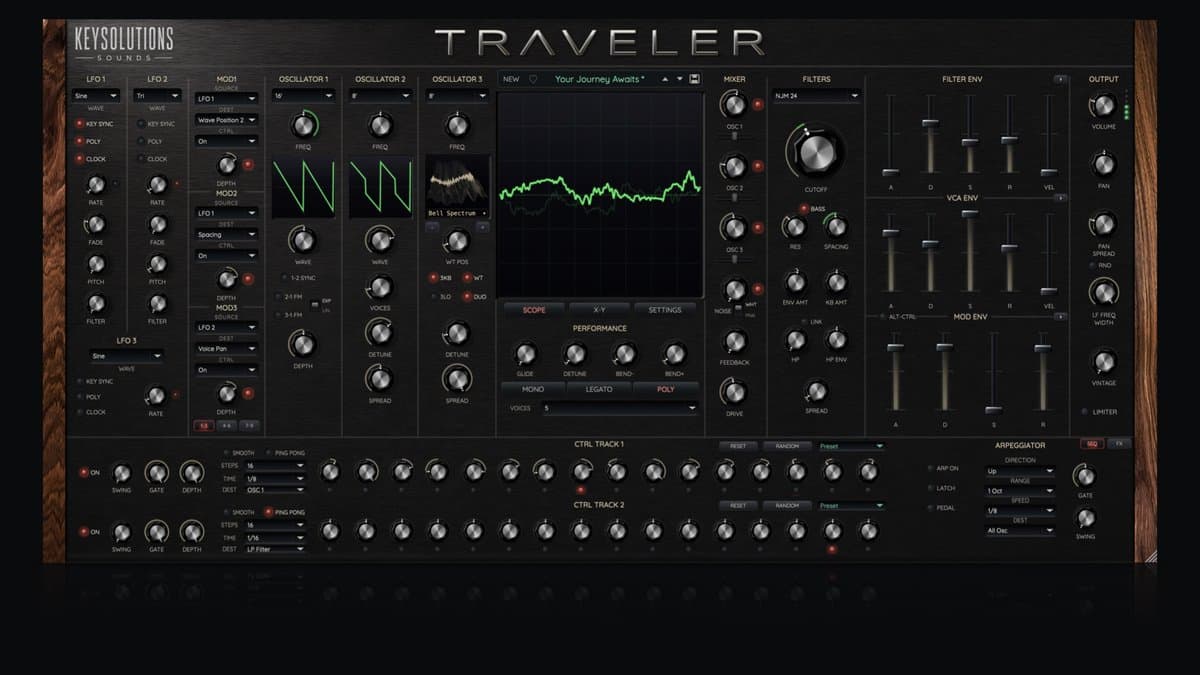
The voice starts with three continuously variable oscillators spanning six octaves, each with real-time waveform modulation. They aren't clones of one another.
Oscillator 1 carries sync plus linear and exponential FM. Reach for it when a lead needs a hard edge, or when a bass needs more than a saw stack underneath it. Linear FM stays closer to pitch. Exponential FM gets dirty faster.
Oscillator 2 is the Super oscillator, a 7-voice unison stack with detune and stereo spread. Pads and anything that has to fill a cue without a chorus plugin start here, which lets you keep Osc 1 focused and still get a wide bed.
Oscillator 3 switches into wavetable mode with 85 factory tables, universal-format import, and a Duo stack with stereo spread. If you already live in Serum 2, this is the familiar half of Traveler. It's one oscillator, though, not a five-engine workstation.
A vintage parameter ages the whole voice with oscillator drift and non-periodic behavior. Use it when a locked stack sounds too clean, and leave it alone for modern centered bass.
Filters, stereo, and envelopes
The filter section is a choice rather than a single model. A multi-topology ladder low-pass runs at 6, 12, 18, and 24 dB/octave. Next to it sits an NJM2069-style filter at 24 and 12 dB/octave, the chip family behind the Korg DW-8000 and DSS-1. Either path can add modern low-end compensation, so a 24 dB ladder doesn't thin the bottom the way a hardware-style slope usually does.
An independent high-pass sits alongside, with linked low-pass cutoff tracking. In front of the filters you get a mixer feedback loop and pre-filter drive. That's the grit path: push level into the ladder or the NJM2069, then decide how much low end survives.
Dual and stereo filter topology is the cinematic part. Left/right frequency spacing plus a per-voice Spread parameter offset the filter on each note, while the output section pans voices alternately or at random. A Low Frequency Width control keeps bass centered as the top end opens up, and per-oscillator panning with assignable voice-pan modulation sits on top. The upshot is a synth that writes stereo into the voice instead of asking a width plugin to fake it downstream.
Envelopes on the filter, amplifier, and modulation slots switch between ADSR and ADBSSR. The extra break and slope stages exist for evolving pads, not plucks, and every time-based stage has a curve you shape on screen. The modulation envelope also has an alternate-control mode, triggered by a modulation controller or an LFO cycle, which turns it into a looping envelope rather than a one-shot.
Control Tracks and the arpeggiator
Control Tracks are modulation sequencers. Each one writes a repeating series of values and sends that series to a destination, with step length, rate, smoothing, swing, randomization, and ping-pong built into the engine. That's how you get rhythmic filter movement, wavetable animation, stereo motion, and evolving effects without drawing a dozen automation lanes.
The arpeggiator sits beside them with its own direction, range, speed, gate, swing, destination, latch, and pedal controls, plus independent oscillator destinations. The two systems are designed to run together. The arp writes the notes, the Control Tracks write the motion around those notes, and for trailer pulses and ostinatos that division of labor is the whole workflow.
If you already animate MIDI with a tool like Animation Station Pro, Traveler is doing a related job inside one synth rather than hosting other plugins. You stay in a single window. You also stay inside Traveler's own destinations.
Onboard FX, plus KeyTIME and KeySPACE
The built-in effects finish the voice: EQ, a three-mode analog-inspired chorus (two flavors, or both at once), dual or ping-pong delay, and three reverb algorithms running from a focused room to a wide cinematic space. That's enough to print a cue-ready patch without touching a send, though it isn't a 90-processor FX rack.
The launch bundle adds KeyTIME and KeySPACE as separate plugins, $49 each on their own and free with Traveler through 30 September 2026. Treat them as motion and space tools that can sit on other tracks too, not as extra oscillators. After the intro window closes, the synth is $149 and those two plugins go back to being their own purchases.
Traveler specifications
| Spec | Detail |
|---|---|
| Type | Cinematic hybrid synthesizer |
| Oscillators | 3 variable: Osc 1 sync + lin/exp FM; Osc 2 7-voice Super; Osc 3 wavetable (85 tables + import, Duo stack) |
| Filters | Ladder 6/12/18/24 dB and NJM2069-style 12/24 dB; dual/stereo; independent HPF; drive and feedback |
| Envelopes | ADSR or ADBSSR with per-stage curves; looping mod envelope option |
| Motion | Control Tracks (modulation sequencers) + arpeggiator |
| FX | EQ, 3-mode chorus, dual/ping-pong delay, 3 reverbs; launch includes KeyTIME + KeySPACE |
| Polyphony | 1 to 16 voices, poly or mono |
| Presets | 400+ |
| Formats | VST3, AU, AAX, standalone |
| macOS | 11 or later, Intel and Apple Silicon; 450 MB disk; 3.4 GHz quad-core or Apple Silicon, 16 GB RAM recommended |
| Windows | 10 or later, 64-bit; 150 MB disk; 3.4 GHz quad-core, 16 GB RAM recommended |
| License | 3 computer installs; online or offline activation |
| Price | $99 intro through 30 September 2026, then $149 list |
Traveler vs Omnisphere 3 and Serum 2
| Traveler | Omnisphere 3 | Serum 2 | |
|---|---|---|---|
| Role | Cinematic hybrid voice with motion FX | Hybrid workstation + huge library | Wavetable lab with five engines |
| Oscillators | 3 specialized (FM/sync, Super, wavetable) | Deep hybrid engine + samples | 5 engines (wavetable, sample, granular, spectral, multisample) |
| Factory pool | 400+ presets, 85 wavetables | 26,000+ patches | 626+ presets, 288 wavetables |
| Motion | Control Tracks + arp | Deep modulation + FX Rack | Arp, clip sequencer, flexible FX |
| Formats | VST3, AU, AAX, standalone | VST3, AU, AAX | VST3, AU, AAX |
| Price | $99 intro / $149 list | $479 full / $199 upgrade | $249 |
Pick Traveler when you want a playable cinematic voice with motion built in and a launch price that includes two extra FX plugins. Pick Omnisphere 3 when you need a desert-island library and can pay for it. Pick Serum 2 when wavetable design is the daily job and you want the visual editor that category was built around.
Pigments 6 is the other hybrid worth weighing. It's deeper as a playground (wavetable, VA, granular) and costs more than Traveler's intro. Traveler stays deliberately narrower: three oscillators, two filter families, Control Tracks.
Who Traveler is for
Traveler suits film and game composers who want a hybrid they can play rather than a library they browse. Sound designers who like FM, unison, and wavetables in one voice will get through the panel quickly. Control Tracks and the bundled KeyTIME and KeySPACE are the reason to buy during the intro window instead of later.
There are clear reasons to pass. Four hundred presets is a working set, not a catalog, so anyone shopping for sheer patch volume should look elsewhere. Producers whose day is visual wavetable editing still belong at Serum 2. If you need more than 16 voices in one instance, or you're on macOS 10 or Windows 8, Traveler is out.
Keyboardists who just want an analog-style poly with a vintage switch will like Osc 1 and Osc 2 and may never touch Osc 3. Nothing here forces the wavetable path.
How much does Traveler cost?
Traveler is $99 through 30 September 2026, then $149. The intro purchase includes KeyTIME and KeySPACE, normally $49 each. One license covers three computer installations, with online or offline activation, and the formats are VST3, AU, AAX, and standalone on macOS 11+ and Windows 10+. Buy it from the KeySolutions Sounds shop.
FAQ
What is KeySolutions Traveler?
Traveler is a cinematic hybrid synthesizer with three specialized oscillators, ladder and NJM2069-style filters, Control Tracks, an arpeggiator, and onboard EQ, chorus, delay, and reverb. It ships with 400+ presets and runs as VST3, AU, AAX, and standalone.
How much does Traveler cost?
$99 intro through 30 September 2026, then $149 list. That launch price includes KeyTIME and KeySPACE, which are $49 each as separate effects.
Does Traveler include wavetable import?
Yes. Oscillator 3's wavetable mode offers 85 factory tables plus universal-format import, along with a Duo stack with stereo spread.
Traveler vs Omnisphere 3?
Traveler is a smaller, cheaper cinematic hybrid built around a three-oscillator voice and motion tools. Omnisphere 3 is a $479 workstation with a 26,000+ patch library. Choose Traveler for a focused writing instrument, and Omnisphere when the library itself is the product.
What are the Traveler system requirements?
macOS 11 or later on Intel or Apple Silicon, or Windows 10 or later, 64-bit. KeySolutions recommends a 3.4 GHz quad-core (or Apple Silicon) processor and 16 GB of RAM. Disk use runs about 450 MB on Mac and 150 MB on Windows, and one license activates three computers.
Verdict
Traveler reads like a composer synth with a clear plan for its voice. Osc 1 handles FM and sync, Osc 2 handles width, Osc 3 handles tables, and the dual filter plus Control Tracks are what turn that voice into cue material instead of a static preset. At $99 with KeyTIME and KeySPACE in the box, the intro is the moment to try it. After 30 September it's a $149 synth without those two plugins attached, which still looks fair if cinematic writing is your lane. It won't replace Omnisphere or Serum, and it isn't trying to. Browse the rest of our hybrid synth coverage to see where it sits next to the other instruments on this shelf.