Some links on this page are affiliate links. If you buy through them, Dubspot may earn a commission at no extra cost to you. It never affects our scores or what we recommend — read our policy.
Jun Murakami Synth81Z: A Measured TX81Z
Jun Murakami Synth81Z is a measured Yamaha TX81Z with Performance mode and a hardware librarian. The intro price is $39, and the regular price is $59.
T
Theo Nakamura
October 2, 2026 · 9 min read
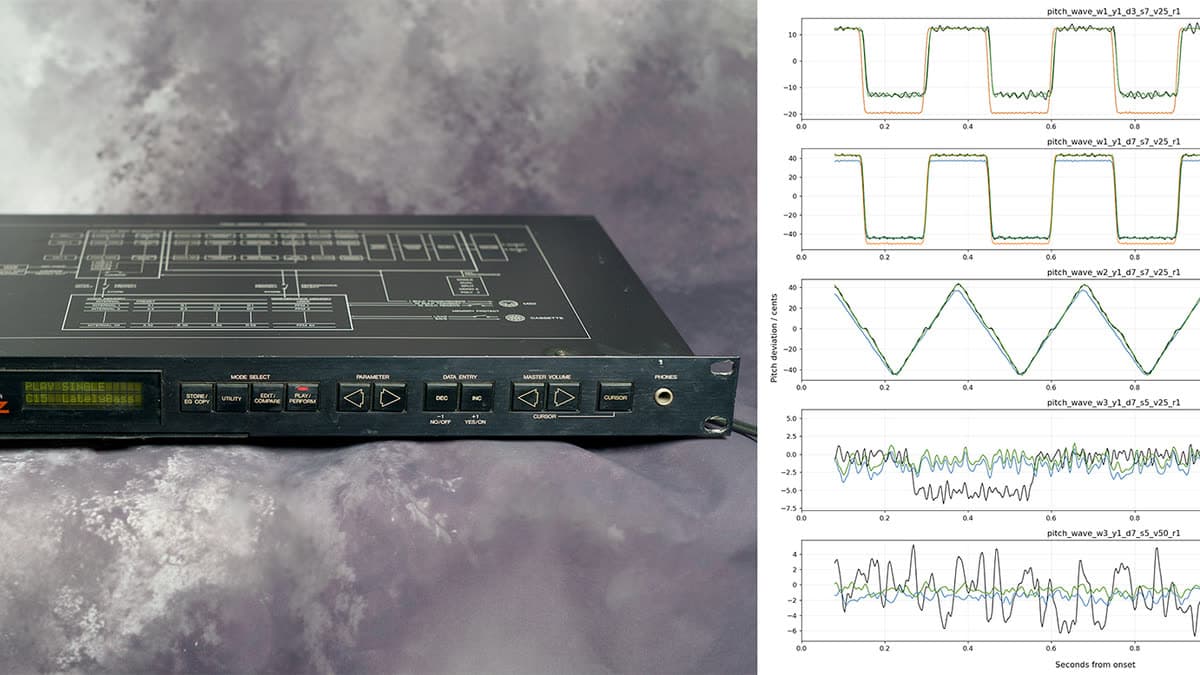
Jun Murakami has released Synth81Z, a four-operator FM instrument built by measuring a real Yamaha TX81Z. The intro price is $39 from 1 October 2026 (JST) through 31 October 2026 (anywhere on Earth). The regular price is $59. This is a first look from the official product page and Jun Murakami's demo video, not a hands-on review.
At a glance: One measured TX81Z, the YM2414 OPZ chip plus the analog output stage. Polyphony of 8, 16, 24, or 32 voices. Eight-part Performance mode. A five-slot effects rack carried over from Synth-80. A full editor and librarian for a hardware TX81Z. Standalone, VST3, and AAX on Windows 10 or later, 64-bit, with no Windows ARM build. Standalone, VST3, AU, and AAX on macOS 10.15 or later, Universal Binary. Sold direct.
What Synth81Z is
The TX81Z, released in 1987, is a 1U four-operator FM module. Yamaha built it as a cheaper way into the synthesis the six-operator DX7 had started. It is not a cut-down DX7. Each operator can pick from eight waveforms, where earlier FM synths were stuck on a sine. That extra wave choice, plus the analog circuitry after the DAC, is why a TX81Z bass does not sit in the same place as a DX7 bass.
The preset that made the module famous is Lately Bass. Distorted harmonics, a sharp attack, and a low end that holds a dance record. Synth81Z treats that sound as a measurement problem, not a preset to approximate. Jun Murakami started from the same method used on Synth-80: measure the hardware until the plugin and the unit agree, then check the result by ear against recordings of the real machine.
That is a different job from a multi-chip FM collection. Plogue Chipsynth OPMZ emulates four Yamaha four-operator chips in one plugin, including the OPZ. Synth81Z stays on a single instrument, the TX81Z, and then adds the things you do with a real rack unit: Performances, a librarian, and a screen that shows all four operators at once.
What the measurement covers
The official page lists the parts that were matched to the hardware. Operator phase resolution and the rounding of the waveform tables. The fine shape of each of the eight waveforms. Output levels that change with the algorithm. The timing of every envelope step. How the LFO, velocity, and controllers respond. The frequency response from the DAC through the output stage. Lately Bass was then pushed against recordings of the real unit.
Set polyphony back to 8 and the plugin behaves like one chip. The higher settings, 16, 24, and 32, are the software equivalent of stacking several chips. None of those extras are meant to replace the 8-voice hardware tone. They sit on top of it.
The original front panel was a two-line LCD and a handful of buttons. Synth81Z puts waveform, frequency, output level, envelope, and scaling for all four operators on one screen. Each operator has its own colour, matched to the numbers in the algorithm diagram, so carriers and modulators read at a glance. Envelopes are graphs. Waveforms are icons. Click a parameter label and a hint opens in English or Japanese. Direct numeric entry, including frequency ratios, per-module copy and paste, and a resizable window are all there. The control layout follows Synth-80, so the two instruments share a way of working.
Performance mode and the effects rack
Eight-part Performance mode covers the hardware-style layers, splits, and multitimbral setups. A software-oriented mode adds continuous pan and an independent LFO on every part. That is the difference between loading a TX81Z voice and arranging with one.
The effects rack has five slots and twelve effects inherited from Synth-80: four choruses (Synth, Studio, Pitch, and Digital), plus Delay, Phaser, Flanger, EQ, Compressor, Distortion, Reverb, and an arpeggiator. Effects can be copied between Synth81Z, Synth-80, and Synth-80 FX. MIDI Learn and DAW automation cover the effects and the Performance mixer, and those maps can be saved and loaded.
Jun Murakami's pairing note is practical. Late-eighties racks often held an analog polysynth next to an FM module. Thick pads, brass, and leads go to Synth-80. Defined FM basses, electric pianos, bells, and sequences go to Synth81Z.
Editor and librarian for a real TX81Z
Connect a hardware TX81Z over MIDI and edits in the plugin are mirrored to the unit. A MIDI interface is required. SysEx send and receive covers voices, Performances, and tables. You can import .syx and .mid files and build banks, so an existing voice library stays in use. Factory content is 420+ presets. Version 1.0.0 also bundles 52 additional patches by Saif Sameer, added 29 September 2026.
Licensing is online activation, or a key file for offline activation on the authorized machine. A demo is available. After purchase, the same install runs as the full version.
Synth81Z specifications
| Spec | Detail |
|---|---|
| Type | Measured Yamaha TX81Z / OPZ (YM2414) instrument |
| Developer | Jun Murakami |
| Version | 1.0.0 |
| Polyphony | 8, 16, 24, or 32 voices (8 matches one chip) |
| Performance | 8-part layers, splits, and multitimbral setups, plus per-part pan and LFO |
| Effects | 5 slots, 12 effects shared with Synth-80 |
| Librarian | Hardware mirroring, SysEx, .syx / .mid import, bank builder |
| Presets | 420+ factory, plus 52 Saif Sameer patches in 1.0.0 |
| Automation | MIDI Learn and DAW automation, maps save and load |
| Windows | 10 or later, 64-bit. Standalone, VST3, AAX. No ARM, no VST2, no 32-bit |
| macOS | 10.15 or later. Standalone, VST3, AU, AAX. Universal (Intel and Apple silicon) |
| Computer | 4 GB RAM, 4-core CPU at 3 GHz (or Apple M1), 100 MB disk |
| License | Online activation or offline key file |
| Price | $39 intro through 31 October 2026 (AoE), $59 regular |
Synth81Z vs Chipsynth OPMZ
Both plugins care about Yamaha's four-operator era. They do not replace each other. Chipsynth OPMZ is a multi-chip instrument: OPM, OPP, OPZ, and OPZ2, an eight-sound stack, SysEx loading, and VGM playback, at $49.95, with Linux and CLAP as well. Synth81Z is one measured TX81Z, with the output stage in the model, a Performance mixer, and a librarian that talks back to the hardware.
| Jun Murakami Synth81Z | Plogue Chipsynth OPMZ | |
|---|---|---|
| Price | $39 intro, $59 regular | $49.95 |
| Engine | One measured TX81Z (OPZ plus output stage) | OPM, OPP, OPZ, and OPZ2 |
| Layering | 8-part Performance | Stack of up to 8 sounds |
| Hardware link | Editor and librarian for a real TX81Z | SysEx patch import |
| Extra tools | 5-slot effects rack | VGM playback and analysis, NKS |
| Formats | Standalone, VST3, AAX, plus AU on Mac | VST3, AU, AAX, CLAP, standalone |
| Systems | Windows 10+ (no ARM), macOS 10.15+ | Windows 10+, macOS 10.15+, Linux |
If the goal is Lately Bass, the eight operator waveforms, and a panel you can actually program, Synth81Z is the specific tool. If the goal is arcade OPM, a DX100, a V50, and chiptune logs in one plugin, OPMZ is the broader one. A free Dexed or Arturia's DX7 V answers a third question, the six-operator DX7, and will not give you the TX81Z waveforms.
Who Synth81Z is for
Buy it if the TX81Z is already part of how you write bass, electric piano, bells, or brittle digital brass, and you want that instrument with a modern screen. It also fits anyone who still owns the rack unit and wants edits, banks, and Performances in one place.
Skip it if you need Windows on ARM, Linux, or CLAP. Skip it if you wanted every four-operator Yamaha chip, or a general six-operator FM synth with a huge matrix. Eight voices is the hardware. The 32-voice mode is a stack, not a different synth.
How much Synth81Z costs
Synth81Z is sold direct from Jun Murakami. Specs also live on the Synth81Z plugin page. The intro price is $39 from 1 October 2026 (Japan Standard Time) through 31 October 2026 (anywhere on Earth). After that window the regular price is $59. The download is the instrument, the editor, and the librarian. Version 1.0.0 includes the Saif Sameer patch set.
FAQ
Is Synth81Z the same plugin as Chipsynth OPMZ?
No. Synth81Z models one TX81Z, measured as a complete instrument, and adds Performance mode plus a hardware librarian. Chipsynth OPMZ models four chips, including the OPZ, and stacks up to eight sounds with VGM playback.
Can Synth81Z edit a real TX81Z?
Yes. With a MIDI interface, edits in the plugin mirror to the hardware. It sends and receives SysEx for voices, Performances, and tables, imports .syx and .mid files, and builds banks.
What does the $39 intro include?
The full instrument at version 1.0.0, the editor and librarian, 420+ factory presets, and the 52 additional Saif Sameer patches. The regular price is $59.
What are the system requirements?
Windows 10 or later, 64-bit, standalone, VST3, and AAX. ARM Windows is not supported. macOS 10.15 or later, Universal Binary, standalone, VST3, AU, and AAX. Both need 4 GB RAM, a 4-core CPU at 3 GHz or an Apple M1, and about 100 MB of disk. VST2 and 32-bit are not supported.
Does eight-voice mode match the hardware?
Eight voices is the single-chip behaviour. 16, 24, and 32 voices are extra chips in software. The measurement target is the original 8-voice TX81Z, including Lately Bass.