Ask the Dust: One Spring Voice for Electric Guitar
Ask the Dust is a $9.50 spring-driven electric guitar voice with six controls. Specs, formats, license, comparisons, and who should buy it at $19 regular.
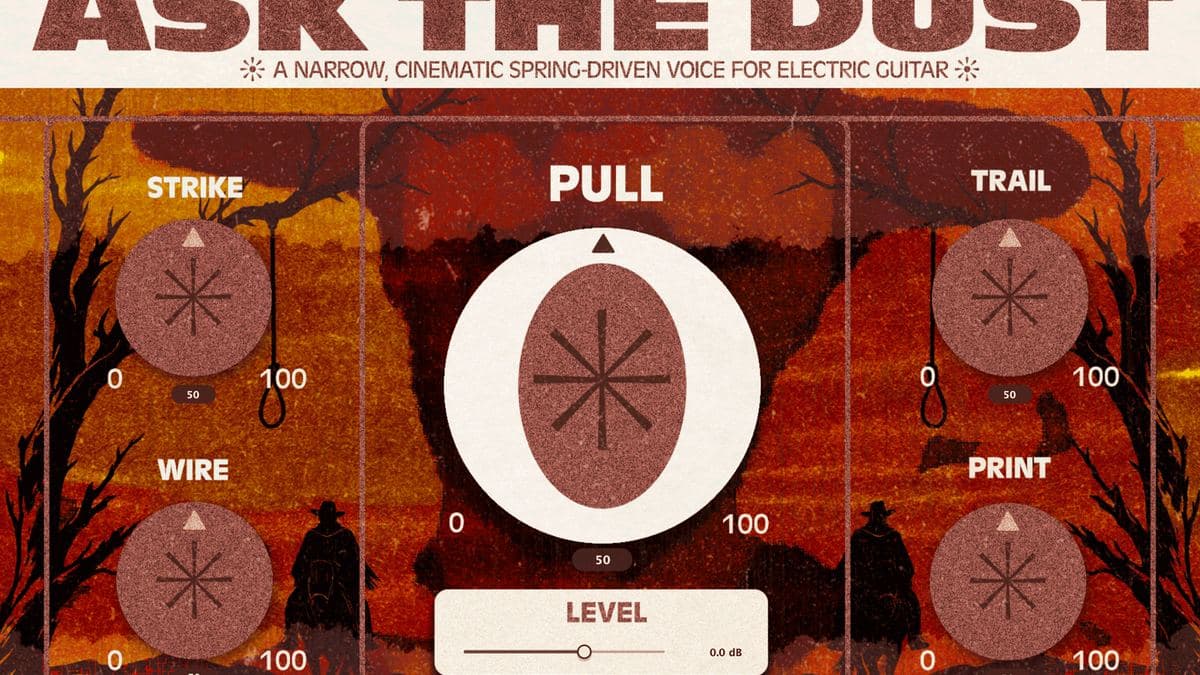
Hell Yes Loop Lab's Ask the Dust is a cinematic, spring-driven voice for electric guitar. One character, six knobs, no amp menu. Street price is $9.50 against a $19 regular price, and version 1.0.0 ships as a ZIP for macOS (AU and VST3) or Windows (VST3).
At a glance: $9.50 street, $19 regular. Six controls and one fixed voice. macOS AU plus VST3, Windows VST3. No AAX build and no standalone. Sold direct by Hell Yes Loop Lab.
This is a first look at the shipping plugin and its published design. We haven't run Ask the Dust on a session guitar yet, so nothing below substitutes for putting your own DI through it.
What Ask the Dust is
Most guitar plugins open with a menu: amp, cab, era, model. Ask the Dust opens with a single voice and one question, which is how far your guitar should fall into it. Hell Yes Loop Lab is blunt about that: it isn't an amp, and it doesn't pretend to be one.
Your hands stay in charge, so attack, vibrato, chord voicings, and phrasing all survive the trip intact. What changes is tone, and a Telecaster, a humbucker, and a cheap single-coil come back living in the same narrow world: dry, compressed, worn, with the spring mechanism audible inside the sound rather than bolted onto the end of it.
The tonal family is easy to name even though the developer names no artists. Think 1960s film-score guitar, surf, spaghetti-western twang. The published claims stay careful too, and nothing here is said to reproduce a specific artist, recording, amplifier, cabinet, spring tank, or historical studio chain. It's a creative guitar processor with one character, and that's the whole pitch.
If a modeler is what you actually want, Helix Native and TONE3000 sit in the other aisle. Ask the Dust is closer to a color box than a rig.
Six controls, one voice
Six parameters make up the entire instrument, and each one earns its slot.
Pull decides how strongly the guitar gets drawn into the machine. It isn't a wet/dry mix. Low Pull leaves more of the incoming guitar intact, while high Pull makes pickup and instrument differences give way to the same tonal world. This is the first decision on every pass, because it sets how much identity you keep.
Strike handles pick attack, running from soft and rounded to hard and percussive. Push it when the part needs to click on the front of the note. Back it off when the line should arrive already worn.
Wire brings the metallic spring mechanism forward, so more Wire means more metal and more tension, with the tank itself sitting closer to the front of the sound. This is the control that keeps the plugin from being guitar plus reverb. You hear the springs.
Trail sets how long those springs keep moving after the note fades. The official description is the useful one: the note can stop while the springs keep going. A short Trail gives you a tight rattle, and a long Trail lets the guitar disappear into the mechanism.
Print moves the result from open and dynamic toward narrow, compressed, and worn. Read it as how hard the recording gets pressed, not as a compressor you'd otherwise reach for separately.
Level is output, shown in the GUI as a slider with a dB readout.
The workflow follows the panel in order, so set Pull for how far the guitar falls in, Strike for the front of the note, then Wire and Trail for how much tank you want behind it. Print decides how worn the result reads, and after that you leave it alone, because there's no amp menu to reopen.
You hear the springs
Plenty of plugins treat a spring as decoration at the end of a chain. Here the mechanism stays in the voice: Wire pushes the metal forward, and Trail lets the guitar drop out while the springs carry on behind it. That split is why a short, muted note can still leave a mechanical afterimage hanging in the track.
Twangström is the other named spring specialist on this site, and the two aren't interchangeable. Twangström is a dedicated tank with a full u-he parameter set at €69. Ask the Dust is a guitar voice built around a spring at $9.50. Reach for Twangström when the spring is the effect and the source could be anything at all. Reach for Ask the Dust when the guitar should already sound like it came off that machine.
A plate does a different job again, and UAD EMT 140 and 250 Native gives you studio plate plus early digital space without handing you a worn, narrow guitar print. CORRIDOR couples rooms together, while Ask the Dust couples a guitar to a tank.
One machine, different guitars
The design goal is to shrink the tonal distance between electric guitars without flattening the performance. Your playing stays in the result, and turning Pull up is what makes the incoming instrument give way. Nothing asks you to hunt for a cabinet or switch a model, so the world stays put while you work.
That's a scoring-session pitch, and it's the strongest argument for the plugin. If three cues in a row need the same cinematic guitar color, you don't rebuild a chain each time. You drop Ask the Dust on the track and decide where Pull and Print should sit. Single notes, chords, and full guitar parts all appear in the published use case.
It also tells you who'll bounce off it. Players who enjoy auditioning fifteen amps will feel trapped by six knobs. Producers who want one print that makes a cheap guitar and an expensive one sit in the same cue will feel at home immediately.
Formats, install, and license
Ask the Dust is a direct download, and you pick your system before adding it to the cart.
macOS gets AskTheDust.component for /Library/Audio/Plug-Ins/Components/ plus AskTheDust.vst3 for /Library/Audio/Plug-Ins/VST3/. Windows gets AskTheDust.vst3 for C:\Program Files\Common Files\VST3\. There's no installer and no plugin manager, so you copy the files across and rescan the DAW. Depending on your macOS or DAW security settings, you may need to confirm that you want to open it.
Each ZIP includes the plugin, a Read Me, and a license, and both packages report version 1.0.0.
The license covers commercial and non-commercial music, so you can release, sell, stream, license, and distribute anything you make with it. What you can't do is redistribute, resell, repackage, or reverse-engineer the plugin itself, and Hell Yes Loop Lab asks that you download it only from their shop.
Two absences matter, starting with AAX. Without an AAX build, Pro Tools users are out unless they run a VST3 host alongside it. There's also no standalone app, so this one lives inside the DAW.
The shop page carries A/B audio demos of the same performance with the plugin engaged and with it bypassed, using the original demo files with no loudness matching and no extra processing after the plugin. That's a fair way to present a fixed-voice effect, and it's worth ten minutes before you spend anything.
Ask the Dust specifications
| Spec | Detail |
|---|---|
| Type | Cinematic spring-driven electric guitar voice |
| Controls | Pull, Strike, Wire, Trail, Print, Level |
| Voice | One fixed character; not an amp collection |
| Formats (macOS) | AU (.component) plus VST3 |
| Formats (Windows) | VST3 |
| Install | ZIP copy; no installer |
| Version | 1.0.0 |
| License | Commercial and non-commercial music; no plugin redistribution |
| AAX / standalone | No |
| Price | $9.50 street / $19 regular |
| Sold by | Hell Yes Loop Lab, direct only |
Ask the Dust vs Twangström and TONE3000
| Ask the Dust | Twangström | TONE3000 Plugin | |
|---|---|---|---|
| Job | One spring-driven guitar voice | Dedicated spring tank | Free NAM amp/cab player |
| Controls | 6 | Full spring-reverb panel | Capture browser plus chains |
| Amp models | None (not an amp) | None (it's a reverb) | 700,000+ captures |
| Formats | AU + VST3 (Mac); VST3 (Win) | VST3, AU, AAX | VST3, AU, AAX, CLAP, LV2, standalone |
| Price | $9.50 / $19 | €69 | Free |
Choose Ask the Dust when the guitar should already sound like one cinematic machine and six knobs reads as a feature rather than a limit. Choose Twangström when any source needs a serious spring and a dedicated tank is worth the money. Choose TONE3000 when you want real amp captures and you don't mind browsing a library to find them.
A full modeler such as Helix Native or Guitar Rig 7 will give you springs, amps, and cabs in one graph. It also costs considerably more, and it asks you to build the voice yourself. Ask the Dust already made that decision.
Who Ask the Dust is for
Consider it if you want a single worn, cinematic print on electric guitar for cues, indie records, surf-adjacent lines, or anything that should sound like it went through one strange machine.
Consider it if $9.50 next to a DI reads as a rounding error, and you'd rather learn six controls between takes than assemble a rig.
Consider it if you record several different guitars and need them sitting in the same tonal world without matching pickups first.
Skip it if Pro Tools needs AAX, or if you're on Windows and hoped for a second format. Windows is VST3 only.
Skip it when the job calls for an amp collection, or a general-purpose spring you can put on vocals and synths. This is a guitar voice.
Skip it if designing a tank from scratch is the fun part, or if a hardware spring and a cheap compressor already get you this color.
How much does Ask the Dust cost?
Ask the Dust is $9.50 street against a $19 regular price at Hell Yes Loop Lab. You choose macOS (AU plus VST3) or Windows (VST3) before checkout. There's no Plugin Boutique, Thomann, or Best Service listing, so the developer's own shop is the only place to buy it.
FAQ
What is Ask the Dust?
Ask the Dust is a cinematic, spring-driven electric guitar processor with one fixed voice and six controls: Pull, Strike, Wire, Trail, Print, and Level. It isn't an amp sim.
How much does Ask the Dust cost?
$9.50 street and $19 regular, direct from Hell Yes Loop Lab.
What formats does Ask the Dust support?
macOS AU and VST3, or Windows VST3, at version 1.0.0. There's no AAX and no standalone build.
Is Ask the Dust an amp sim?
No. It doesn't model amplifiers or cabinets, and there's no model list to browse. The plugin gives you one guitar voice with the spring mechanism built into it.
How is it different from a spring reverb?
A spring reverb is usually an effect you place after a finished guitar sound. Ask the Dust builds the mechanism into the voice, so Wire and Trail stay audible even as the note fades. Twangström is the dedicated tank if you want that effect on any source.
Can I use Ask the Dust on commercial releases?
Yes. The license allows commercial and non-commercial music. You may not redistribute the plugin itself.
Verdict
Ask the Dust is a cheap, stubborn idea: one guitar world, six knobs, springs you can hear. At $9.50 it's priced like an impulse rather than a suite, and the panel stays small enough that you'll finish a part instead of auditioning gear for an hour. It won't replace an amp sim, and it won't replace Twangström on a mix bus.
What it should do is give a DI the worn cinematic print that a modeler menu usually talks you out of. We haven't printed a guitar through it yet, so start with the A/B demos on the shop page and decide whether that character is the one you keep reaching for. If it is, $9.50 buys a plugin that already made the hard decision for you.