Some links on this page are affiliate links. If you buy through them, Dubspot may earn a commission at no extra cost to you. It never affects our scores or what we recommend — read our policy.
CA-72: A Free Minimoog Model D Built From Its Circuit
Idle Foundry CA-72 is a free, open-source Minimoog Model D emulation modelled from the real circuit in SPICE. Specs, polyphony, pricing and FAQ.
M
Marcus Feld
October 5, 2026 · 9 min read
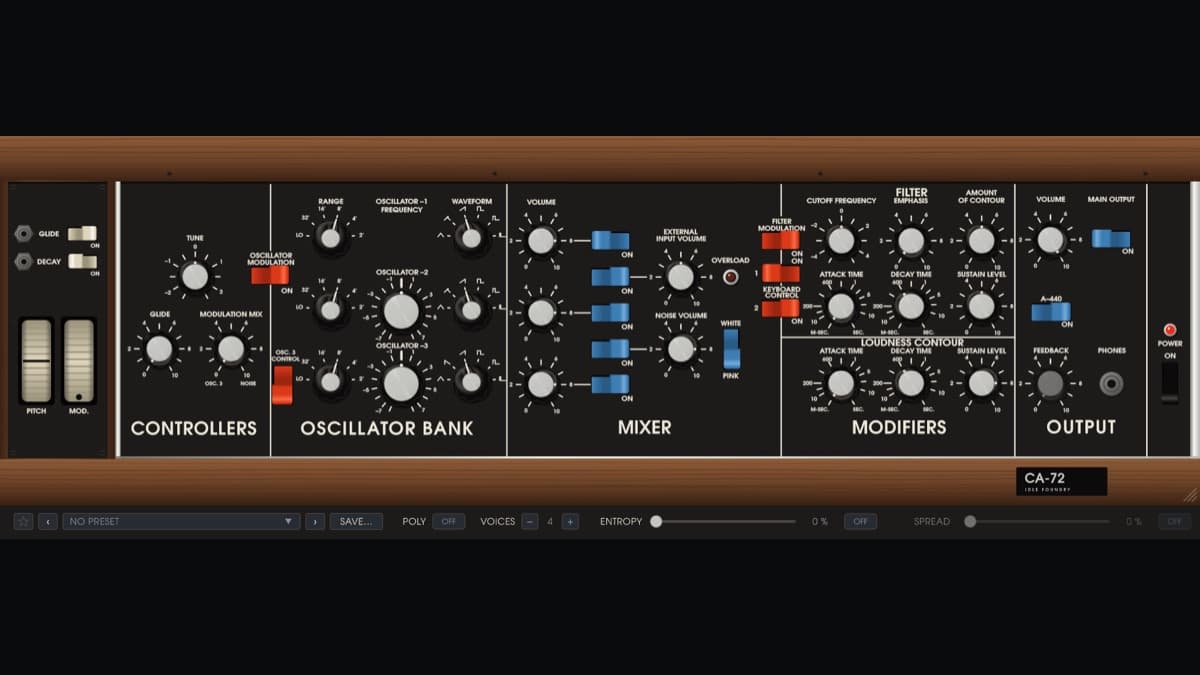
Idle Foundry has released CA-72, a free, open-source synthesizer that models the Minimoog Model D from the circuit up. Most Mini plugins get voiced by ear. This one did not. The developer transcribed the vintage synth's boards from its service documents into SPICE netlists, simulated them in ngspice, and built the real-time models from those simulations. The result is a VST3 and CLAP plugin for macOS, Windows and Linux that costs nothing and ships under the GPL. This is a first look drawn from the official project page and Idle Foundry's walkthrough, not a hands-on review.
At a glance: CA-72 is a free, open-source Minimoog Model D emulation in VST3 and CLAP for macOS 11 or later, Windows 10 or 11, and Linux. It is monophonic like the original, or up to ten voices with its own POLY mode, and it adds per-voice analog variation, stereo spread and a feedback overdrive the hardware only reached with a patch cable. It is version 0.1.0, the first release, and it comes with 24 factory presets. Get it from Idle Foundry on GitHub.
What CA-72 is
CA-72 is a software recreation of the Minimoog Model D, the 1970 monosynth that set the template for synthesizer bass and lead. Idle Foundry aimed the model at one specific instrument: a Model D of about 1972 to 1973 fitted with the CA3046-based oscillator board, the version collectors call the "old" board. That choice matters. The Minimoog changed across its production run, and the oscillator section is where much of its character lives.
The method is what sets CA-72 apart from the many Minimoog plugins already on the market. Every relevant board was transcribed from the instrument's published service documentation into a SPICE netlist and simulated in ngspice, the open-source circuit simulator. The developer then built faster real-time models from those simulations and checked them against the reference, factory calibration procedures included. The plugin does not copy recordings of a Minimoog. It reproduces the behaviour of the circuit that made those recordings.
What CA-72 does differently
The front panel follows the Minimoog closely: three oscillators, the famous ladder filter with its EMPHASIS control, two contour generators, glide, a mixer with external input, and the pitch and modulation wheels. Programmed a Mini before? You will be at home in seconds. The interesting work happens in the controls Idle Foundry added under the panel, none of which the hardware had.
POLY turns the monosynth into a polyphonic instrument. Left off, CA-72 behaves like the original, with lowest-note priority and a single trigger while keys are held. Turn it on and each note gets a whole instrument of its own, with its own keyboard circuit, contours and glide, up to the number set by VOICES, which runs from 2 to 10. This is not a shared-voice approximation. It is the full model, stamped out per note.
ENTROPY keeps that polyphony from sounding sterile. It adds per-voice variation, as if each instrument came from a different batch of components. The three oscillators' tuning, the filter's cutoff and emphasis, the contour times and the glide all drift a little, and the oscillators and cutoff waver slowly over time. Even at zero, each oscillator keeps a tiny mismatch, because perfectly identical oscillators lock in phase and sound louder rather than better. A host-side Lock parameter is there for anyone who does want the mathematically identical circuit.
SPREAD places POLY's voices across the stereo field, the first in the centre and the rest alternating left and right, which turns a stack of voices into a wide pad with no external widener. FEEDBACK recreates a trick Minimoog players have used for decades. The instrument has no overdrive control, so people cable its headphone output back into the external input to overload the preamp and mixer. CA-72 builds that cable in as a knob. Turn it up, open the external input, and the output overdrives itself until the overload light comes on. There is also a real external input, fed by the host's sidechain, so you can run other audio through the Minimoog's filter and overdrive.
Presets live in a searchable browser with tags and favourites, and you can save, rename and organise your own. The 24 factory presets cover basses, leads, pads and percussion. A few show off the engine rather than the archive. One is a small drum kit built entirely on the panel, with kick, snare, two hats, a crash and a noise riser. Another, Warped Pad, runs eight POLY voices drifting under ENTROPY.
CA-72 specifications
| Spec | Detail |
|---|---|
| Type | Virtual analog monosynth, Minimoog Model D model |
| Developer | Idle Foundry |
| Version | 0.1.0, first release |
| Licence | Free, open source, GPL version 3 or later |
| Modelling | Circuit transcribed to SPICE, simulated in ngspice, real-time models verified against it |
| Reference hardware | Minimoog Model D, about 1972 to 1973, CA3046 oscillator board |
| Polyphony | Monophonic, or POLY mode with 2 to 10 voices |
| Analog variation | ENTROPY per-voice detune and drift, plus SPREAD and FEEDBACK |
| Presets | 24 factory presets, searchable browser with tags and favourites |
| Formats | VST3, CLAP |
| macOS | 11 or later, Apple Silicon or Intel, signed and notarised installer |
| Windows | 10 or 11, 64-bit, installer not yet signed |
| Linux | x86-64, Ubuntu 22.04, Debian 12, Fedora 36 or later |
| Price | Free |
CA-72 vs Arturia Mini V
The obvious commercial point of comparison is Arturia Mini V, the long-running Minimoog emulation in Arturia's V Collection. Mini V is polished, deeply documented and loaded with extras the hardware never had, including a modulation matrix, effects and a standalone build. It also costs money and keeps its engine closed. CA-72 is narrower and newer. Its circuit-first approach and free, open licence give it a different kind of appeal.
| Idle Foundry CA-72 | Arturia Mini V | |
|---|---|---|
| Price | Free | $149 |
| Licence | Open source, GPL 3+ | Commercial, closed |
| Modelling approach | Circuit simulated in SPICE and ngspice | Component modelling, closed engine |
| Polyphony | Mono, or 2 to 10 voices | Mono, with added poly modes |
| Extras | ENTROPY, SPREAD, FEEDBACK, external input | Mod matrix, effects, arpeggiator |
| Formats | VST3, CLAP | VST, VST3, AU, AAX, standalone |
| Platforms | macOS, Windows, Linux | macOS, Windows |
Pick Mini V if you want a finished product with support, presets by the hundred and a standalone app, and you are happy to pay for it. Pick CA-72 if you care about the authenticity of the underlying circuit, you run Linux, or you just want a serious free Minimoog with room to grow. For official brand lineage, there is the Moog Minimoog Model D app. If free and open source matters above all else, the broader Surge XT covers very different synthesis territory for the same price of nothing.
Who CA-72 is for
It suits anyone chasing authentic Minimoog bass and lead who would rather not spend a cent. It suits Linux producers, who are routinely left out of commercial plugin lineups. It suits sound designers who enjoy the drift and instability that ENTROPY and the feedback path bring. POLY mode quietly makes it more flexible than the hardware, so it also works if you have ever wanted Minimoog character on pads and chords. And because it is open source, it is a sensible choice for anyone who wants a synth that keeps working no matter what happens to a company's roadmap.
Hold off, for now, if you need a one-click standalone instrument, a large preset library, or official support. CA-72 is a first release with 24 presets and no help desk behind it. Heavy POLY use is demanding, too. A single voice can take a few per cent of a modern processor core, so a ten-voice patch is real work for your CPU, and very old machines fall back to playing every voice on the host's audio thread.
How much CA-72 costs
CA-72 is free. It is released under the GNU General Public License, version 3 or later, and the full source lives on the project's GitHub page, where you can also download ready-made installers for macOS, Windows and Linux. The macOS installer is signed and notarised. The Windows installer is not yet signed, so the first time you run it Windows will warn you; choose More info and then Run anyway. There is no paid tier and no account to create, because there is nothing to unlock. For more free instruments worth installing, see our best free synth VSTs of 2026 and the wider best free VST plugins of 2026. Full specs also live on the CA-72 plugin page.
FAQ
Is CA-72 really free?
Yes. CA-72 is free and open source under the GPL version 3 or later. You can download installers for macOS, Windows and Linux, or build it yourself from the source, and there is no paid version.
How is CA-72 different from other Minimoog plugins?
Most Minimoog emulations are voiced by ear or modelled as a closed product. CA-72 was derived from the Model D's actual circuit, transcribed from service documents into SPICE netlists, simulated in ngspice, and checked against that reference. It also adds true polyphony, per-voice analog variation and a built-in feedback overdrive.
What formats and systems does CA-72 support?
CA-72 runs as a VST3 and CLAP plugin. It supports macOS 11 or later on Apple Silicon or Intel, Windows 10 or 11 in 64-bit, and 64-bit Linux on recent Ubuntu, Debian and Fedora. There is no AU or AAX build in this first release.
Can CA-72 play chords?
Yes. The original Minimoog is monophonic, and CA-72 matches that by default. Turning on POLY mode gives you 2 to 10 full voices, each with its own circuit, so you can play pads and chords with Minimoog character.