Arturia KeyStep 37 mk2 Review: Sequencer Grows Up
The Arturia KeyStep 37 mk2 adds an OLED screen, four encoders, LED key guides, and generative tools. Full specs, how it compares to the mk1, and price.

See full specs, price, and alternatives in the plugin database →
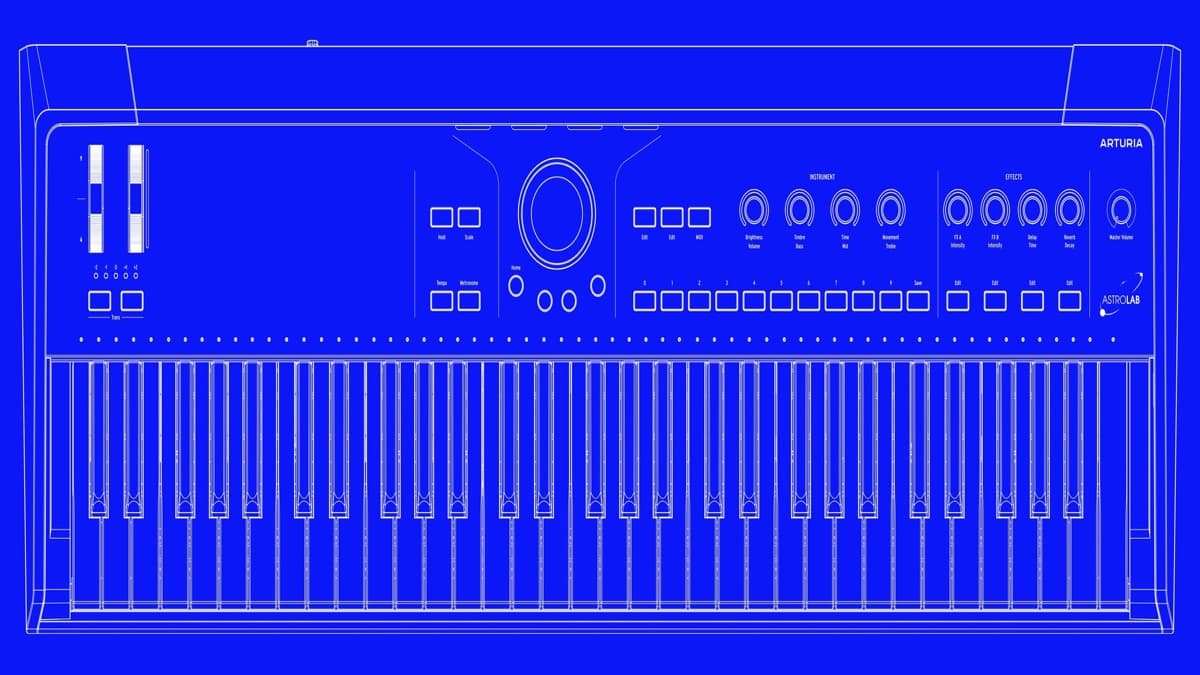
Arturia released the KeyStep 37 mk2 on February 26, 2026. It is the biggest rethink of the KeyStep line since the original arrived. That first KeyStep packed a lot of power behind a single knob and a long list of button combinations, and much of it stayed hidden unless you memorized the manual. The mk2 brings that power out where you can see it, with an OLED screen, four context-aware encoders, and a strip of LEDs above the keys. It is still a compact controller that fits in a bag. Now it also works like a proper sequencing brain for a studio.
At a glance: $229 at Arturia, with street prices near $199. You get a 37-key slimkey controller and standalone sequencer with velocity and aftertouch, a polyphonic 64-step sequencer, a 16-mode arpeggiator, chord and scale modes, four CV/Gate outputs, full MIDI DIN, USB-C, and the generative Mutate, Spice, and Dice tools. It ships with Analog Lab Intro and a DAW starter license.
What is the Arturia KeyStep 37 mk2?
The KeyStep 37 mk2 is a keyboard controller and a standalone step sequencer in one slim box. It sits in the middle of Arturia's controller range, above the pocket-sized KeyStep 32 mk2 and below the larger KeyLab boards. Connectivity has always been the point of a KeyStep. It speaks USB to your DAW, five-pin MIDI to hardware synths and drum machines, and CV/Gate to modular systems, so it can sit at the center of a hybrid rig and clock everything at once.
The interface is what changed with the mk2. The original asked you to memorize shift functions and trust a single encoder. The mk2 gives you a screen and four encoders that relabel themselves depending on whether you are in Sequencer, Arpeggiator, Chord, or Mutate mode. That turns the whole board from something you memorize into something you read at a glance.
What is new in the KeyStep 37 mk2
An OLED screen and four encoders
The headline addition is a high-contrast OLED display paired with four mode-aware encoders and a clickable menu control. Deep parameters that used to live under button combinations now appear on the screen. Switch modes and the four encoders remap to the most useful controls for that mode, so editing a sequence, dialing an arpeggio, or building a chord all happen without a manual in your lap.
LED key guides
A strip of RGB LEDs runs above the keybed. The lights show which notes are playing back in a sequence, which scale you are locked to, and which bank or pattern is active. On a controller this size, that visual feedback matters. You can see the shape of a pattern instead of guessing at it, which makes editing on the fly far less error prone.
Polyphonic sequencer and a deeper arpeggiator
The sequencer records up to 64 steps with up to 8 voices of polyphony, and you can store up to 64 sequences on the unit. The arpeggiator offers 16 modes, including the usual up, down, and random patterns plus Walk, Pattern, and Phrase styles for less predictable motion. Chord mode lets one key trigger a full chord. Scale mode locks your playing to a chosen key, so wrong notes stay out of the way.
Generative tools: Mutate, Spice, and Dice
Generative composition is where the mk2 puts most of its new energy. Mutate creates melodic variations of a sequence at the turn of a dedicated control, so a static loop can drift into new territory without you rewriting it. Spice and Dice add controlled randomization from live sliders, letting you nudge timing and note choices by feel. Together they keep a loop moving long after a plain sequencer would start repeating itself.
Expanded hands-on MIDI control
A MIDI CC button opens access to 16 assignable controls spread across four banks, so the four encoders can send 16 parameters to a plugin or hardware synth. Two capacitive touch strips handle pitch bend and modulation, and a Gate Length slider shapes note length in real time. For a board this small, that is a lot of assignable control.
KeyStep 37 mk2 specifications
| Spec | Detail |
|---|---|
| Keys | 37 slimkeys, velocity sensitive with aftertouch |
| Sequencer | Polyphonic, up to 64 steps, 8-voice, up to 64 sequences |
| Arpeggiator | 16 modes including Walk, Pattern, Phrase, and Random |
| Performance modes | Chord mode, Scale mode |
| Generative | Mutate, Spice, and Dice |
| Display | High-contrast OLED, four mode-aware encoders, clickable control |
| Assignable control | 16 MIDI CC across 4 banks, two capacitive touch strips, Gate Length slider |
| CV/Gate | Four assignable CV/Gate outputs (pitch, gate, mod) |
| MIDI | Full-size five-pin MIDI In and Out, MIDI Thru support |
| Connectivity | USB-C (class compliant, bus powered), 3.5mm Sync In/Out, TRS sustain/expression input |
| Included software | Analog Lab Intro, DAW starter license |
| Dimensions and weight | 550 x 147 x 35 mm, roughly 1.09 kg |
| Price | $229 (street prices near $199) |
KeyStep 37 mk2 vs KeyStep 37 mk1 and MiniLab 37
The clearest comparison is the mk2 against the controller it replaces, with the Arturia MiniLab 37 as a reference point for buyers weighing a pure USB controller instead.
| KeyStep 37 mk2 | KeyStep 37 (mk1) | Arturia MiniLab 37 | |
|---|---|---|---|
| Keys | 37 slimkey, aftertouch | 37 slimkey, aftertouch | 37 slim, aftertouch |
| Screen | OLED | None | Small OLED |
| Encoders | Four mode-aware | One | Eight |
| LED key guide | Yes | No | No |
| Standalone sequencer | Yes, up to 64 steps poly | Yes, 64 steps poly | No |
| Generative tools | Mutate, Spice, Dice | Limited | No |
| CV/Gate | Four outputs | Yes | No |
| MIDI DIN | In and Out | In and Out | No |
| Price | $229 | Was around $199 | Around $199 |
The MiniLab 37 is the better desk companion if you live inside a DAW and want pads and eight encoders for mixing and mapping. The KeyStep 37 mk2 is the better hub if your rig includes hardware or modular gear, because the CV outputs, MIDI DIN, and standalone sequencer let it run a whole setup with no computer in the chain. Against the mk1, the mk2 wins on everything but price, and the screen alone justifies the step up for most players.
Who the KeyStep 37 mk2 is for
This is a controller for the hybrid producer. If your studio mixes software instruments with a hardware synth, a groovebox, or a modular case, the KeyStep 37 mk2 ties them together and sequences them from one place. It also suits anyone who composes from patterns rather than by recording long takes, because the generative tools keep sequences alive while you work.
It is a weaker fit if you mainly play piano parts. The slimkey bed is fast and expressive for synth lines, but it does not replace a full-size weighted keyboard. Pianists should look at a hammer-action controller instead.
How much does the KeyStep 37 mk2 cost?
Arturia lists the KeyStep 37 mk2 at $229, and retailers commonly sell it closer to $199. The price includes Analog Lab Intro, a curated slice of Arturia's flagship Analog Lab sound library, plus a DAW starter license. A new producer can go from box to first track without buying more software. You can check current pricing on Thomann.
FAQ
Is the KeyStep 37 mk2 worth upgrading from the mk1?
For most players, yes. The OLED screen, four encoders, and LED key guides remove the guesswork that defined the original, and Mutate, Spice, and Dice add real creative features rather than cosmetic tweaks. If you rarely used the mk1 beyond basic MIDI, the upgrade matters less.
KeyStep 37 mk2 vs MiniLab 37, which should I buy?
Buy the KeyStep 37 mk2 if your setup includes hardware synths or modular gear, because it offers CV/Gate, MIDI DIN, and a standalone sequencer. Buy the MiniLab 37 if you work entirely in a DAW and want pads and eight encoders for hands-on mixing and mapping.
Can the KeyStep 37 mk2 sequence hardware without a computer?
Yes. The onboard sequencer and arpeggiator run standalone, and the four CV/Gate outputs, five-pin MIDI, and 3.5mm sync let it clock and drive external synths, drum machines, and modular systems with no computer connected.
What are the KeyStep 37 mk2 system requirements?
The KeyStep 37 mk2 is class compliant over USB-C, so it works with macOS, Windows, and iOS without drivers. The bundled Analog Lab Intro follows Arturia's standard current-OS requirements, which you should confirm on the official product page before installing.
Verdict
The KeyStep 37 mk2 is the rare sequel that fixes the real weakness of the original. The screen and encoders make its depth usable, the generative tools give it a creative edge, and the connectivity keeps it at the center of a hybrid studio. It costs a little more than the mk1, and the slimkeys still favor sequencing over piano playing. Even so, for the producer who wants one small box to drive everything, this is the compact controller to beat. Explore more options in our guide to the best MIDI keyboards of 2026 and our take on controllers as instruments.