Some links on this page are affiliate links. If you buy through them, Dubspot may earn a commission at no extra cost to you. It never affects our scores or what we recommend — read our policy.
Akai MPK Mini Plus II: 37 Keys, MPC Pads and CV for $139
Akai MPK Mini Plus II adds a color screen, aftertouch pads, MPC 3 control and generative arp tools to a 37-key controller with CV out. $139 at Thomann. Specs, rivals.
E
Elena Marsh
October 27, 2026 · 9 min read
Black Friday 2026AKAI Professional Black Friday 2026: dates and deals →
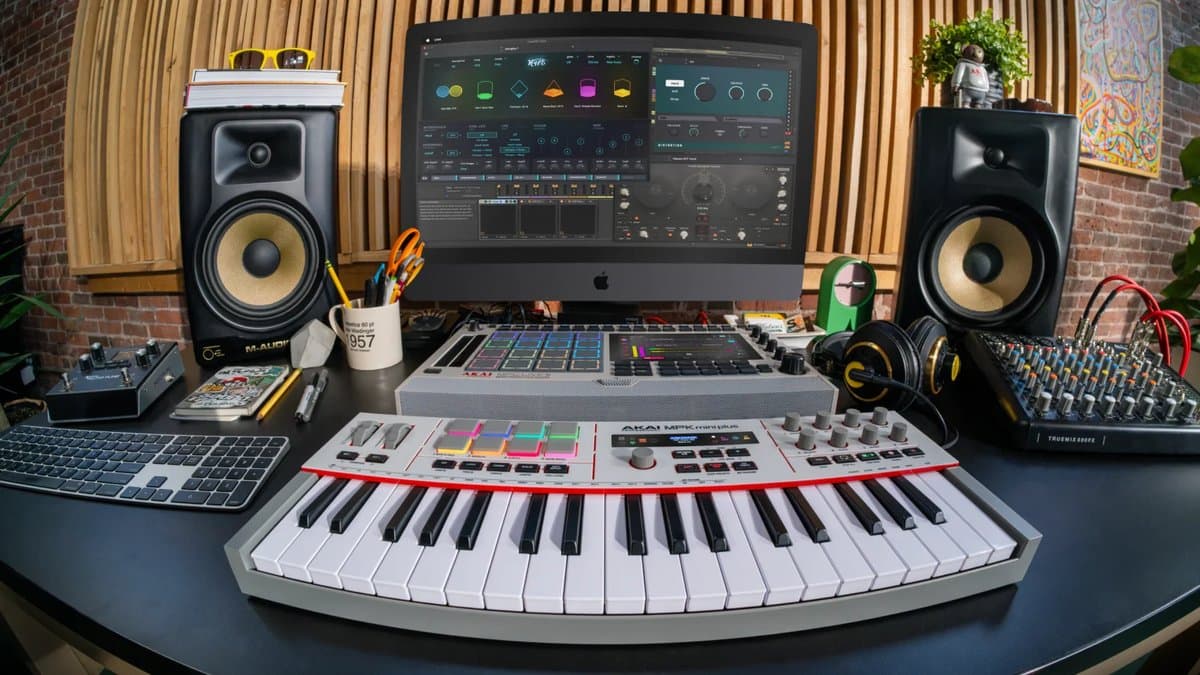
Akai Professional has launched the MPK Mini Plus II, the second generation of its 37-key MPK Mini. It keeps the compact mini-key format and the CV outputs that made the first Plus popular with modular and synth owners, and adds a full-color screen, pressure-sensitive pads, MPC 3 integration and a set of generative performance tools. It is in stock at Thomann's US store for $139.
At a glance: 37 velocity-sensitive mini keys; pitch and mod wheels; eight velocity- and pressure-sensitive RGB MPC pads; eight 360-degree assignable knobs; a 160x80 color LCD; arpeggiator, Chord, Scale and Note Repeat modes with Glitch, Mutate, Strum and Freeze; USB-C, 5-pin MIDI out, three CV/Gate outputs and a sustain input. Deep control of MPC 3, Ableton Live, Logic Pro, Cubase and FL Studio, plus NKS. $139 at Thomann.
What is the MPK Mini Plus II?
The MPK Mini is one of the most widely used small controller families, and the Plus is its bigger sibling: 37 keys instead of 25, so you can play a bass line with one hand and chords with the other. The first MPK mini Plus, from 2022, was also unusually well connected for its price, with CV and gate outputs, clock in and out and a 64-step sequencer, which made it a cheap way to play a Eurorack system or a semi-modular synth.
The Plus II is a different take on the same size. Akai has moved its focus from hardware sequencing towards DAW and MPC control, with a color screen that shows parameter names and values, pads that respond to pressure, and creative arpeggiator and chord tools that generate variations for you. It sits above the new 25-key MPK Mini IV in Akai's range and goes up against Arturia's MiniLab 37 and Novation's Launchkey Mini 37 MK4.
What's new on the MPK Mini Plus II?
Color display and feedback. The old OLED is replaced by a 160x80 full-color LCD. Together with the pre-mapped DAW scripts it shows the names and values of the parameters under the knobs, so you spend less time guessing what a knob controls.
Pressure-sensitive MPC pads. The eight RGB pads are now velocity- and pressure-sensitive, so you can bring in filter or volume swells by leaning on a pad. They still do Note Repeat and Full Level, switch across two banks, and can trigger chords, custom progressions or clips.
Pitch and mod wheels. The first Plus had wheels too. On the Plus II, Akai's page lists an upgraded 37-key keybed alongside dedicated pitch and modulation wheels and an octave switch.
Generative performance tools. This is the biggest change. On top of the arpeggiator, Chord and Scale modes and Note Repeat, there are Glitch, Mutate, Strum, Freeze and Follow functions, User Progressions and custom arpeggiator patterns. Strum staggers the notes of a chord the way a guitarist would, while Mutate and Glitch create variations on what you play. Akai pitches them as ways to find melodies, rhythms and progressions you would not have played yourself.
MPC integration. The Plus II works with both MPC standalone hardware and the MPC 3 desktop software. From the controller you get transport, pads, Q-Link controls, track functions, mixer controls, plugin presets and clip launching.
DAW control. Akai lists deep integration with MPC 3, Ableton Live, Logic Pro, Cubase and FL Studio, plus NKS support for Native Instruments' Komplete Kontrol, which maps over 2,000 NKS instruments and effects to the knobs automatically.
What did the MPK Mini Plus II drop?
Compared with the first MPK mini Plus, Akai's specifications for the Plus II no longer list a MIDI input, the clock input and output, the 64-step sequencer or the joystick. The Plus II has one 5-pin MIDI out, three 3.5 mm CV/Gate outputs and a USB-C port that carries power and MIDI in and out. If you used the original as a sequencer for a modular rack, or synced it to a drum machine by clock, check that before you upgrade. If your work is in a DAW or on an MPC, the new screen, pads and tools matter more.
MPK Mini Plus II specifications
| Spec | Detail |
|---|---|
| Keys | 37 velocity-sensitive mini keys, octave switch |
| Wheels | Pitch bend and modulation |
| Pads | 8 velocity- and pressure-sensitive RGB MPC pads, two banks |
| Controls | 8 assignable 360° knobs, 1 push encoder, 2 bi-color and 16 single-color LED buttons |
| Display | 160x80 full-color LCD |
| Creative tools | Arpeggiator, Chord, Scale, Note Repeat, Glitch, Mutate, Strum, Freeze, Follow, User Progressions |
| Connections | USB-C (power, MIDI in/out), 5-pin MIDI out, 3 x 3.5 mm CV/Gate out, 1/4" sustain input |
| Power | USB bus power, wall adapter or power bank (sold separately) |
| Integration | MPC standalone and MPC 3, Ableton Live, Logic Pro, Cubase, FL Studio, NKS |
| Software | MPC Beats, Ableton Live Lite 12, Komplete Select (Akai Edition), Studio Instrument Collection (1,000+ sounds), Melodics 30-day trial, 2 months of Splice |
| Size and weight | 49.3 x 19.2 x 5.4 cm, 1.46 kg |
| Price | $139 at Thomann |
MPK Mini Plus II vs MiniLab 37 vs Launchkey Mini 37 MK4
| Akai MPK Mini Plus II | Akai MPK mini Plus (2022) | Arturia MiniLab 37 | Novation Launchkey Mini 37 MK4 | |
|---|---|---|---|---|
| Price at Thomann (27 Oct) | $139 | $125 | $122 | $136 |
| Keys | 37 mini | 37 mini | 37 slim | 37 mini |
| Pads | 8 RGB, velocity and pressure | 8, velocity | 16 RGB (two banks of 8), velocity and pressure | 16 FSR, polyphonic aftertouch |
| Knobs and faders | 8 knobs | 8 knobs | 8 encoders, 4 faders | 8 knobs |
| Pitch and mod | Wheels | Wheels and joystick | Touch strips | Touch strips |
| Display | Color LCD | OLED | OLED | OLED |
| MIDI out | 5-pin DIN | 5-pin DIN in and out | Yes | 3.5 mm TRS |
| CV/Gate | 3 outputs | Pitch, mod, gate, clock in/out | No | No |
| Sequencer | Arp, chord and generative tools | 64-step sequencer, arp | Arp, chord mode | Arp, fixed chord |
Which to pick? The MPK Mini Plus II is the only one here with CV outputs and MPC integration, so it is the obvious choice if you own an MPC or want to play an analog synth directly. The Arturia MiniLab 37 is $17 cheaper and the only one with faders, which matters for mixing and synth envelopes. The Launchkey Mini 37 MK4 has the most expressive pads of the group, with 16 FSR pads and polyphonic aftertouch, though its MIDI output is a 3.5 mm jack rather than 5-pin DIN. The first MPK mini Plus is now $14 cheaper than its successor and still the better hardware sequencer, thanks to its step sequencer and clock jacks. For bigger keyboards and full-size keys, see our best MIDI keyboards guide.
Who is the MPK Mini Plus II for?
It is for beatmakers who work in MPC or a DAW and want 37 keys in a bag-sized controller, and for producers who want to drive a hardware synth or a small modular setup from the same keyboard as their computer. The generative tools also make it a good songwriting controller for anyone who gets stuck on chord progressions and melodies.
Who should skip it: players who need full-size keys, since mini keys are hard to play two-handed for long. Anyone who relied on the original Plus's step sequencer, MIDI input or clock jacks should keep it or buy the original while it is still available. And if you mostly mix, a controller with faders, such as the MiniLab 37, is the better fit.
How much does the MPK Mini Plus II cost?
The MPK Mini Plus II is $139 at Thomann, in stock. The included software covers MPC Beats, Ableton Live Lite 12, Native Instruments Komplete Select (Akai Edition) and the Studio Instrument Collection with over 1,000 sounds from AIR Music Technology, Moog and Akai. For comparison, the first MPK mini Plus is $125, the Arturia MiniLab 37 is $122 and the Launchkey Mini 37 MK4 is $136 at Thomann. If you also want the MPC software side, our Akai MPC buyer's guide covers the range.
FAQ
What is new on the MPK Mini Plus II?
A full-color display, pressure-sensitive RGB pads, MPC standalone and MPC 3 integration, and generative tools (Glitch, Mutate, Strum, Freeze and Follow) on top of the arpeggiator and chord modes.
Does the MPK Mini Plus II have CV outputs?
Yes. It has three 3.5 mm CV/Gate outputs, plus a 5-pin MIDI output, so it can play analog and modular synths without a computer.
MPK Mini Plus II vs MPK mini Plus: should I upgrade?
Upgrade for the color screen, pressure pads, MPC integration and generative tools. Keep the original if you use its 64-step sequencer, MIDI input or clock in and out, which the Plus II does not list.
Does the MPK Mini Plus II work with Ableton Live and FL Studio?
Yes. Akai lists pre-mapped integration with Ableton Live, Logic Pro, Cubase, FL Studio and MPC 3, plus NKS for Komplete Kontrol.
How much does the MPK Mini Plus II cost?
$139 at Thomann's US store on 27 October 2026.