Sightlines: A Playable Harmonic Filter for Any Sound
Aqeel Aadam Sightlines is a playable harmonic filter and resonator for desktop and iOS. $20 sale against $30 list; iOS AUv3 is $7.99. One-week free trial.
Aqeel Aadam is selling Sightlines as a playable harmonic filter. The desktop street price is $20 against a $30 list. The iOS AUv3 is $7.99. Formats are VST3, AU on macOS, AAX, and AUv3 on iOS.
At a glance: $20 sale / $30 list on desktop. $7.99 on iOS. A tuned resonant bandpass bank you play with MIDI or park as a fixed resonator. Noise and sample sources, or a harmonic synth that skips the filters. Overtone stretch and bend. Scale quantize. A modulation matrix with LFOs, sequencers, random, and performance sources. Chorus, BBD delay, and reverb. One-week free trial that does everything except save presets. Buy it from aqeelaadamsound.com.
This is a first look at the shipping plugin and the official product page. We have not run Sightlines in a session yet.
What Sightlines is
Sightlines is a bank of tuned resonant bandpass filters. Each band sits on a harmonic of the root, the way overtones sit on a string. You bring those frequencies forward in any sound, or you play the bank as an instrument. The official jobs are adding tonality to percussion, turning found sound into instruments, building synths with a shifting harmonic balance, and making noise follow the key of a track.
It loads as an instrument or as an audio effect. As an instrument it filters noise or samples, or it skips the filters and plays as a harmonic synth. As an effect it adds motion, stereo spread, and a distinct tonality to whatever you run through it. That is two plugins in one installer.
It sits next to creative filters we already cover, with a more specific tuning model. Volcano 3 is a four-filter modulation playground. Filterscape is u-he's morphing filter and EQ. FilterFreak is analog-style filtering with a groove. Sightlines is a harmonic series you can play. The bands are notes, not only a cutoff.
Aqeel Aadam's other titles live on the same shop. Waymaker is the sibling. Sightlines can take pitch from Waymaker without a MIDI cable in the DAW. Coastline and Outgrowth are separate instruments on the same site. Sightlines is the harmonic filter.
A bank tuned like a string
The filters follow the overtone series. Band one is the root. The rest are natural harmonics. You set the volume of each band independently. You can randomize those levels. You can modulate them. Then you stretch and morph the series into versions that do not occur on a physical string.
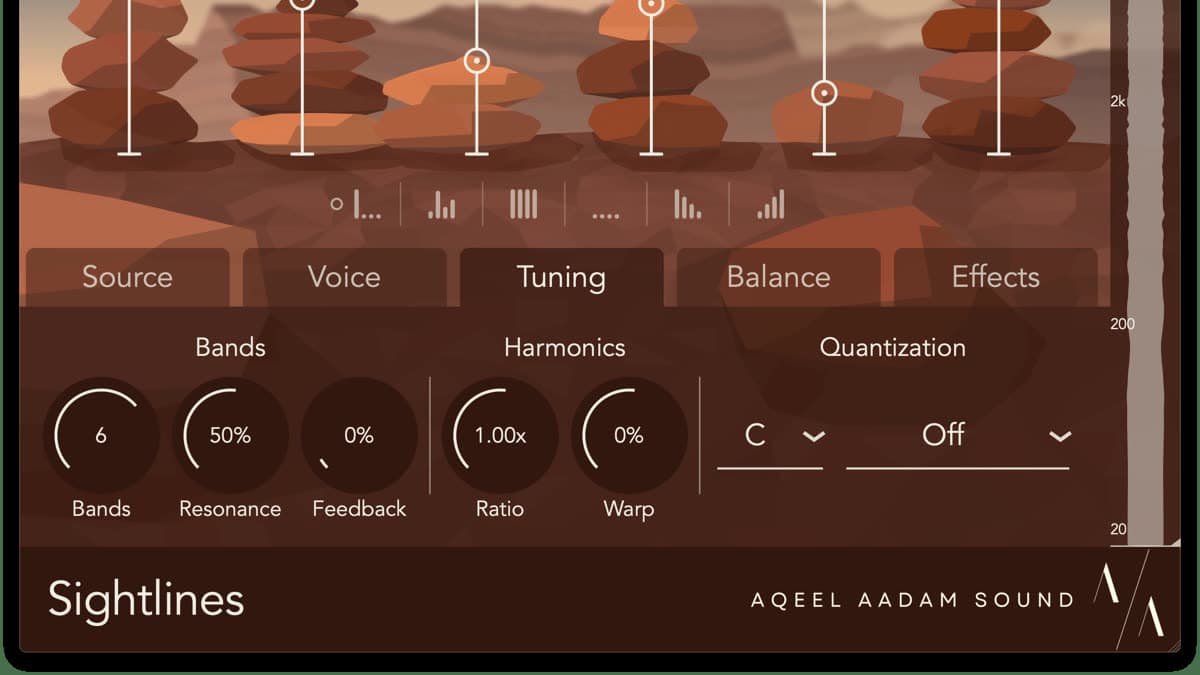
That stretch is the Sound Design half. A perfect harmonic series is a resonator. A stretched series is a metallic, inharmonic, or choir-like stack. Warp and Ratio on the official GUI are the bend and stretch. Feedback and Resonance push the bank from a gentle tone into a ringing filter.
Quantize snaps the tuning to a scale. The official GUI shows a scale selector and an on/off. Use it when the resonator should stay in key. Turn it off when you want the raw harmonic series, stretched or not.
You can park the bank on a fixed frequency and treat it as a resonator. Or you send MIDI and the whole series follows the notes you play. That is the difference between a filter insert and a playable instrument. The same bands do both jobs.
The cairn-style faders on the GUI are the band levels. The bank runs up to eight resonant bandpass filters. Balance is its own page: scan, tilt, and spread the bank instead of drawing each cairn by hand.
Instrument, effect, and sources
As an effect, Sightlines sits on a drum bus, a texture, a field recording, or a synth you already like. The bank pulls a key out of noise. Used lightly, percussion starts to hum the track's root. Used hard, the source becomes a modal instrument.
As an instrument, the Voice page picks a source. Official options are a noise generator, a sample player with repitch, or a harmonic synth that can skip the filter bank. The first two weeks of the desktop sale include a free sample pack of noise, textures, and impulses. Those files are the obvious first loads for the sample player.
Supported sample formats are WAV, AIFF, FLAC, OGG, MP3, and more. You are not locked to a proprietary library.
The harmonic-synth path is the third voice. Skip the bandpass bank and the plugin is already a tuned oscillator. Keep the bank and the oscillator is only the energy that the resonators ring.
Hold on the header is the sustain / freeze gesture. Presets sit in the middle. Modulation is the right-hand page. The official claim is full preset control over every parameter, which matters once the matrix is writing into band levels and stretch.
Modulation, effects, and Waymaker
The modulation matrix is a full page: multiple LFOs, sequencers, smooth random sources, and performance effects. Any control can take a source. That is how a static resonator starts to scan, tilt, and breathe. Performance sources are how you play the bank instead of automating it in the DAW.
Chorus, a BBD delay, and reverb sit on the Effects page. Those three are the finish. Sightlines is still a filter. The effects keep a ringing bank from leaving the plugin dry.
Waymaker is the sibling sequencer. Official copy: connect Waymaker and sequence Sightlines' pitch without setting up MIDI routing in the DAW. If you already own Waymaker, that is the intended pair. If you do not, MIDI from the host still plays the bank.
A video manual and demo are linked on the official product page.
Sightlines specifications
| Spec | Detail |
|---|---|
| Type | Playable harmonic filter / resonator, instrument or audio FX |
| Engine | Up to 8 tuned resonant bandpass filters (overtone series) |
| Play modes | MIDI-playable or fixed resonator |
| Sources | Noise, sample player with repitch, or harmonic synth |
| Tuning | Overtone stretch / bend, scale quantize |
| Modulation | LFOs, sequencers, random, performance, full matrix |
| Effects | Chorus, BBD delay, reverb |
| Sibling | Waymaker pitch sequencing without DAW MIDI |
| Formats | VST3, AU (macOS), AAX, AUv3 (iOS) |
| System | macOS 10.13+ (Intel and Apple Silicon), Windows 10+ 64-bit |
| Trial | 1 week, all features except preset save |
| Auth | Internet for first license or trial, offline after |
| Price | $20 sale / $30 list desktop; iOS AUv3 $7.99 |
Sightlines vs Volcano 3 and Filterscape
| Sightlines | Volcano 3 | Filterscape | |
|---|---|---|---|
| Job | Playable harmonic resonator | Four analog-style filters | Morphing filter / EQ |
| Tuning | Overtone series, stretch, scale quantize | Cutoff / spread / pan | EQ + filter morph |
| MIDI instrument | Yes, plus FX | Filter FX | Filter FX |
| Sources | Noise, samples, harmonic synth | Host audio | Host audio |
| Price | $20 / $30; iOS $7.99 | $149 | €129 |
| Formats | VST3, AU, AAX, AUv3 | VST, VST3, AU, AAX, CLAP | VST3, AU, CLAP, AAX |
Pick Sightlines when the filter should be a harmonic series you can play, or when a texture needs to lock to a key. Pick Volcano 3 when you want four analog filters and FabFilter's modulation graph. Pick Filterscape when the job is morphing EQ and filter snapshots. FilterFreak stays the analog groove filter if you wanted envelope motion, not overtones.
$20 is a different conversation from $149. You are buying a specialist resonator, not a flagship filter suite.
Who Sightlines is for
Sightlines suits producers who want noise, percussion, and found sound to carry a pitch. It also suits anyone who wants a small modal instrument with a sample player and a matrix, or an iOS AUv3 that matches the desktop idea. Waymaker owners get a pitch path that skips host MIDI.
Skip it if you only needed a cutoff and resonance. Skip it if you wanted a deep analog filter model. Skip it if you needed to save presets during the trial: the week is full-featured except preset save.
The trial needs internet once. After that, Sightlines runs offline. Same rule for the paid license: one validation, then local.
How much does Sightlines cost?
Desktop is $20 on sale against a $30 list on aqeelaadamsound.com. iOS AUv3 is $7.99. A one-week free trial is on a separate trial listing. The trial includes every control except saving presets.
Formats are VST3, AU on macOS, AAX, and AUv3 on iOS. macOS 10.13 or later, 64-bit, Intel and Apple Silicon. Windows 10 or later, 64-bit.
The first two weeks include a free sample pack of noise, textures, and impulses. Sold direct from Aqeel Aadam Sound.
FAQ
What is Aqeel Aadam Sightlines?
A playable harmonic filter built from a bank of tuned resonant bandpass filters. Use it as a MIDI instrument or as an audio effect. Noise, samples, or a harmonic synth can feed the bank.
How much does Sightlines cost?
$20 sale against a $30 list on desktop. $7.99 for the iOS AUv3. A one-week trial is available.
Can I try Sightlines before buying?
Yes. The official trial listing is one week, with every feature except preset save.
Does Sightlines run on iOS?
Yes. AUv3 on iPhone and iPad, sold separately from the desktop license.
What are the system requirements?
macOS 10.13+ (Intel and Apple Silicon), Windows 10+ 64-bit. VST3, AU (Mac), AAX, AUv3 (iOS).
Verdict
Sightlines is a harmonic filter you can play. A tuned bandpass bank, stretch and quantize, noise or samples, a small FX rack, and a matrix. $20 against $30 on desktop, $7.99 on iOS, one-week trial. It will not replace Volcano 3 as a general filter studio. If the job is making any sound resonate in key, this is the Aqeel Aadam tool for that sentence.