Tupos MPE Subtractive First Look 2026
Tupos MPE Subtractive is a 19.99 euro MPE synth for Mac and Windows, with two oscillators, a resonant filter, an arp, a sequencer, and eight effect slots.
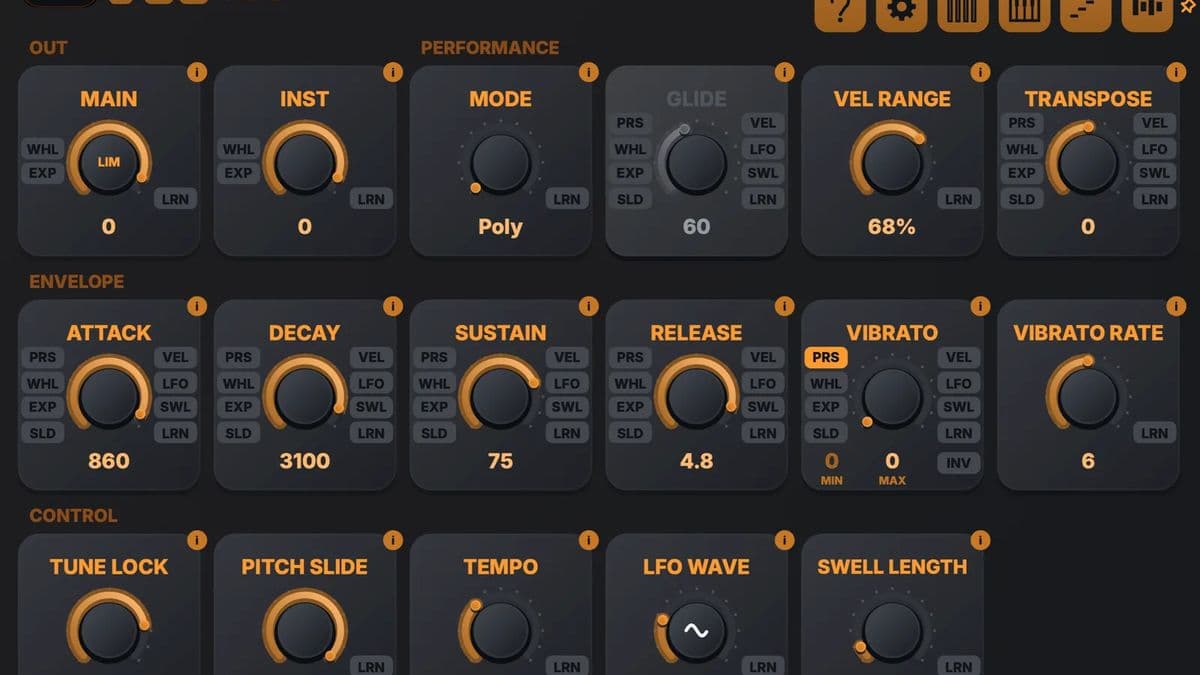
Tupos Audio has released MPE Subtractive, the second instrument in its MPE line, after Tupos MPE FM. It is a polyphonic subtractive synth with two oscillators, a resonant multimode filter, and per-note pitch, pressure, and slide. The desktop licence is 19.99 euros. This is a first look from the official product page, not a hands-on review.
At a glance: MPE Subtractive runs on Mac and Windows as a plug-in and as a standalone app. Mac builds are notarized. The Windows installer is not code-signed yet. An App Store edition for iPad and Mac is marked coming soon and is sold separately. You get an arpeggiator, a step sequencer, and eight effect slots, with modulation assigned on the knobs themselves.
What is Tupos MPE Subtractive?
Subtractive synthesis is the familiar path. Start with a bright oscillator, then carve it with a filter. Plenty of soft synths already do that. Tupos is aiming at players who want that tone to move under the fingers, note by note, without a modulation matrix as the front door.
The developer is the same small studio in Northern Finland behind MPE FM. That instrument put 2, 4, and 6 operator engines on one panel. Subtractive keeps the same idea and changes the engine. Oscillators and a filter replace operators. The expression model stays. Pressure, slide, and pitch bend can sit on the control they move, shown as a badge so the routing is visible where you play.
It is built for an MPE controller or a keyboard with polyphonic aftertouch. It is not limited to one. A Standard MIDI profile in Settings routes velocity, the mod wheel, channel aftertouch, and an expression pedal to the same destinations. The whole voice moves together instead of each note on its own.
What you can shape
Two oscillators, plus sub and noise. The main tone is a pair of oscillators with sub and noise layers. Unison thickens the voice. Pulse-width modulation, hard sync, and cross-modulation sit on the panel, next to drift, stereo width, and pan spread. You sync, widen, and cross-modulate those oscillators, then send them into the filter.
A resonant multimode filter. Low-pass, band-pass, high-pass, and notch are available, at 12 or 24 dB. A filter envelope and a pitch envelope sit in the movement view with the sync and pulse-width controls. That is a classic subtractive layout, pointed at bass, keys, and leads rather than FM sidebands.
Expression on the knob. Light a badge and pressure, slide, velocity, the wheels, Swell, or an LFO moves that control. You set the range under the knob. MIDI Learn can tie a hardware control to the same place. A built-in guide walks through badges, pages, and shortcuts, which matters on a first day with MPE.
Arpeggiator and step sequencer. Held notes can run through the arp. The sequencer writes patterns with per-step note, octave, velocity, and length. It is the same performance idea as on MPE FM: sketch a figure inside the instrument instead of drawing it in the DAW first.
Eight effect slots. The chain can be reordered, and you can start from effect presets. Pin the effects if you want the chain to stay put while you browse sounds. The types on the product page are delay, reverb, phaser, flanger, chorus, rotary speaker, tremolo, ring mod, compressor, bitcrusher, frequency shifter, Doppler orbit, and graphic EQ. Synth and effect controls share the same modulation sources.
Presets, and a scene that is standalone only. Factory sounds are included, with a browser for favourites, ratings, and single-bank import and export. The standalone app on Mac, Windows, and iPad can switch to a full-screen scene that moves with your playing. The plug-ins do not include those scenes.
Tupos MPE Subtractive specifications
| Spec | Detail |
|---|---|
| Type | Polyphonic subtractive synthesizer with per-note MPE |
| Developer | Tupos Audio |
| Oscillators | Two, with sub and noise, unison, pulse-width modulation, hard sync, cross-modulation |
| Filter | Resonant low-pass, band-pass, high-pass, or notch, 12 or 24 dB |
| Expression | Per-note pitch bend, pressure, and slide, plus a Standard MIDI profile |
| Sequencing | Arpeggiator and step sequencer (note, octave, velocity, length per step) |
| Effects | Eight slots, reorderable, with effect presets |
| Mac formats | Standalone, AUv2, VST3. Installer and apps notarized |
| Windows formats | Standalone and VST3. Installer version 1.0.1, not code-signed yet |
| iPad and Mac App Store | Standalone and AUv3, one purchase for both, listed as coming soon |
| Licence | Desktop full licence, Mac and Windows, up to three computers |
| Price | 19.99 euros, direct |
Tupos MPE Subtractive vs MPE FM
The closest comparison is the sibling, Tupos MPE FM. Both cost 19.99 euros for the desktop licence on the Tupos site today. Both use on-knob modulation, MPE, an arp, a sequencer, and an eight-slot effect chain. The split is the oscillator model.
| MPE Subtractive | MPE FM | |
|---|---|---|
| Engine | Two oscillators, sub, noise, resonant multimode filter | 2, 4, and 6 operator FM, plus a routing matrix |
| Best at | Analog-style bass, keys, and leads | Bell tones, metallic hits, evolving FM |
| MPE | Per-note pitch, pressure, slide | Per-note pitch, pressure, slide |
| Desktop price | 19.99 euros | 19.99 euros |
| Mobile | App Store edition coming soon, sold separately | Standalone and AUv3 on iPhone, iPad, and Apple Silicon Mac |
| Reach for it when | You want a filter and a familiar subtractive layout | You want FM that still plays under the fingers |
u-he Diva is the other yardstick if you want deep analog circuit models and you already accept the CPU cost. Subtractive is a much smaller instrument. It does not try to mix and match classic filter circuits. It tries to put a filter, two oscillators, and per-note expression in one view.
If you play an Expressive E Osmose or another MPE board, either Tupos synth will take per-note pressure and slide. Pick FM when you want operators. Pick Subtractive when you want a filter sweep that follows one finger in a chord.
Who it is for
Buy it if you want subtractive tone with MPE already wired in, and 19.99 euros is the budget. The badge workflow suits players who dislike buried modulation pages. The arp and sequencer help if you sketch ideas inside the plug-in.
It is a strong second licence if you already own MPE FM and want the same playing surface on a filter-based engine. The two do not overlap much in timbre.
Skip it if you need a signed Windows installer today. Smart App Control blocks the current installer. Download the free Windows installer from the product page and confirm it opens before you pay. Skip it if you need AAX, Linux, or a huge preset library from a long-running developer. Skip the desktop licence if you are waiting for the App Store edition, which is a separate purchase and not on sale yet.
How much does Tupos MPE Subtractive cost?
The desktop full licence is 19.99 euros. It covers Mac and Windows, on up to three computers. Mac software is signed with an Apple Developer ID and notarized, so the install should open without a security warning. Windows is the caveat above.
Formats on the direct edition are standalone, AUv2, and VST3 on Mac, and standalone and VST3 on Windows. VST is a Steinberg trademark, as the page notes.
The App Store edition, standalone and AUv3, covers iPad and Mac with one purchase. It is marked coming soon and is not included in the 19.99 euro desktop licence. Tupos has not posted an App Store price.
You can buy the Mac and Windows versions from the official checkout. It is not listed at Plugin Boutique, Thomann, or Best Service.
FAQ
Does Tupos MPE Subtractive need an MPE controller?
No. MPE hardware, or polyphonic aftertouch, gives each note its own pitch, pressure, and slide. Without that, velocity, the mod wheel, channel aftertouch, and an expression pedal still reach the same controls. The Standard MIDI profile sets this up in one step.
Will it install on Windows?
The Windows installer for version 1.0.1 is not code-signed yet. If Smart App Control is on, Windows blocks it. Tupos tells you to download the free installer and check that it opens before you buy. After install, the app asks for the licence key.
How is it different from Tupos MPE FM?
MPE FM is operator-based, with 2, 4, and 6 operator engines. MPE Subtractive is two oscillators into a resonant multimode filter. Both use the same expression badges, arp, sequencer, and eight effect slots, and both desktop licences are 19.99 euros. MPE FM already runs on iPhone and iPad. The Subtractive App Store edition is still marked coming soon.
What are the effect types?
Delay, reverb, phaser, flanger, chorus, rotary speaker, tremolo, ring mod, compressor, bitcrusher, frequency shifter, Doppler orbit, and graphic EQ. You can reorder the eight slots and pin a chain while you change presets.
Is there an iPad version?
An App Store edition for iPad and Mac is listed as coming soon. It is standalone and AUv3, sold separately from the desktop licence. The desktop standalone app is the version that includes the full-screen playing scenes. Plug-ins do not.