Some links on this page are affiliate links. If you buy through them, Dubspot may earn a commission at no extra cost to you. It never affects our scores or what we recommend — read our policy.
Techivation T-De-Breather: Zero-Latency Breath Control
Techivation T-De-Breather is a zero-latency RNN breath suppressor for vocals and dialogue. $45 intro until 5 September, then $90. Specs and comparisons.
E
Elena Marsh
August 26, 2026 · 9 min read
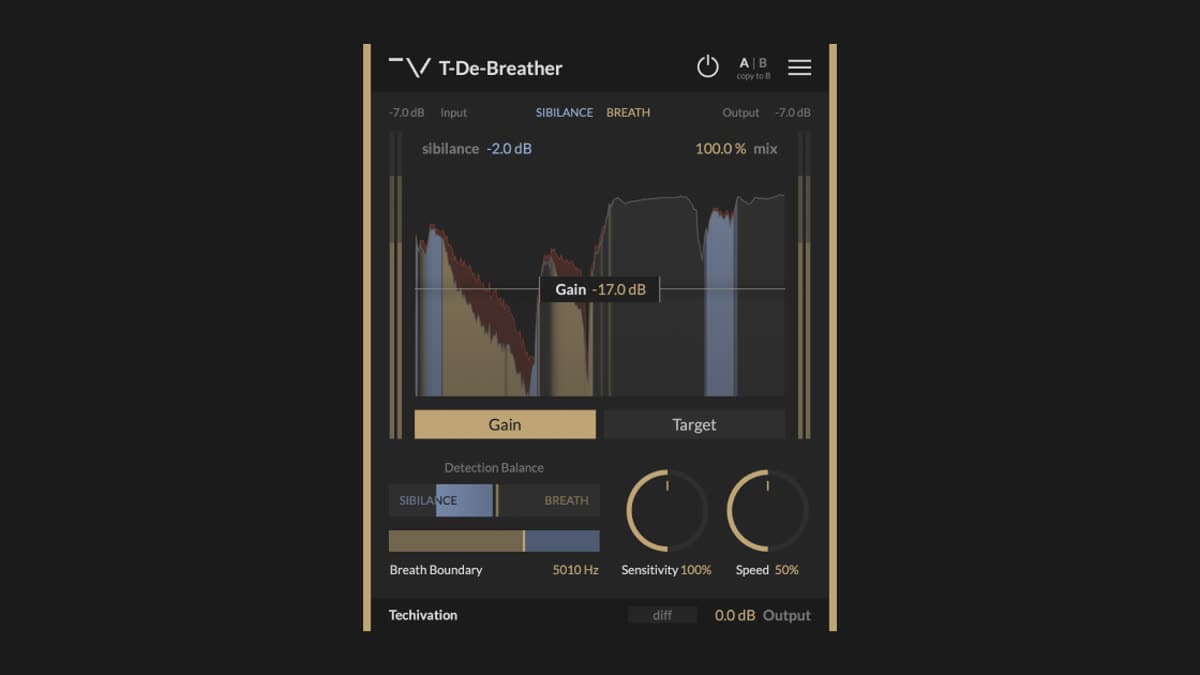
Techivation shipped T-De-Breather on 25 August 2026. It is a dedicated breath suppressor for vocals and dialogue, built to run at zero latency so the same plugin can sit on a live vocal, a tracking chain, or a print. Detection uses a recurrent neural network plus conventional analysis, and it is not a threshold gate. This is a first look at the shipping feature set. We have not used it in a session.
At a glance: $45 until 5 September 2026, then $90. Crossgrade $35 for other premium Techivation owners. Included in Full Access. VST, VST3, AU, AAX. Windows 7+ 64-bit. macOS 10.15+ Intel and Apple Silicon. 14-day trial. Buy it from Techivation.
What T-De-Breather is
Breaths are part of a performance. Strip them all and the vocal turns robotic. Leave them loud and the compressor, de-esser, and limiter pump around every inhale. Most editors still draw gain rides or drop a clip-gain pass on the waveform. T-De-Breather is the plugin version of that job: find the breath, turn it down, leave the rest.
It is not a de-esser that happens to catch air. It is not a resonance suppressor. It is not a restoration suite. Techivation built a detector that classifies breath and sibilance as separate events, then gives you a boundary slider between them. That is the whole product. The current first look is Acoustica 8.
The nearest tools in our library do adjacent work. soothe3 hunts harsh resonances. Nectar 4 is a full vocal chain. RX 11 is a restoration suite with spectral editing. T-De-Breather is one processor with one job, and it claims to do that job without adding latency. An artist-built option is the MixWave Spiritbox vocal chain plugin, with seven rearrangeable modules.
How the detector works
Level-independent breath detection
The engine combines algorithmic analysis with an RNN that forecasts in real time. Breaths are identified from spectral and time-domain shape, not from how loud they are. A quiet inhale after a whisper and a hard gasp after a belt are both breaths. A conventional expander set on level will miss one and grab the other. T-De-Breather's pitch is that it will not.
Zero latency is the other half. If the detector needed a lookahead buffer, you could not put it on a live vocal or a hardware-monitoring session. Techivation says the same suppression is usable while recording, on stage, in broadcast, and in post. We have not timed the round trip. The claim is architectural, not a marketing extra.
Gain mode and Target mode
Two suppression modes cover different recordings.
Gain applies a fixed amount of reduction to every detected breath. The dynamics between breaths stay. A soft inhale stays softer than a hard one. Techivation recommends it for clean recordings and light-to-medium work. Gain is independent of input level, so riding the preamp does not retune the plugin.
Target pulls breaths toward a set output level. Louder breaths get more reduction. Breaths already under the target stay untouched. That is the mode for messy recordings, live dialogue, and heavier cleanup. Because Target is an absolute level, changing input gain means you revisit the knob.
Pick Gain when the breaths are already even and you just want them quieter. Pick Target when a few breaths explode and the rest are fine.
Breath versus sibilance
The hard part of this category is the overlap. An "s" and a breath both live in air and high frequencies. T-De-Breather detects both and lets you move the line.
The waveform display draws the output in grey, breaths in gold, sibilance in blue, and gain reduction in red. A Detection Meter fills gold on the right for breath and blue on the left for sibilance. The Breath Boundary slider sets the frequency split: energy below that frequency votes breath, energy above votes sibilance. Sensitivity decides how eager the classifier is. Missed breaths: raise Sensitivity. False hits on the lyric: lower it, or move the boundary.
The Sibilance control then attenuates the tails of sibilant sounds. Speed only changes breath-suppression onset. High Speed is gate-like. Low Speed lets some air through. Speed does not touch the Sibilance knob. That separation is the useful part of the UI. You can tame esses without making the breaths snap, and the other way around.
Mix, Diff, and the rest of the panel
Mix is parallel processing. Diff solos only what the plugin is removing, which is how you set Boundary and Sensitivity without guessing. Output is clean makeup gain. An internal bypass avoids the click you get from the DAW's on/off. The GUI scales from 80% to 150%. Undo, redo, and optional tooltips are in the box.
Those are small features. They are also the difference between a detector you trust and one you fight.
T-De-Breather specifications
| Spec | Detail |
|---|---|
| Type | Zero-latency breath suppressor for vocals and dialogue |
| Detection | Hybrid analysis + RNN; level-independent; separate breath and sibilance |
| Modes | Gain (fixed reduction) and Target (absolute level) |
| Key controls | Breath Boundary, Sensitivity, Speed, Sibilance, Mix, Diff, Output |
| Latency | Zero |
| Formats | VST, VST3, AU, AAX |
| Windows | Windows 7+ 64-bit VST, VST3, AAX (Pro Tools 11+) |
| macOS | 10.15 Catalina+; Intel and Apple Silicon; VST, VST3, AU, AAX |
| Trial | 14 days |
| Price | $45 intro until 5 September 2026, then $90; crossgrade $35; in Full Access |
T-De-Breather vs soothe3 and Nectar 4
The comparisons are a resonance tool and a vocal suite, because a dedicated zero-latency breath plugin is a thin category. For a whole spoken-word chain with loudness presets in one window, see our 23audio V-23 voice processor first look.
| T-De-Breather | soothe3 | Nectar 4 | |
|---|---|---|---|
| Job | Breath (and sibilance tails) | Dynamic resonance suppression | Full vocal chain |
| Latency | Zero | Low-latency mode at base rates | Suite-dependent |
| Live / tracking | Built for it | Possible in low-latency mode | Heavier chain |
| Breath-specific detector | Yes, RNN + analysis | No. Resonances, not breaths | Vocal modules, not this detector |
| Street / list | $45 intro / $90 | See the soothe3 card | $55 on our Nectar 4 card |
| Formats | VST, VST3, AU, AAX | oeksound set | iZotope set |
| Buy from | Techivation | oeksound | iZotope / usual retailers |
Which to pick. Choose T-De-Breather when the problem is breaths on a vocal or a dialogue track and you need the plugin live. Choose soothe3 when the problem is harshness and resonances, not inhales. Choose Nectar 4 when you want pitch, EQ, compression, and a starter chain in one insert. RX 11 remains the spectral-repair suite for damaged audio; it is a different purchase than a real-time breath insert.
If you already own Full Access, T-De-Breather is in the bundle. You are not shopping.
Who T-De-Breather is for
Consider it if you mix vocals or dialogue and you are tired of clip-gaining every inhale.
Consider it if you track or broadcast and you want the same suppressor on the way in, not only on the print.
Consider it if you already own another premium Techivation plugin. $35 is the crossgrade. Full Access owners get it with the rest of the line.
Skip it if your breaths are already quiet and you only need a de-esser. The Sibilance knob is a helper, not a replacement for T-De-Esser or a dedicated sibilance tool.
Skip it if you want a full vocal rack. Buy Nectar, or build a chain.
Skip it if you only restore damaged location audio in a spectral editor. Stay in RX.
How much T-De-Breather costs
$45 until 5 September 2026. $90 after that. Other premium Techivation owners crossgrade for $35. Full Access includes T-De-Breather; the bundle is a one-time license, currently $499 against a $2,999 list through 31 August 2026.
A 14-day trial is on the product page. Buy it from techivation.com/t-de-breather. The plugin card lives at /plugins/techivation-t-de-breather.
FAQ
Can I use T-De-Breather live?
Yes. Techivation built it at zero latency for live vocals, broadcast, podcasts, and dialogue, as well as studio mixes.
Gain vs Target?
Gain applies a fixed cut and keeps the original breath dynamics. Target pulls louder breaths down to a set level and leaves quieter ones alone.
Does it catch quiet breaths?
The detector is level-independent. Loud and quiet breaths are both in scope. If it misses, raise Sensitivity or move Breath Boundary.
Does it replace a de-esser?
No. It detects sibilance and can shorten sibilant tails. A dedicated de-esser is still the tool for esses. T-De-Breather is the breath insert that happens to see sibilance so it does not confuse the two.
What are the system requirements?
Windows 7 and up, 64-bit VST, VST3, and AAX (Pro Tools 11+). macOS 10.15 and up as VST, VST3, AU, and AAX, Intel and Apple Silicon.
The bottom line
T-De-Breather is a single-purpose, zero-latency breath suppressor with a real detector, not a gate dressed up as AI. $45 through 5 September 2026. $90 after that. $35 if you already own other premium Techivation plugins. Full Access includes it.
This is a first look, not a scored review. We have not ridden it on a sung vocal or a live desk. Download the 14-day trial, put Diff in your headphones, and see whether gold marks are breaths or lyrics. The live storefront is techivation.com/t-de-breather.


