23audio V-23: A Channel Strip Built for the Spoken Voice
23audio V-23 is a one-window voice channel strip for podcasts, audiobooks, and voiceover, with loudness presets for ACX. Intro price GBP 49.99, from GBP 69.99.
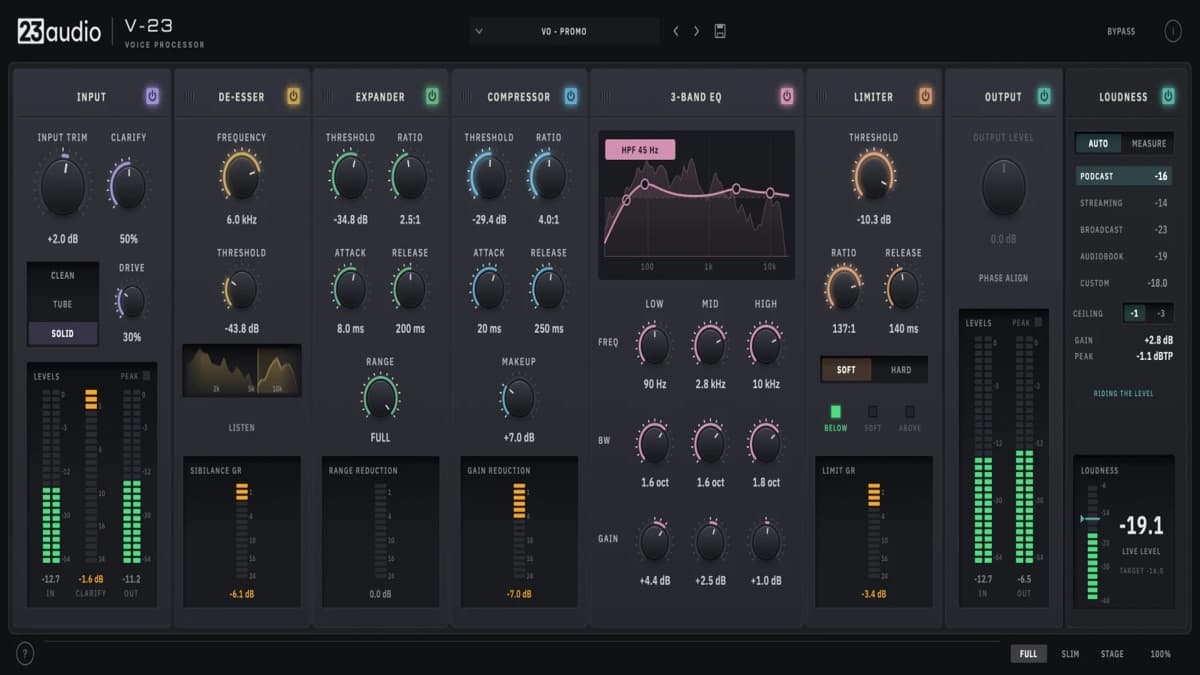
23audio has released V-23 Voice Processor, a channel strip aimed squarely at the spoken voice rather than the sung one. It puts input colour, de-essing, expansion, compression, EQ, and limiting in a single window, then finishes with one-click loudness presets for podcasts, streaming, broadcast, and ACX audiobooks. The launch price is GBP 49.99, rising to GBP 69.99 after the intro period. This is a first look based on the official 23audio product page, not a hands-on review.
At a glance: V-23 is a voice-first channel strip for narration, audiobooks, podcasts, and voiceover. The chain runs input colour, de-esser, expander, compressor, EQ, and limiter, with loudness presets that target podcast, streaming, broadcast, and ACX delivery. Formats are VST3, AU, and AAX on Mac and Windows. The product page carries a loudness-matched A/B player, so you can hear a raw take against the processed version before buying. Launch price is GBP 49.99, up to GBP 69.99 after the intro.
What is 23audio V-23?
Most "vocal" plugins are built for singing. They assume pitch rides, long sustains, doubles, and a chorus that needs to sit over a dense arrangement. Spoken-word work is a different problem. A podcast host, an audiobook narrator, or a voiceover artist needs a clean, consistent, intelligible voice over a quiet bed, delivered to a platform target without clipping. V-23 is built for that second job.
The pitch is simplicity. Instead of opening a de-esser, a compressor, an EQ, and a limiter as separate plugins and guessing at gain staging between them, V-23 lays the whole chain out in one window in a fixed, sensible order. You colour the input, tame sibilance, gate the room out between phrases, even out the level, shape the tone, catch the peaks, and hit a loudness target. That's the standard spoken-voice chain, and V-23 delivers it as a single instrument.
23audio is a new plugin developer. V-23 launched alongside a free ACX compliance checker called Audibook Checker and a free oscilloscope called TELLYSCOPE, with more instruments and effects listed as in development. V-23 is the flagship of that first wave and the one with the clearest everyday use.
What V-23 does, module by module
Input colour opens the chain. This is the character stage, the place to add a little weight or presence before anything dynamic touches the signal. On a thin lavalier or a budget USB mic, this is where a voice starts to sound like it was recorded on purpose.
De-esser comes next, before compression, which is the right order. Compressing a sibilant signal first only makes the "s" louder relative to everything else. Catching sibilance early means the compressor behind it isn't fighting the hiss.
Expander is the module singing-focused strips usually skip, and it matters most for the spoken voice. An expander pulls down the signal between phrases, so the room tone, the chair creak, and the breath are quieter without a hard gate chopping off word tails. For a long audiobook chapter, that's the difference between a clean read and a distracting one.
Compressor evens out the level. Spoken delivery drifts in and out as a narrator leans in or pulls back, and the compressor keeps the voice at a steady, intimate level without pumping.
EQ shapes the tone after the dynamics are settled. Cutting a muddy low-mid buildup and lifting a little presence is the usual move. Doing it after compression means the EQ works on a stable signal, not a moving target.
Limiter catches the last peaks so nothing clips on the way out.
The chain then lands on a loudness stage. This is the part that saves the most time. Spoken-word platforms each want a different target. Podcasts commonly aim near -16 LUFS, streaming and broadcast have their own numbers, and Audible's ACX audiobook spec is the strictest: a running RMS between -23 and -18 dB, true peaks no higher than -3 dB, and a noise floor below -60 dB RMS. Hitting ACX by hand is where a lot of first-time narrators get rejected. V-23 offers one-click presets for these targets, so the delivery stage becomes a choice rather than a math problem.
The product page backs the pitch with a loudness-matched A/B player. You can switch between a raw recording and the same take through V-23, on both a podcast and an audiobook example, with the two levels matched so the processing is what you judge, not a volume jump. That's an honest way to demo a voice tool, and it's worth using before you buy.
V-23 specifications
| Spec | Detail |
|---|---|
| Type | Voice channel strip for spoken word |
| Chain | Input colour, de-esser, expander, compressor, EQ, limiter |
| Delivery | One-click loudness presets for podcast, streaming, broadcast, and ACX |
| Target use | Narration, audiobooks, podcasts, voiceover |
| Formats | VST3, AU, AAX |
| Platforms | macOS and Windows |
| Standalone | No, plugin only |
| Launch price | GBP 49.99 |
| Full price | GBP 69.99 |
| Demo | Loudness-matched A/B player on the product page |
How V-23 compares
Few spoken-word strips exist at this price, so the useful comparison is with the vocal suites people reach for by default. Here is V-23 next to iZotope Nectar 4, the best-known vocal channel strip, and iZotope RX, the standard for dialogue cleanup.
| V-23 | Nectar 4 | RX 11 | |
|---|---|---|---|
| Built for | Spoken voice, delivery | Sung vocals, production | Dialogue repair |
| Chain | Fixed voice strip in one window | Modular vocal suite, pitch, harmony, reverb | Spectral repair, de-noise, de-reverb |
| Loudness presets | Podcast, streaming, broadcast, ACX | No delivery presets | No delivery presets |
| Expander for room tone | Yes | Via gate | Via de-noise |
| Price | GBP 49.99 intro, from GBP 69.99 | Around USD 249 | From around USD 399 |
Nectar 4 is the pick when the voice is sung and needs pitch, harmony, and a reverb send inside one plugin. Reach for RX when the recording is damaged and needs spectral surgery before anything else can help. V-23 fits when the voice is spoken, the recording is already clean, and the job is to make it consistent and hit a platform target quickly and cheaply. If sibilance or breath is the specific problem rather than the whole chain, a dedicated tool like Techivation T-De-Breather still does that one job more surgically. The card is V-23 in the plugin database.
Who V-23 is for, and who should skip it
Buy it if you record podcasts, audiobooks, or voiceover and you want a repeatable chain that gets a clean voice to a platform target without opening five plugins. At GBP 49.99 it's cheaper than most single compressors, and the ACX preset alone can save a rejected audiobook submission.
Buy it if you are a newer narrator who has been rejected by ACX for loudness or noise floor and doesn't want to learn the full measurement workflow yet. The loudness stage is the point of the product.
Skip it if you mix sung vocals for music. V-23 leaves out pitch correction, harmony, reverb, and modular routing. iZotope Nectar 4 or a dedicated tuner like the UAD Topline Vocal Tune is the tool for that work.
Skip it if your raw recordings are noisy, roomy, or damaged. A fixed channel strip will push a bad recording to the target without fixing why it's bad. Repair first with RX, then reach for a strip.
Skip it if you already run a settled spoken-word chain you trust. V-23 is a convenience and a loudness shortcut, not a sound you can't get another way. The trial player is the audition.
How much does V-23 cost?
V-23 is GBP 49.99 as a launch offer, rising to GBP 69.99 after the intro period. It is sold directly by 23audio in VST3, AU, and AAX for Mac and Windows, with no standalone version. The official page, with the loudness-matched A/B demo and the buy link, is 23audio.com. For a wider view of where a voice strip sits in a finished chain, our mixing and mastering overview puts delivery loudness last, after the voice is clean and even, which is exactly where V-23's loudness stage belongs.
FAQ
What is V-23 for?
It is a channel strip for the spoken voice: podcasts, audiobooks, and voiceover. It runs input colour, de-essing, expansion, compression, EQ, and limiting in one window, then finishes with loudness presets for common platforms including ACX.
Can V-23 pass ACX audiobook requirements?
ACX requires a running RMS between -23 and -18 dB, true peaks at or below -3 dB, and a noise floor below -60 dB RMS. V-23 includes a one-click ACX loudness preset aimed at that target. Clean source audio still matters, since a strip sets level and tone but doesn't repair a noisy room.
Is V-23 good for singing?
No. It has no pitch correction, harmony, or reverb, and it isn't designed for sung vocals. A vocal suite like iZotope Nectar 4 is the better fit for music.
What formats and systems does V-23 support?
VST3, AU, and AAX, on macOS and Windows. There is no standalone version. The product page hosts a loudness-matched A/B player so you can compare raw and processed voice before buying.
How much is V-23?
GBP 49.99 at launch, rising to GBP 69.99 after the intro period, sold directly by 23audio.