Leapwing CenterOne 3 Controls the Phantom Center
Leapwing CenterOne 3 raises or lowers the phantom center without mid-side math. Intro price is $174 through 22 October 2026, with dual EQ and sidechain.
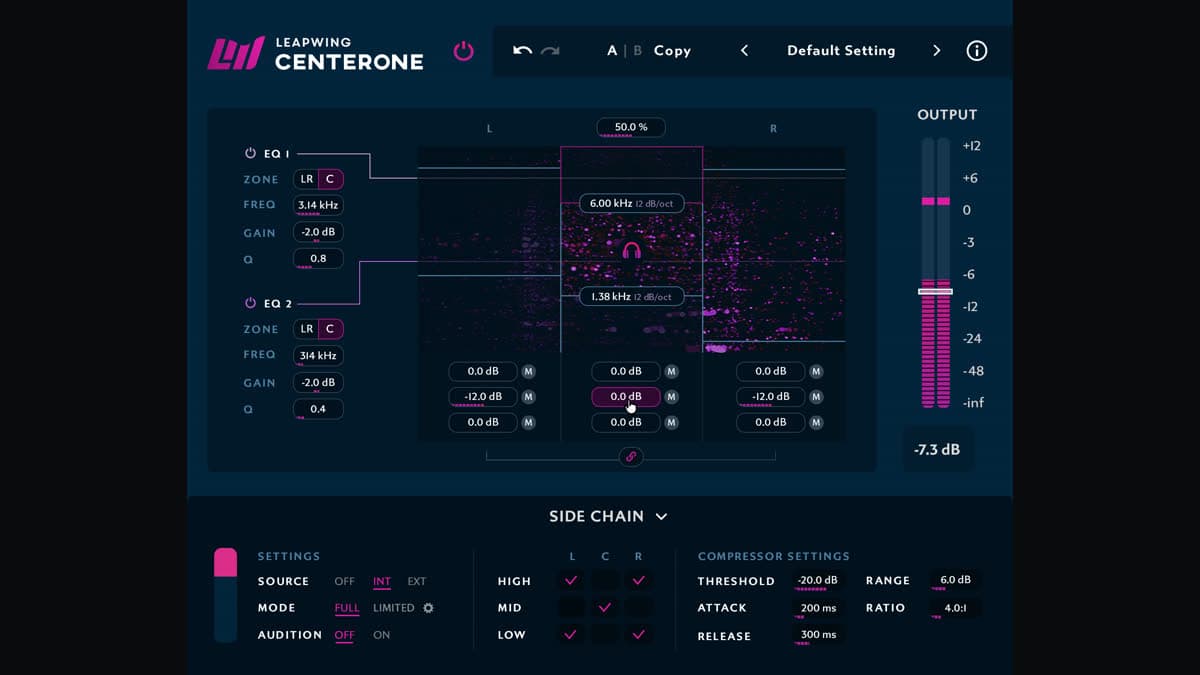
Leapwing has released CenterOne 3, a stereo processor that changes how much phantom center you hear without a classic mid-side split. The US store shows $174, down from $249, through 22 October 2026. Version 3 adds three-band left/center/right levels, two parametric EQs aimed at the center or the sides, and a sidechain compressor. This is a first look from the CenterOne 3 product page, the version 3 manual, and Leapwing's own video. We have not used it in a session.
At a glance: $174 intro / $249 list through 22 October 2026. Best Service lists €174.30 and $174.30, excluding VAT. A fully functional 30-day trial is on the Leapwing page. Formats in the manual are AAX, VST3, and AU on macOS, and AAX and VST3 on Windows. System line: macOS 10.13 or later, including Apple Silicon, and Windows 8 or later, 64-bit.
What is CenterOne 3?
CenterOne treats a stereo file as spatial information, not as two independent channels you then encode to mid and side. Its Center Prominence process finds the phantom center, the part of the signal that lands in the middle of the image, and separates that from the left and right information that is unique to each side. You can raise or lower that center, and you can do it in three frequency bands.
Leapwing's own line is the useful one. Mid-side processing treats whatever is shared between left and right as mid. Mid is not the phantom center. A vocal that sits a little off the exact middle, a snare with a wide room, or a bass that is centered in level but not in phase will not behave the same way in both tools. CenterOne is also explicit that it is not a stereo widener. The job is deciding how much center should exist, how that center should sound, which frequencies should move, and when.
That is a mix and master job. A lead vocal that is stuck in a finished stereo bounce. Low end that is wider than the club system will forgive. A dense pad that needs a hole in the middle without a remix. The manual lists mastering, mix-bus work, stem balancing, post, restoration, and creative stereo moves as the intended seats.
What version 3 adds
CenterOne already extracted a center. Version 3, documented in manual 3A, is about where that extraction is allowed to act.
Three bands. Low, Mid, and High each have their own Left, Center, and Right level, plus a mute for each component. Two crossovers set the boundaries, and a slope value sets how fast the bands hand off. You can pull level out of the center of the low band and leave the mid-band center alone. Clicking the main area solos that region so you can hear what the band actually caught.
Center extraction width. This is not a width knob for the mix. It decides how tightly "center" is defined. Lower settings stay on content that sits exactly in the middle. Higher settings pull in material that lives a little off center. The manual's audition trick is to mute L and R in all three bands, listen to C alone, then move this control before you restore the sides.
Two parametric EQs. Each band switches on or off and assigns to the LR zone or the C zone. Frequency, gain, and Q are the controls. LR processes the extracted left and right together. C processes only the phantom center. The practical splits are the ones mixers already want: take harshness out of a centered vocal without dulling cymbals, add presence around the vocal or snare and leave the sides, clean low-mid from the sides without thinning a centered kick and bass, or add air to the sides and keep the center stable.
Sidechain dynamics. Source is Off, Internal, or External. Full uses the selected sidechain path. Limited opens a bandpass on the detector. A matrix of High, Mid, and Low against L, C, and R decides which regions the compressor is allowed to move. Threshold, ratio, attack, release, and range sit on that matrix. Range caps the gain reduction so a hot threshold does not dive the center. The manual's example is a lead vocal on the external key, aimed at Mid/C, so a music stem moves aside only while the vocal is present. A second example ducks a vocal's reverb return while the vocal is singing.
Bypass keeps the plugin's latency so an A/B stays time-aligned. Undo and redo are on the window. A and B store two full states, and Copy duplicates the active state. Output gain and a stereo meter are there so you can level-match after you have moved L, C, or R. The manual is direct about that last point: changing those levels changes the stereo balance on purpose. At unity, with no EQ and no dynamics, the L/C/R path is built to reconstruct the source. Once you gain, EQ, or compress, panorama and spectrum change because you asked them to.
The plugin wants a stereo input. On a stereo track the main output is stereo. On a multichannel track it can be LCR. Hosts that expose auxiliary outputs can also hand you the extracted Left, Center, and Right as separate outs. External sidechain depends on the DAW actually offering a key input.
CenterOne 3 specifications
| Spec | Detail |
|---|---|
| Price | $174 intro / $249 list on Leapwing through 22 October 2026. Best Service: €174.30 and $174.30, excl. VAT |
| Upgrade | CenterOne 2 to 3 at Best Service: €30 and $30, excl. VAT, against a struck $50 |
| Trial | Fully functional 30-day trial on the Leapwing page |
| Type | Phantom-center level, tone, and dynamics. Not a mid-side encoder and not a widener |
| Bands | Low, Mid, High, with crossover frequency and slope |
| Per band | Independent L, C, and R gain and mute. L/R link. Click a region to solo it |
| Extraction | Center extraction-width control |
| EQ | Two parametric bands, each assignable to LR or C. Frequency, gain, Q |
| Sidechain | Off, internal, or external. Full or limited detector. Threshold, ratio, attack, release, range |
| Other | A/B with copy, undo/redo, presets, output gain, host automation |
| Routing | Stereo input required. Stereo or LCR main out. Extracted L/C/R aux outs where the host allows |
| macOS formats | AAX, VST3, AU, per the CenterOne 3 manual |
| Windows formats | AAX, VST3, per the CenterOne 3 manual |
| Systems | macOS 10.13 or later, Apple Silicon compatible. Windows 8 or later, 64-bit |
| License | Email plus serial. Hardware ID. Periodic online authentication |
| Manual | CenterOne 3 manual (PDF) |
Install paths in that manual are the usual system folders: AAX, VST3, and AU on macOS, AAX and VST3 on Windows.
CenterOne 3 vs Nolvra IMAGER vs MicroShift
Nolvra IMAGER is a three-band width tool with a mono fold-down reading. Soundtoys MicroShift makes width by detuning and delaying. CenterOne does not replace either. The overlap is the word "stereo."
| CenterOne 3 | Nolvra IMAGER | Soundtoys MicroShift | |
|---|---|---|---|
| Price | $174 intro / $249 list through 22 Oct 2026 | $79, 7-day trial | $99 on the MicroShift card |
| Main job | Raise, lower, EQ, or duck the phantom center | Set width per band and read fold-down loss | Pitch-and-delay width from H3000 and AMS-style doubling |
| Frequency split | Low, Mid, High L/C/R levels, plus two zone EQs | Three width bands. Low band cannot go wider than unity | Focus control, not a three-band center extractor |
| Dynamics | Internal or external sidechain into selected bands | No sidechain compressor | No sidechain |
| Formats | AAX, VST3, AU (macOS). AAX, VST3 (Windows) | AU, VST3, standalone. Windows is VST3 and standalone | AAX, VST 2, VST 3, AU |
| Reach for it when | A bounce needs a stronger vocal or a tighter low center | You want a fold-down number next to the width knobs | A mono source needs width, fast |
Which to pick. Choose CenterOne 3 when the source is already stereo and the problem is the middle: a vocal that will not come forward, low end that is too wide, or a center that should duck when something else plays. Choose IMAGER when the question is "how wide, and what does that cost in mono?" The longer IMAGER write-up is the RIDGE + IMAGER first look. Choose MicroShift when the track is mono, or close to it, and you want the doubled width those hardware algorithms are known for. Buying CenterOne does not retire a widener. They fail different sessions.
Who CenterOne 3 is for
Consider it if you mix or master from stereo bounces and stems, and you keep reaching for mid-side EQ because you cannot get the vocal, the kick, or the bass to sit without touching the sides.
Consider it if low-frequency width is the note you write on every master. The manual's low-band move is specific: reduce L and R together, leave C alone, leave Mid and High at unity.
Consider it if you want the center to move only when another signal is present. The sidechain matrix is built for that, including a vocal key into a music stem.
Skip it if you need to widen a mono vocal, guitar, or synth. That is a doubling plugin. CenterOne has nothing to extract until there is a stereo relationship.
Skip it if you are tracking a vocal and the insert has to stay near zero delay. Bypass keeps the comparison time-aligned. Use CenterOne on a bus you can print.
Skip it if your host is VST2-only. The version 3 install locations are VST3, AU, and AAX.
How much does CenterOne 3 cost?
Leapwing's store shows $174, struck through from $249, with the intro printed through 22 October 2026. A fully functional 30-day trial is on the same page. Best Service lists the intro at €174.30 and $174.30, excluding VAT. Plugin Boutique shows $174 from $249, 30% off until 22 October.
CenterOne 2 owners have a separate upgrade. Best Service lists it at €30 and $30, excluding VAT, against a struck $50. The product page calls the window a release offer that includes the upgrade.
Activation is an email and a serial tied to a hardware ID, with periodic online authentication. Leapwing support handles offline machines. The plugin card has the short spec if you only need the finder entry.
FAQ
Is CenterOne 3 the same as mid-side processing?
No. Mid-side calls shared left/right energy the mid. CenterOne's Center Prominence process identifies the phantom center and leaves unique left and right information alone. You can still EQ and level those sides. You are not encoding the mix to M/S to do it.
What is new compared with CenterOne 2?
Three-band L/C/R levels with crossovers, two parametric EQs you can aim at the center or the sides, and a sidechain compressor with an internal or external key and a band/channel matrix. The manual lists those three as the version 3 additions.
Does CenterOne 3 widen a mono track?
It needs a stereo input, because the extraction uses the relationship between left and right. A mono source has no phantom center to separate from unique side information. Use a doubler or a widener for that job, and use CenterOne when the stereo image is already there.
What are the system requirements?
macOS 10.13 or later, Apple Silicon compatible, in AAX, VST3, and AU. Windows 8 or later, 64-bit, in AAX and VST3. Those format paths are the ones in the CenterOne 3 manual.
Is the CenterOne 2 upgrade worth it during the intro?
If you already own CenterOne 2 and you want per-band center control, zone EQ, or a sidechain, Best Service has the upgrade at €30 / $30 excluding VAT while the release pricing is up. A new licence at $174 is the path if you do not own version 2. The 30-day trial is the way to hear the three new sections before either purchase.