Synth / plugin file

PolyRex

Safari Audio / $39.99

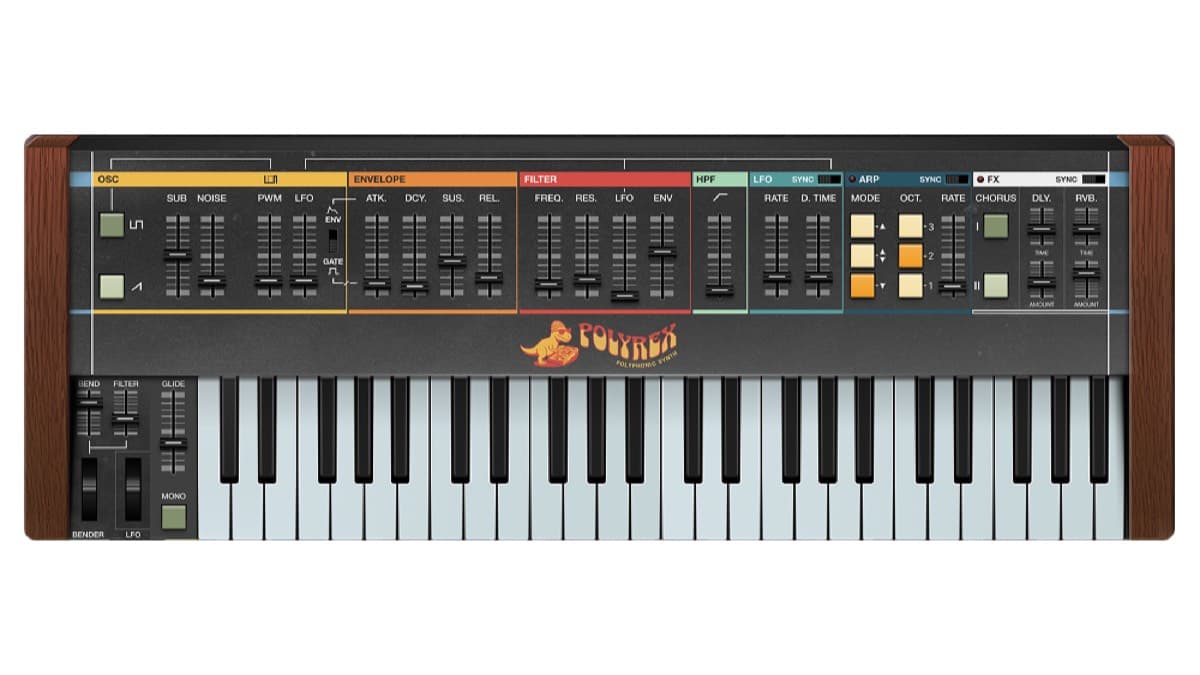
PolyRex by Safari Audio is a $39.99 Juno-106-style virtual-analog polysynth with 8 voices, a modulation matrix, an arpeggiator, and a built-in chorus, delay, and spring reverb FX engine.

Safari Audio PolyRex vintage polyphonic synthesizer plugin interface
7.6Good
Il verdetto Dubspot
7.6Good

Il verdetto Dubspot

A warm, immediate Juno-style polysynth with a mod matrix and onboard FX for $39.99. The single-oscillator engine keeps it simple, but it nails the classic chorused sound.

Ideale per Producers who want instant, affordable Juno-106 pads, chords, and basses without deep sound design.

Pros

  • Lush, authentic early-80s polysynth character out of the box
  • Eight voices, modulation matrix, and a built-in chorus, delay, and spring reverb engine
  • $39.99 perpetual license with free updates
  • Light on CPU and fast to dial in

Cons

  • Single core oscillator limits it next to multi-oscillator emulations
  • No standalone app and no Linux build

Field notes

Panoramica

PolyRex is Safari Audio's take on the early-80s Juno-106 sound, and its third virtual instrument after Cubby and Super Chunk. Each of its eight voices runs a single oscillator with pulse-width modulation, a sub oscillator, and a noise generator into a resonant low-pass filter and a separate high-pass, shaped by a full ADSR. The defining chorus sits in a built-in Safari FX engine alongside a delay and a spring reverb.

A modulation matrix, an arpeggiator, and glide push it a little past a straight clone, which is where it earns its keep against the reference emulations. Formats are VST3, AU, and AAX on macOS, and VST3 and AAX on Windows, with a 4 GB RAM minimum.

Use TAL-U-No-LX when you want the most detailed Juno modeling and a standalone app, listed at €70 on that card. Use u-he Diva when you want analog modeling across the whole era rather than one instrument. Use Repro-5 when the part calls for a Prophet-style voice instead. The full breakdown is the PolyRex review.

Technical matrix

Specifiche

Type
Virtual-analog polysynth (Juno-106 inspired)
Polyphony
8 voices
Oscillators
One core oscillator with PWM, sub oscillator, noise
Filters
Resonant low-pass, separate high-pass
Envelope
Full ADSR with gate mode
Modulation
LFO section, LFO pitch mod, modulation matrix
Effects
Chorus, delay, spring reverb
Formats
VST3, AU, AAX (macOS); VST3, AAX (Windows)
System
macOS 10.15+, Windows 8+, 64-bit, 4 GB RAM
Price
$39.99 perpetual

Ultima verifica 2026-10-01

Quick reference

FAQ

How much does PolyRex cost?

PolyRex is $39.99 for a perpetual license with free updates, sold direct from Safari Audio and through Plugin Boutique. A demo is available.

Is PolyRex a Juno-106 emulation?

In spirit, yes. It is built around the early-80s Juno blueprint with a single PWM oscillator, sub, a resonant filter, and a defining chorus, capturing the character rather than claiming a circuit-exact clone.

What formats does PolyRex support?

VST3, AU, and AAX on macOS, and VST3 and AAX on Windows. It needs a 64-bit host, macOS 10.15 or later, or Windows 8 or later.

PolyRex vs TAL-U-NO-LX?

PolyRex is the cheaper, faster route to the classic sound with a mod matrix and onboard FX. TAL-U-NO-LX offers more detailed Juno modeling and a standalone app for more money.

Comparison matrix

Concorrenti diretti

PolyRex vs — head-to-head specs, price, and Dubspot Score.

TAL-U-No-LX8.4
PolyRex vs TAL-U-No-LX
Confronta →
u-he Diva9.1
PolyRex vs u-he Diva
Confronta →
u-he Repro-58.8
PolyRex vs u-he Repro-5
Confronta →

Adjacent signals

Plugin correlati

Further routing

Vedi anche