Emergence Audio Envoy: Analog Percussion That Keeps Changing
Emergence Audio Envoy is a $149 intro Kontakt Player instrument of analog percussion that recombines as you play. Specs, Cadence Engine, and who it is for.
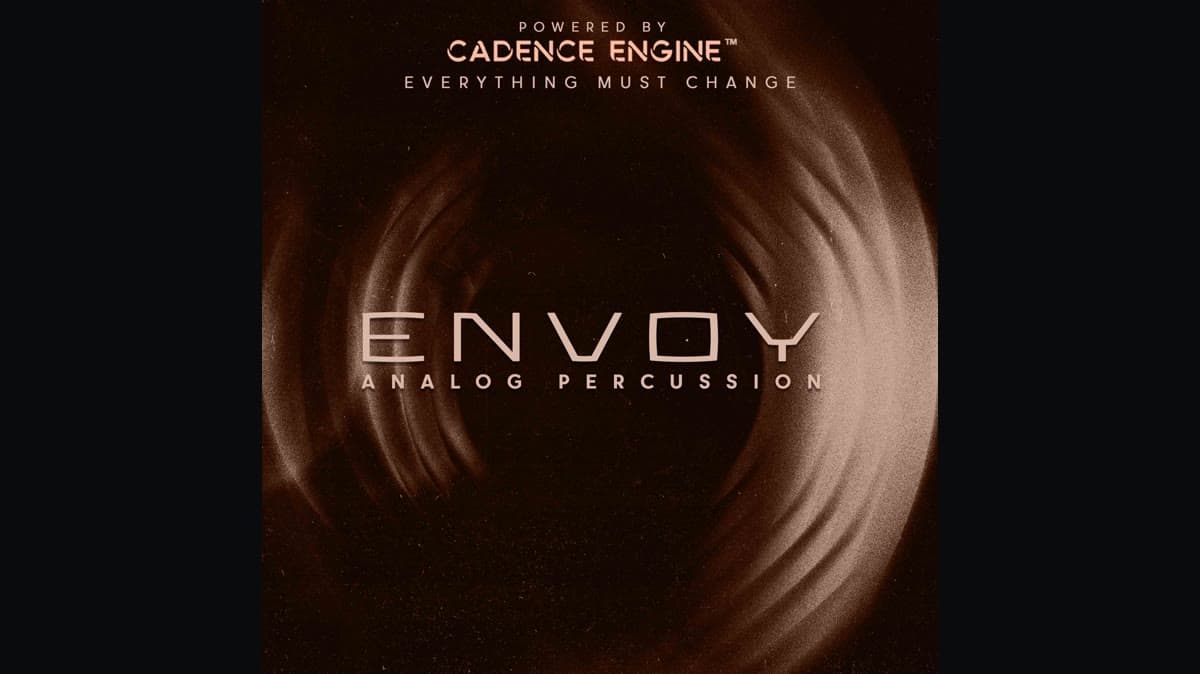
Emergence Audio has released Envoy, the first instrument on its new Cadence Engine, built from 600 analog percussion sources that recombine while you play. Intro pricing is $149 against a $199 regular. It runs in free Kontakt Player 8.1 or later. This is a first look at the shipping feature set. We have not used it in a session.
At a glance: $149 intro, then $199. About 2.48 GB. Native Access serial. NKS. VST3, AU, and AAX through Kontakt, plus standalone Player. macOS 12 through 14 and later supported versions, Windows 10 or 11 64-bit, 8 to 16 GB RAM recommended. You can't load your own samples. Buy it at emergenceaudio.com/product/envoy.
What Envoy is
Loop percussion is fast, and it's also someone else's groove. Program a kit by hand instead and you'll spend the afternoon drawing velocity lanes so the thing doesn't sound like a sample pack on repeat. Envoy is Emergence Audio's answer to that boredom. The company already has a long run of Infinite Motion Engine libraries for evolving textures, and Cadence Engine is a new architecture aimed at rhythm: two independent layers, step envelopes, and a randomizer that keeps moving without erasing the pattern you wrote.
The source material is all analog, with no acoustic kits and no user-sample import. Founder Michael Vignola recorded percussive synths and Eurorack, often as longer, unstable hits with filter movement and noise already sitting in the tail. Ten round robins per source keep some of that hardware drift. The engine then decides how much of the tail you hear on each step.
If you want a session drummer that plays nu-disco phrases, that's UJAM Virtual Drummer NEON. If you want analog voices you can hit with your hands, that's Polyend Drums. Envoy is for composers who hate static loops and don't mind living inside a Kontakt instrument.
The Cadence Engine
Two layers. Each layer holds 32 steps in four blocks of 1 to 8 steps. The rate sets how long a block lasts, so adding steps subdivides time instead of stretching it. Rates run from 4 bars to 1/128.
Three clocks sit under that: Layer 1, Layer 2, and a Master LFO. Lock the layers and they sit in the grid. Set them apart and they cycle against each other for bars. There's no conventional 5/4 or 7/8 selector, because meter comes out of independent step counts, blocks, and rates. HOST mode follows the DAW tempo. Each factory preset was authored at a specific BPM, printed in the preset name, so a patch can feel denser or more open when you drop it on a different session tempo.
Every step carries five parameters: velocity, pitch, pan, length, and a low-pass or high-pass filter. Draw them independently. The filter is part of the rhythm here, not a static EQ you set once and forget. Length is the other sleeper. Many sources started life as longer textural hits, so tighten Length and you get a tick, open it and the recorded modulation in the tail comes through.
A crossfade matrix on an infinity curve morphs the two layers in one gesture. An independent volume orb sits on each layer. Link the morph to the mod wheel and you can sweep the stack while you play. The Master LFO can drive the whole path from one depth control.
Flux, RND, and the four NKI workflows
Envoy splits randomization on purpose.
RND is a one-shot. Hit it, get a new sequence state, keep the one you like, edit the steps, save a preset. Call that "find something."
Flux Randomizer is continuous and non-destructive. You set a percentage per mode, choose which of the four blocks may move, and pick which of the five per-step parameters are allowed to change. Velocity can wander on blocks 1 and 4 while pitch only moves in block 3. Turn Flux off and the original pattern comes back untouched. Call that "keep something moving."
Use both. RND gets you a starting groove, and Flux makes sure bar 16 isn't a copy of bar 1.
Envoy ships as four NKI patches. The engine stays the same. The keyboard map changes.
Envoy Omni stacks both layers across one range. Each layer can load a LOW, MID, or HIGH source section, so you crossfade two sections under the same keys.
Envoy Zoned is a kit layout. The keyboard splits into color-coded source zones (LOW red, MID blue, HIGH yellow). Each zone triggers a different source inside the loaded kit.
Envoy Split Omni splits the keyboard between the two layers, one single-zone section per side. Play each layer on its own half.
Envoy Split Zoned splits the keyboard and turns each half into its own multi-zone kit with independent sequencing.
LOW, MID, and HIGH are source sections, not fixed frequency bands. Transpose a source and the final range moves with it. Each section runs from simple, direct hits toward more abstract, unstable material as you browse deeper.
MIDI drag-and-drop out of the instrument isn't supported. If you want the sequence in the DAW, enable Kontakt Options, Engine, Send MIDI to Outside World, Script Generated Notes, then record the output in a host that accepts instrument MIDI. One-Shot View turns the sequencer off so keys fire single samples.
Sources, presets, and effects
The library is 600 analog sources, 10 round robins each, 6,000 samples, and 273 presets. Emergence Audio puts the pairing count at 4,501,500 unique two-layer combinations (600 sources across five octave positions, then unique pairings, without double-counting swaps or round robins). Treat that as a combinatorial ceiling rather than a promise that you'll hear four million useful kits.
Each layer gets seven effect modules, and the master chain adds convolution reverb with 100+ impulse responses. Saturation, delay, and lo-fi sit in that path too. The point is that motion can live in the FX as easily as in the step envelope.
NKS tagging is on, so you can browse and control Envoy from Komplete Kontrol and other NKS hardware. Installation runs through Native Access: paste the serial from the order email, then install from the Available tab. Emergence Audio is also rolling out an eight-part Cadence Engine walkthrough series on its own channel, one episode a week after launch.
Envoy specifications
| Spec | Detail |
|---|---|
| Developer | Emergence Audio |
| Type | Analog percussion instrument for Kontakt Player |
| Engine | Cadence Engine, two layers, 32 steps each (four blocks of 1-8) |
| Per-step | Velocity, pitch, pan, length, LP / HP filter |
| Clocks | Layer 1, Layer 2, Master LFO, 4 bars to 1/128 |
| Random | Flux (non-destructive, per block / param) and RND (one-shot) |
| Library | 600 analog sources, 10 RR, 6,000 samples, 273 presets, ~2.48 GB |
| Workflows | Omni, Zoned, Split Omni, Split Zoned NKI |
| FX | 7 modules per layer plus master convolution (100+ IRs) |
| Host | Free Kontakt Player 8.1+ (full Kontakt not required) |
| Formats | VST3, AU, AAX via Kontakt, plus Player standalone. NKS |
| System | macOS 12-14 or later supported versions; Windows 10 / 11 64-bit |
| RAM | 8 to 16 GB recommended |
| Install | Native Access serial |
| User samples | Not supported |
| Intro price | $149 |
| Regular price | $199 |
| Buy | emergenceaudio.com/product/envoy |
Envoy vs UJAM NEON vs Polyend Drums
| Envoy | UJAM Virtual Drummer NEON | Polyend Drums | |
|---|---|---|---|
| Job | Evolving analog percussion for score and sound design | Phrase-based nu-disco / dance-pop drummer | Flagship hybrid hardware drum box |
| Street / list | $149 intro / $199 | $49 intro / $119 on our NEON card | $2,699 on our Polyend Drums review |
| Host | Kontakt Player 8.1+ | VST2, VST3, AU2, AAX | Standalone hardware |
| Sources | 600 analog / Eurorack hits, no user import | 5 vintage acoustic kits, 690 phrases | 4 analog voices + 4 digital / sample tracks |
| Best for | Pulses that keep changing | Finished groove phrases, fast | Playing drums without a laptop |
Which to pick. Envoy is the buy when the loop already sounds like everyone else's and you want analog instability you can steer. NEON is faster if you need a drummer that already plays the style. Polyend Drums leaves the computer behind. VRAC+ is the other software option if you want kits built from your recordings rather than a closed analog library.
Who Envoy is for
Consider it if you write cues and you're tired of the same construction-kit loop turning up in another trailer.
Consider it if you want analog percussion you can sequence, randomize, and morph without building a multi in Kontakt by hand.
Consider it if NKS and a free Player host matter more than a native plugin with its own wrapper.
Consider it if you'll pay $149 for 2.48 GB built around a new engine rather than a phrase library.
Skip it if you need acoustic kits, ghost notes, and a human feel. Buy NEON or a conventional drummer instrument.
Skip it if you need to drop in your own samples, because Envoy won't load them.
Skip it if you want MIDI clip export the way a drum machine plugin drags a file to the arrange page. You record script-generated MIDI instead.
Skip it if 8 to 16 GB of recommended RAM and a Kontakt Player install are more friction than you'll tolerate for percussion.
How much Envoy costs
$149 intro, then $199, direct from emergenceaudio.com/product/envoy. Delivery is a Native Access serial. Full Kontakt isn't required, and free Kontakt Player 8.1 or later is enough.
There's no demo build on offer, so you're buying on the audio demos and the walkthroughs. Emergence Audio points you at the manual and the Cadence Engine series to learn the instrument once it's installed.
The plugin card lives at /plugins/emergence-audio-envoy.
FAQ
Do I need full Kontakt?
No. Envoy runs in free Kontakt Player 8.1 or later.
Can I load my own samples?
No. The instrument is built around its 600 included analog sources.
Envoy vs UJAM Virtual Drummer NEON?
NEON plays recorded acoustic phrases for dance-pop and nu disco. Envoy sequences analog synth percussion that can keep changing. Different job, different sound world.
Does Envoy sync to the DAW?
Yes. Switch to HOST and the engine follows session tempo. Each layer still has its own RATE inside that tempo.
What are the system requirements?
macOS 12 through 14 or later supported versions. Windows 10 or 11, 64-bit. 8 to 16 GB RAM recommended. Library size is about 2.48 GB.
The bottom line
Envoy is a Kontakt Player percussion instrument that treats analog hits as raw material for a two-layer sequencer, then lets Flux move the groove without overwriting it. $149 intro, then $199. We have not scored it.
If you already hate the loop you dragged in this morning, this is the tool aimed at you. The storefront is emergenceaudio.com/product/envoy.