DAWJunkie VinylSynth: Keys and Pads From Real Vinyl
DAWJunkie VinylSynth builds its sound engine from real vinyl samples, with a crackle layer, filter, EQ and five effects. Intro $14.95, regular price $49.
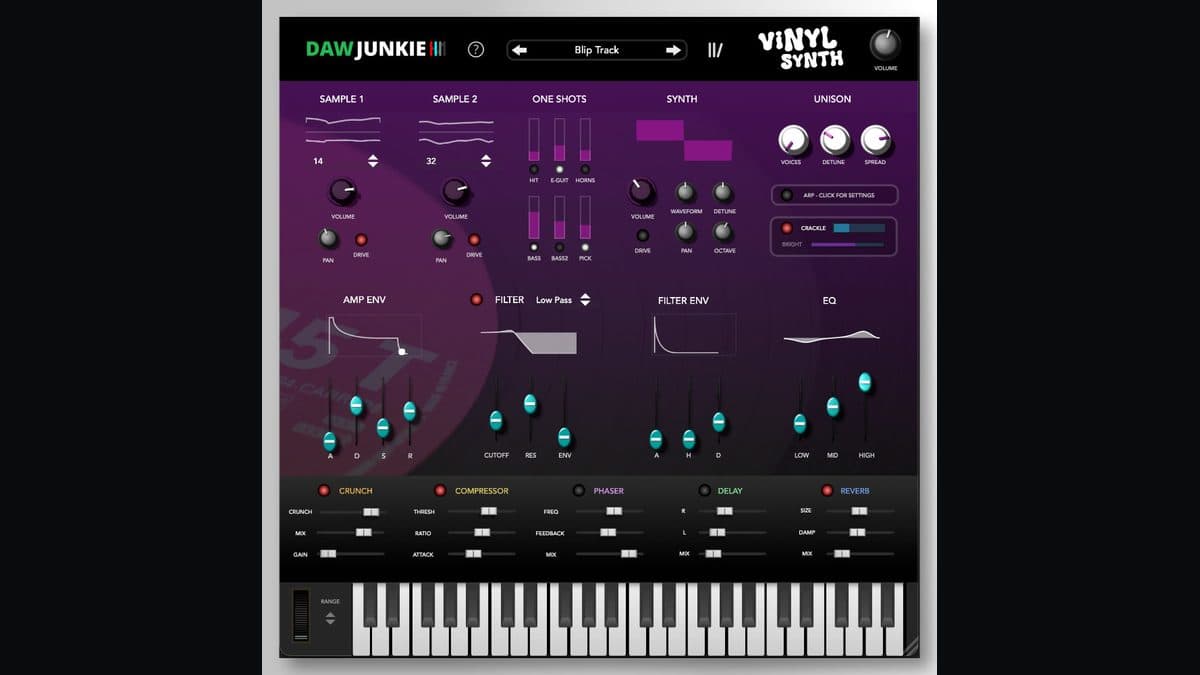
DAWJunkie's VinylSynth builds its sound engine out of records. The sampled material was pulled off actual vinyl first, and every synth feature in the plugin sits on top of that worn source rather than trying to age a clean one. It's $14.95 at the moment, against a $49 regular price.
At a glance: $14.95 intro, $49 regular. macOS 11 or later (AU, VST3, AAX), Windows 10 64-bit or later (VST, VST3, AAX). Over 36 vinyl samples, six sampled one-shots, an eight-waveform oscillator, a five-type filter with envelope, three-band EQ, unison, five effects, and 100 factory presets. It sells direct from DAWJunkie.
One caveat before we go further: we haven't had VinylSynth open in a session yet. This is a first look at what the instrument is built from and who it suits.
How VinylSynth differs from a vinyl effect
Most lo-fi tools run in one direction. You play a clean synth or a sampled piano, then push the output through wow, flutter and surface noise on the way to the bus. iZotope Vinyl is the free version of that idea, and it lives on a lot of channel strips. VinylSynth reverses the order. The wear arrives with the sample, and the synthesis happens afterward. The current first look is Yurt Rock DECADE.
That ordering matters more than the spec sheet makes it look. When the character is baked into the source, the filter and EQ are shaping something already dirty, so the grit moves with the note instead of sitting behind it like a layer of weather. It also means you can't dial the vinyl out entirely, which is either the point or the dealbreaker, depending on what you came for.
DAWJunkie is Steve Cherubino's shop, built around small instruments, expansion packs and a refund policy that doesn't ask questions. He frames VinylSynth as an attempt to bottle how old records feel and hand that to someone else's tracks. Whatever you make of the pitch, it's an accurate description of the product's scope. This is a keys-and-pads instrument with a vintage personality, not a workstation and not a deep sampler.
For context on where it sits: Analog Lab V is the large, polished vintage-keys library at the other end of the shelf, and Arcade is the subscription loop instrument that chases a similar mood. VinylSynth is the small boxed option you learn in one sitting.
Inside the instrument
Vinyl samples as the engine
Over 36 samples recorded from real vinyl make up the sound engine. That's the whole point of the design, not a bonus folder tucked behind the presets. When you play a patch, you're playing records that have already been through a stylus.
Six sampled one-shot sources sit alongside them, aimed at high-attack and melodic material. They're the reason a pad can get a front end, or a lead can get a click, without opening a separate drum sampler.
DAWJunkie doesn't say which records were sampled, and that's a deliberate silence. Reasonable, given how clearance works, but worth knowing if you were hoping to trace the source of a particular tone.
Crackle you can ride
Crackle gets its own layer here, with independent brightness and volume. It's a small design decision with a real workflow payoff. You can keep the keys reasonably clean while surface noise holds the bed, or lean into the dirt until the crackle is part of the performance.
Because it's a layer rather than a global effect, you can automate it across a song. Dusty in the verse, cleaner in the chorus, no bypassing the whole instrument to get there. Anyone who has fought with a static noise floor bolted to the end of a chain will recognize why that's worth something.
Oscillator, filter, EQ and unison
The samples are only half the architecture. A full synth oscillator with eight waveforms sits next to them and does the job of adding weight where a vinyl key sounds thin. From there, a musical filter with five types and envelope functionality shapes the combined stack, a three-band EQ handles the obvious frequency moves, and unison controls widen the result in stereo.
So it's a sample-plus-synthesis layout rather than a ROM player. You can thicken, tuck the highs, spread the stereo image, and shape the envelope. What you can't do is rebuild it into a wavetable synth. The vinyl palette is the palette.
Five effects, 100 presets
Five onboard effects finish the signal path. DAWJunkie doesn't publish a breakdown of which five processors they are, so take them as a fixed chain rather than a modular rack you'll be reconfiguring. What's clear from the preset library is the range they cover, running from subtle vintage warmth through to heavier lo-fi textures.
The factory library is 100 presets written by the instrument's creator. Installation is a standard installer, and Pro Tools users are covered through AAX on both platforms. If the sound doesn't land, DAWJunkie refunds it.
VinylSynth specifications
| Spec | Detail |
|---|---|
| Type | Vinyl-sampled virtual instrument with layered synth oscillator |
| Vinyl sources | Over 36 samples recorded from actual vinyl |
| Extra sources | 6 sampled one-shots; oscillator with 8 waveforms |
| Tone | Filter with 5 types and envelope; 3-band EQ; unison |
| Texture | Dedicated crackle layer with brightness and volume |
| Effects | 5 onboard effects |
| Presets | 100 factory presets |
| macOS | macOS 11 or later; AU, VST3, AAX |
| Windows | Windows 10 64-bit or later; VST, VST3, AAX |
| Price | $14.95 intro, $49 regular |
VinylSynth vs Analog Lab V
If you landed here looking for vintage keys and pads generally, Analog Lab V is the honest comparison. These are products at completely different scales, and the table makes that obvious.
| VinylSynth | Analog Lab V | |
|---|---|---|
| Source | Vinyl-recorded samples plus a layered oscillator | 2000+ presets from Arturia V Collection engines |
| Character | Dust, crackle, lo-fi keys and pads | Cleaner modeled analog and vintage keys |
| Editing | Filter, EQ, unison, five effects | Preset player with limited deep editing |
| Formats | VST, VST3, AU, AAX | VST, VST3, AU, AAX, NKS, standalone |
| Systems | macOS 11+, Windows 10+ | macOS 11+, Windows 10+ |
| Price | $14.95 intro, $49 regular | About $199 (Analog Lab Pro) |
Analog Lab wins on breadth, polish and the sheer number of usable patches you can audition in an hour. It's the desert-island choice if vintage keys are a regular part of your work. VinylSynth wins on one specific thing Analog Lab never starts with, which is the record already sitting inside the sample.
The other two comparisons worth making are quicker. Arcade covers similar territory but as a subscription, and its library keeps growing because Output keeps filling it; VinylSynth is a finished instrument you own outright, and 100 presets is a weekend of exploring rather than a year. Lounge Lizard EP-4 is the serious electric-piano option if what you actually want is a playable Rhodes rather than a dusty one.
Who VinylSynth is for
Lo-fi beatmakers get the most out of this. So do bedroom pop writers and anyone scoring to picture who needs a cue that sounds like a worn copy rather than a fresh session. The crackle layer is the feature that makes those jobs faster, because the texture is already in the part instead of waiting at the end of the chain.
It's also a natural pick if you already run other DAWJunkie instruments and like the one-panel approach. Nothing here demands a manual.
Two groups should look elsewhere. If you need a large, editable vintage catalog, Analog Lab V or a dedicated electric piano covers far more ground. And if you've already built a sampler around your own record rips, 36 factory sources aren't going to displace that folder. There's a third case too. At $49, a small library and a fixed effects chain ask a lot more of you than they do at intro price.
How much does VinylSynth cost?
VinylSynth is $14.95 on the DAWJunkie shop, down from a $49 regular price. Buy it from dawjunkie.com/product/vinylsynth, and if it doesn't work for you, the shop refunds it with no questions asked.
DAWJunkie sells direct only, so there's no Plugin Boutique, Thomann or Best Service listing to compare against. The developer's own cart is the storefront.
FAQ
What is DAWJunkie VinylSynth?
It's a virtual instrument whose sound generators are samples recorded from real vinyl, layered with a synth oscillator, six one-shots, a dedicated crackle layer, a five-type filter, three-band EQ, unison and five effects. One hundred factory presets ship with it.
How much does VinylSynth cost?
$14.95 intro against a $49 regular price, sold direct from the DAWJunkie shop.
What formats does VinylSynth support?
macOS 11 or later gets AU, VST3 and AAX. Windows 10 64-bit or later gets VST, VST3 and AAX. Pro Tools is covered through AAX on both platforms.
Is VinylSynth an effect or an instrument?
An instrument. The sound generators are vinyl recordings, with synthesis and effects layered on top. If you want a vinyl effect for existing tracks, iZotope Vinyl is the free place to start.
VinylSynth vs Analog Lab V?
Pick VinylSynth for a small, vinyl-sourced instrument at intro price. Pick Analog Lab V when you want a large modeled vintage-keys library and you're ready to pay for it.
Can I get a refund?
Yes. DAWJunkie offers a no-questions-asked refund.
Verdict
VinylSynth has a clear point of view and doesn't overreach. The samples came off records, the crackle is a layer you can play rather than a fixed noise floor, and the oscillator plus short FX chain keep it from being a glorified preset player. That's a coherent little instrument.
Size is the limitation. Thirty-six vinyl sources and 100 presets make for a weekend library, and at the full $49 you'd want to be sold on the texture before you commit. At $14.95 the math barely needs doing: if dusty keys and pads are a sound you keep reaching for, it's an easy add to a lo-fi template. If you want depth and breadth in vintage keys, spend the money on Analog Lab V instead.
More options are on the best synth plugins shelf and across the wider plugin database.