Born Second BS-203 Packs Three Acid Boxes for $25
Born Second BS-203 is a $25 monophonic acid synth with Classic 303, Silver 202, and Bassboy modes plus a pattern generator. Specs, price, and who should buy.
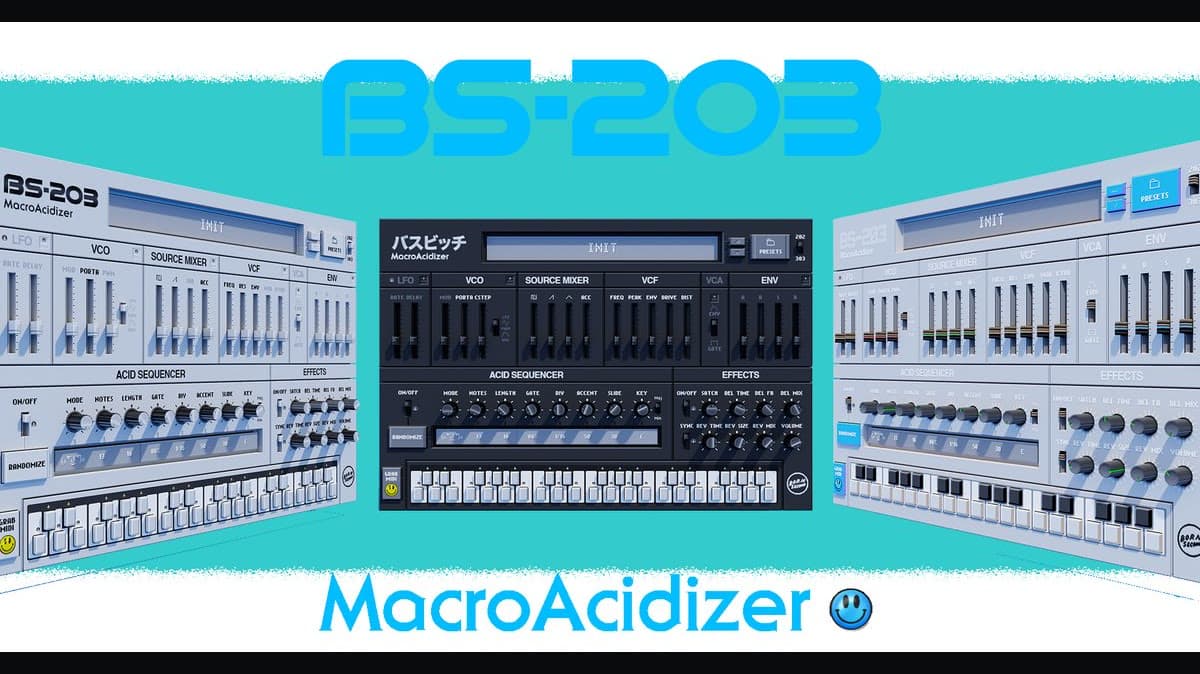
Born Second has released the BS-203 MacroAcidizer, a monophonic acid synth that re-plumbs its mixer and filter into three analog-modeled boxes and hangs a pattern generator on the front. The license is $25 one time, five activations, unlimited updates, no dongle, no subscription. This is a first look at the shipping feature set. We have not used it in a session.
At a glance: $25, VST3, AU, and AAX (64-bit). macOS 11 or later on Intel and Apple Silicon, Windows 10 or later, host DAW required. A free demo is fully functional with periodic white noise. Checkout is bornsecondrecords.com/bs203.
What the BS-203 is
Acid plugins usually pick a lane. Either they chase one silver box as hard as they can, or they build a workstation with a 64-step sequencer and a rack of extras. Born Second's pitch is smaller and stranger: three voices in one panel, and a generator that writes the line for you.
It ships as a monophonic acid synthesizer, so one voice and one line at a time. The three modes tip their hats at two early-80s Japanese bassline computers (the 1982 acid box and the 1983 silver companion sequencer) plus Juteon Bassboy, which is itself an homage with extra nastiness. Born Second isn't affiliated with those manufacturers. The names on the panel are Classic, Silver, and BB (バスビッチ).
The company is careful to point out that the finishes aren't just paint. Each mode re-plumbs the mixer and filter, and the pattern survives the switch. That's the product in one line: one sequence, three circuits.
If you want a one-VCO grey-box tribute with eight-voice poly and no DRM, that's Audio Damage AD-202. If you want a deeper 303 workstation with a 64-step sequencer and a full FX rack, that's Arturia Acid V. The BS-203 is the cheap three-mode box with a generator on the front.
Three modes, one pattern
Classic (303) is the acid squelch most people come for. Use it when the track needs the familiar resonant scream and the accent-and-slide language people mean when they say "303."
Silver (202) brings a steeper envelope and a brighter top end. That's the companion-sequencer voice: still a bassline computer, more bite on the attack, less of the classic squelch and more of the silver-box lead.
BB is the Bassboy homage, the freaky one. Reach for it when Classic is too polite and you want the filter and mixer wired up nastier.
Because the pattern stays put when you switch, the workflow is "write once, audition three circuits." At $25, that's a fair trade. You're not buying three plugins. You're buying a switch.
The pattern-generating sequencer
Born Second calls this the Acid Brain. It writes lines locked to a major or minor scale, then gives you the knobs to push the line around.
MODE, NOTES, LENGTH set personality, density, and phrase size. MODE here is the generator's personality, not the 303 / 202 / BB circuit switch.
GATE, DIV, ACCENT, SLIDE are the articulation controls. This is the 303-ness per square inch: how long notes stay open, how the clock divides, which steps get the accent bump, where the slide glues two notes together.
KEY plus Maj / Min keeps every generated note inside the track. That's the difference between a random acid generator and one you can drop on a song in A minor without a fight.
RANDOMIZE rolls a new idea. GRAB MIDI drags the keepers into the DAW. That last control is the real studio argument. Generate until something is close, grab it, then finish the line on the piano roll if you want.
Born Second's audio demos are the fastest way to judge the voices before you pay. They're all presets, written on the BS-203 with nothing but its onboard FX.
Onboard FX
The FX rack is three blocks: SATCH saturation, a tempo-synced delay, and reverb. Born Second models all three on units from its own studio, the boxes it reaches for when a bassline needs finishing. The claim is character that stays out of the sub.
That's a smaller rack than Acid V's, and it's also the right size for a $25 mono box. If you already have a favorite clipper and a send reverb, ignore it. If you don't, you can print a finished line without opening two more plugins.
BS-203 specifications
| Spec | Detail |
|---|---|
| Developer | Born Second |
| Type | Monophonic analog-modeled acid synthesizer |
| Modes | Classic (303), Silver (202), BB (Juteon Bassboy homage) |
| Sequencer | Pattern generator: MODE / NOTES / LENGTH, GATE / DIV / ACCENT / SLIDE, KEY Maj / Min, RANDOMIZE, GRAB MIDI |
| FX | SATCH saturation, tempo-synced delay, reverb |
| Formats | VST3, AU, AAX, 64-bit |
| macOS | 11 or later, Intel and Apple Silicon |
| Windows | 10 or later |
| Host | DAW required, no standalone |
| License | $25 one-time, 5 activations, unlimited updates, no dongle, no subscription |
| Demo | Free, fully functional, periodic white noise |
| Buy | bornsecondrecords.com/bs203 |
BS-203 vs AD-202 vs Acid V
| BS-203 | Audio Damage AD-202 | Arturia Acid V | |
|---|---|---|---|
| Job | Three-mode mono acid box + pattern generator | One-VCO grey-box synth, poly optional | 303-class workstation |
| Street / list | $25 | $39 intro / $49 on our AD-202 card | $149 on our Acid V card |
| Voice | Mono, three re-plumbed mixer / filter modes | 1 VCO, 24 dB ladder, mono or 8-voice poly | 303-style voice plus modulators and FX |
| Sequencer | Scale-locked pattern generator, MIDI grab | None (drive it from the DAW) | 64-step polymetric sequencer, MIDI export |
| Formats | VST3, AU, AAX | VST3, AU, AAX, CLAP, LV2, iOS | VST, VST3, AU, AAX, NKS, standalone |
| Best for | Cheap acid lines in three flavors | A small grey panel you learn in an afternoon | Deep studio acid with a full sequencer |
Which to pick. The BS-203 is the buy when $25 and a generator that dumps MIDI are the whole brief. AD-202 is the better small-box synth if you want poly, MPE, Linux, and a panel with one path from knob to sound, though it isn't an acid generator. Acid V is the deeper 303 if you want a 64-step sequencer and a serious FX path, and if you'll pay for them. Imaginando TV3 is the other fast 303 with a one-click generator, at €39 on desktop, if you also need mobile builds.
CPU Micron is another 202-era voice, sold direct at £39.99 as a VST3, Audio Unit, and standalone instrument for macOS, Windows, and Linux. CPU pitches it as a schematic-accurate take on the 1983 MC-202 voice (CEM3340 oscillator, IR3109 filter, discrete ADSR and LFO) behind a hardware-exact panel. Use it when one silver voice, modeled hard, is the point. Use the BS-203 when you want three modes and a generator for less money.
The original hardware story still lives in our Roland TB-303 spotlight if you want the box these plugins keep chasing.
Who the BS-203 is for
Consider it if you write acid lines and you want a generator that stays in key.
Consider it if $25 and five activations fits the budget, and you'd rather avoid a subscription or a dongle.
Consider it if switching Classic, Silver, and BB on the same pattern is more useful to you than owning one perfect clone.
Consider it if a fully working demo with occasional white noise is enough of a trial.
Skip it if you need polyphony, because the BS-203 is mono only.
Skip it if you need a standalone app, since it only loads inside a host DAW.
Skip it if you want Linux, CLAP, or iOS builds. This one ships as VST3, AU, and AAX.
Skip it if you already own Acid V and you only wanted a better 303 voice. The BS-203 is a different, smaller instrument.
How much the BS-203 costs
$25, one time, at bornsecondrecords.com/bs203. That buys five activations and unlimited updates, with no dongle and no subscription attached.
Demo installers sit on the same page for macOS Universal and Windows 64-bit. The demo is fully functional, and periodic white noise is the only lock on it.
The plugin card lives at /plugins/born-second-bs-203.
FAQ
Is the BS-203 polyphonic?
No. Born Second lists it as a monophonic acid synthesizer, so you get one voice at a time.
BS-203 vs Audio Damage AD-202?
AD-202 is a one-VCO grey-box synth with optional eight-voice poly and no built-in sequencer. The BS-203 is a mono acid box with three circuit modes and a pattern generator. Overlap is the silver-box heritage, not the feature set.
Does it run on Apple Silicon?
Yes. macOS 11 or later, Intel and Apple Silicon. Windows 10 or later. A DAW is required.
Is there a dongle or a subscription?
No. One payment, five activations, unlimited updates.
Can I get the patterns into my DAW?
Yes. GRAB MIDI drags generated lines out of the plugin.
The bottom line
The BS-203 is a $25 monophonic acid synth with three re-plumbed modes and a scale-locked generator that can dump MIDI into the session. We have not scored it.
If Classic, Silver, and BB on the same phrase is the idea, pay the twenty-five and keep the demo around for a friend. The storefront is bornsecondrecords.com/bs203.