Audio Blast V10F: a Modern Kawai 100F Mono Synth
Audio Blast V10F is a monophonic virtual analog synth inspired by the Kawai 100F, with a step sequencer and 512 presets. EUR 77 until 30 October 2026, then EUR 129.
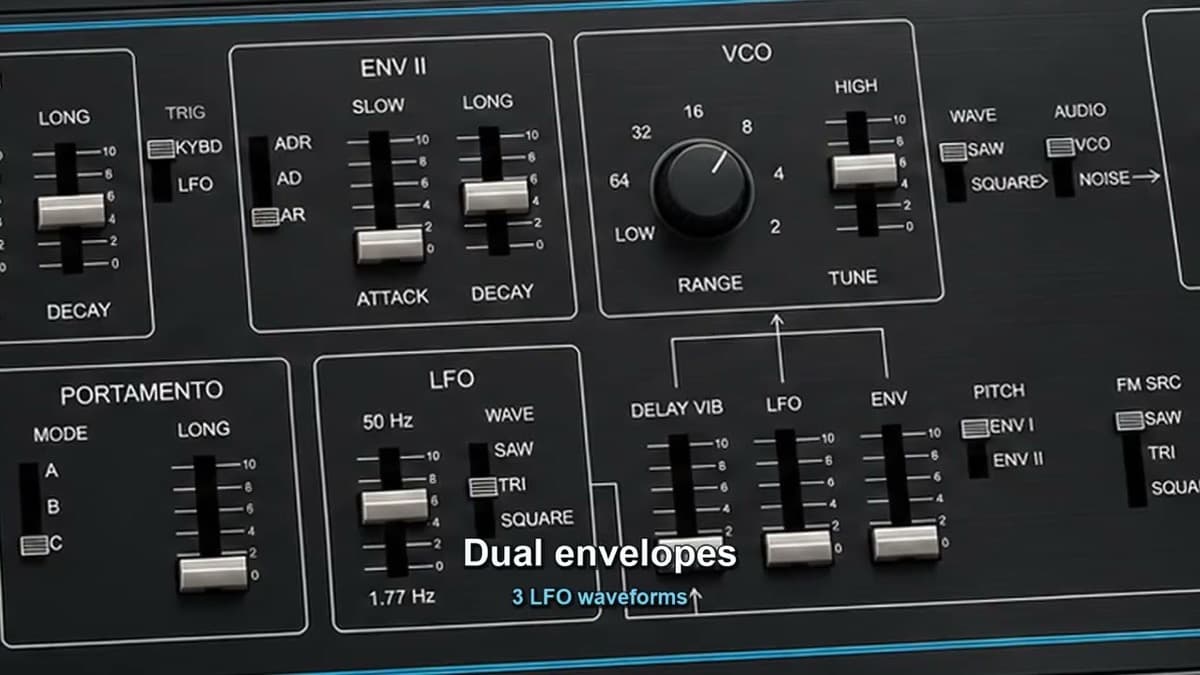
Audio Blast released V10F, a monophonic virtual analog synthesizer modeled on the vintage Kawai 100F. It keeps the original's simple single-path design and adds a step sequencer, extra filter modes, a small effects rack, and 512 factory presets. The launch price is EUR 77, 40 percent off the regular EUR 129, and Plugin Boutique shows the same discount running until 30 October 2026. This is a first look from the official product page and retailer listing, not a hands-on review.
At a glance: V10F is a one-voice synth with a saw or square oscillator plus noise, a sub oscillator, four main filter modes, two envelopes, one LFO, and a 64-step arpeggiator sequencer. It runs on macOS 10.15 or later and Windows 8 or later as VST2, VST3, Audio Unit, and AAX. There is no standalone app. The sound set is bass, lead, and classic mono synth territory, not a polysynth.
What is V10F?
The Kawai 100F was a monophonic analog synth with one oscillator and a pair of simple envelopes. One voice, one VCO, a filter, and not much else. That constraint is the point. A single-oscillator mono synth forces you to shape one strong tone rather than stack layers, which is why this class of synth still earns a slot for bass and lead parts.
V10F takes that layout as a starting point and extends it. Audio Blast keeps the one-voice signal path and the direct, few-knobs feel, then bolts on the parts the hardware never had: more filter choices, a modulatable sub, a step sequencer, an effects chain, and a large preset library. It sits in the affordable mono virtual analog bracket, next to a step-sequenced bass box rather than a deep modular instrument.
What V10F adds to the 100F layout
Oscillators. You get a sawtooth or square waveform plus a noise source. A separate SUB oscillator has an adjustable octave and can route either before or after the filter. Pre-filter routing lets the sub get shaped and driven with the main tone. Post-filter routing keeps a clean low end under a filtered lead.
Filters. There are four main modes: a 24 dB low-pass, a 12 dB low-pass, a band-pass, and a high-pass, plus a separate independent high-pass for cleaning the bottom. The filter takes envelope, LFO, and audio-rate modulation, so you can go from a slow sweep to an FM-style metallic edge from one control set.
Envelopes. Two envelopes each offer ADR, AD, and AR shapes and can be triggered from the keyboard or from the LFO. LFO triggering turns an envelope into a repeating shape, which is how you get rhythmic filter or amp movement without automation.
LFO and expression. The single LFO has sawtooth, triangle, and square shapes. Delayed vibrato and portamento handle the expressive side, which matters on a mono synth where glide between notes is a core part of the sound.
Arpeggiator sequencer. This is the biggest departure from the original. V10F has an ARP mode with a host-synced sequencer of up to 64 steps across 8 patterns. You edit notes, octaves, rests, and pattern length, with copy, shift, and transpose, and you can randomize notes, scale, or pattern length with controls for root note, note range, and rest probability. Patterns save with the preset, so a sound carries its own eight-pattern bank.
Effects. A distortion stage sits alongside three chainable slots that each offer five effect types: delay, phaser, synth verb, chorus, and flanger. That is enough to finish a patch inside the plugin rather than reaching for sends.
Presets. The full version ships with 512 factory presets, each able to store its sound together with the eight-pattern sequence bank.
V10F specifications
| Spec | Detail |
|---|---|
| Type | Monophonic virtual analog synthesizer |
| Developer | Audio Blast |
| Inspiration | Kawai 100F |
| Oscillators | Saw or square, plus noise, plus a SUB with pre/post-filter routing |
| Filters | 24 dB LP, 12 dB LP, band-pass, high-pass, plus independent HP |
| Envelopes | Two, with ADR, AD, AR modes, keyboard or LFO triggered |
| LFO | One, with saw, triangle, square, plus delayed vibrato and portamento |
| Sequencer | ARP mode, up to 64 steps, 8 patterns, host-synced, with randomization |
| Effects | Distortion plus three slots: delay, phaser, synth verb, chorus, flanger |
| Presets | 512 factory presets |
| Formats | VST2, VST3, AU (mac), AAX |
| Systems | macOS 10.15+, Windows 8+ |
| Price | EUR 77 until 30 October 2026, then EUR 129 |
V10F vs Acid V and FB3
V10F lands between two very different price points. Arturia Acid V is the premium mono synth with a sequencer, a modeled 303-style circuit with its own slide and accent engine. Full Bucket FB3 is the free end, a careful recreation of another vintage Kawai, the K3, that costs nothing.
| Audio Blast V10F | Arturia Acid V | Full Bucket FB3 | |
|---|---|---|---|
| Type | Mono VA, 100F-inspired | Mono VA, 303-inspired | Hybrid, Kawai K3-inspired |
| Sequencer | 64-step ARP, 8 patterns | Step sequencer with slide and accent | No built-in sequencer |
| Filters | 4 modes plus independent HP | 303-style ladder | K3-style |
| Price | EUR 77, then EUR 129 | $149 | Free |
| Reach for it when | You want a cheap, modern mono synth with a sequencer | You want authentic acid lines and automation | You want a free vintage Kawai tone |
Acid V is the better buy if your target is classic acid, where the slide and accent behavior is the whole sound. V10F is broader: it covers acid-style lines through its sequencer but also handles plain bass, lead, and noise-based sound design, and it costs less. If budget is zero, FB3 is a genuine free option with its own Kawai lineage, though it has no sequencer and a different tonal character.
For an even cheaper paid mono synth, the Born Second BS-203 sits at $25 and is worth a look if the sequencer is not a priority. If you want to compare vintage-flavored instruments more widely, the Cherry Audio ESQ-1 first look covers another reborn classic.
Who V10F is for
Buy it if you want a direct, affordable mono synth that still has a real step sequencer, and you like the idea of one strong oscillator rather than a stack. The 64-step arp with per-pattern randomization is the standout, and the EUR 77 launch price is the reason to decide before 30 October.
Skip it if you need polyphony, multiple oscillators for detuned stacks, or a deep modulation matrix. A single-voice synth will not do pads or chords, and if that is the session, this is the wrong tool. Producers who already own a 303-style instrument and only want acid should weigh Acid V instead.
How much does V10F cost?
V10F is EUR 77 during the launch period, down 40 percent from EUR 129. Plugin Boutique lists it at the same 40 percent discount, ending 30 October 2026. After the sale the regular price returns. It is sold both direct from Audio Blast and through Plugin Boutique, in VST2, VST3, AU, and AAX. There is no standalone app and no mention of a free time-limited demo on the product page.
FAQ
Is V10F polyphonic?
No. V10F is a monophonic synth, one voice at a time. It is built for bass, lead, and single-line sequencer parts, not chords or pads. If you need polyphony, look at a polysynth instead.
What is the Kawai 100F?
The 100F is a vintage Kawai monophonic analog synthesizer with a single oscillator and simple envelopes. V10F is inspired by its layout and sound, then expands it with more filters, a sub oscillator, a sequencer, effects, and presets.
Does V10F have a sequencer?
Yes. Its ARP mode is a host-synced step sequencer with up to 64 steps and 8 patterns. You can edit notes, octaves, rests, and length, and randomize notes, scale, or pattern length. Patterns save inside each preset.
What formats and systems does V10F support?
V10F runs on macOS 10.15 or later and Windows 8 or later. It is available as VST2, VST3, Audio Unit, and AAX. There is no standalone application.