Arturia MiniBrute & MicroBrute RED: Same Synth, New Look
Arturia MiniBrute RED and MicroBrute RED wrap the analog Brutes in striking red. Same 100% analog engine, cosmetic-only change, and who should buy.
Black Friday 2026Arturia Black Friday 2026: dates and deals →
Arturia is dressing two classics in a new coat. The MiniBrute RED and MicroBrute RED bring the company's cult analog mono-synths back in striking red finishes. The sound engine is the same legend; the look is the news.
These are color editions, not new instruments, and that is worth being upfront about. Still, the Brute family remains one of the best analog entry points around, so a fresh run is welcome. For broader options, see our best synth roundups and our drum machine guide.
What's new with the RED editions?
The change here is cosmetic, and that is fine. The MiniBrute RED wears a vibrant red finish, while the MicroBrute RED features a semi-transparent red chassis that shows off its compact build.
Under the panel, both keep the Brute architecture intact. According to Arturia, these are the same analog mono-synths producers already know, now offered in a standout color. If you have wanted a Brute that looks as aggressive as it sounds, this is the run to catch.
Color editions of the Brute line have a history of selling out, so availability tends to be the real story rather than features. The MicroBrute UFO is no longer listed at Thomann. If the RED run proves hard to find, Thomann still stocks the larger, current-production MiniBrute 2 Noir as another dark-finish Brute option.
Check Arturia MiniBrute 2 Noir price at ThomannWhat do the Brutes actually sound like?
This is where the Brute name earns its reputation. Both synths use a 100% analog signal path built around Arturia's collaboration with synth designer Yves Usson.
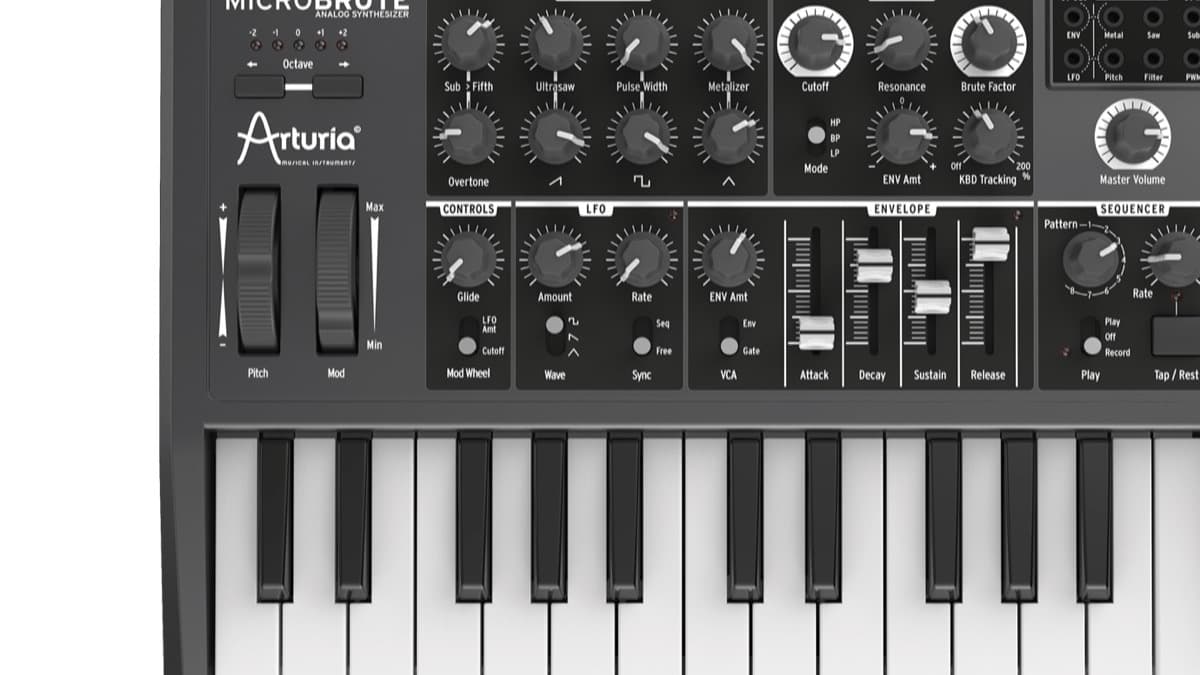
You get sawtooth, pulse, and triangle waves with character-defining modifiers. Ultra Saw thickens the sawtooth into something huge, and the Metalizer adds biting harmonics to the triangle. The Steiner-Parker filter gives the Brutes their signature snarl.
There are no presets and no menus. You sculpt the sound directly with your hands, which is exactly why these synths are such good teachers.
MiniBrute RED vs MicroBrute RED: which one?
The two share DNA but suit different needs. The MiniBrute is the larger, more fully featured board, with a bigger keybed and more hands-on controls.
The MicroBrute is the compact one. It keeps the pure analog voice path in a smaller body and adds flexible connectivity, including USB MIDI, 5-pin DIN MIDI input, and CV/GATE for patching with modular gear.
Choose the MiniBrute RED if you want the more complete playing experience. Choose the MicroBrute RED if desk space, portability, or modular integration matter more.
Are the RED editions worth it?
If you already own a Brute, a color swap is not a reason to upgrade. The sound is unchanged, so there is no sonic gain here.
If you have been eyeing your first analog mono-synth, the calculation flips. The Brute architecture is a superb way to learn subtractive synthesis by hand, and the RED finish is a genuinely good-looking version to own. Color runs are usually limited, so waiting risks missing it. To see how the Brutes stack up against the wider field, our guide to the best hardware synthesizers in 2026 covers the current landscape.
Pair either one with a compact controller like the Arturia MiniLab 37 and a DAW from our best DAWs for beginners guide, and you have a hands-on hybrid setup. For pricing and stock, check Plugin Boutique.
Frequently Asked Questions
Are the RED editions different synths?
No. The MiniBrute RED and MicroBrute RED are color editions. The analog sound engine is the same as the standard models.
What kind of synth is the MiniBrute?
It is a 100% analog monophonic synthesizer with sawtooth, pulse, and triangle oscillators, the Ultra Saw and Metalizer modifiers, and a Steiner-Parker filter.
Does the MicroBrute have CV/GATE?
Yes. The MicroBrute supports CV/GATE alongside USB MIDI and a 5-pin DIN MIDI input, so it integrates with modular and hardware setups.
Which Brute should a beginner buy?
The MicroBrute RED is the more affordable, compact option and a great first analog synth. The MiniBrute RED offers a fuller playing experience with more controls and a larger keybed.