Aethis First Look: Three Neural Amps for $34.99
Aethis is a $34.99 neural guitar amp sim with three heads, dual cabs, ten pedals and a four-voice harmonizer. A first look at the shipping 1.0.0 release.
AethisDSP's Aethis is a neural guitar amp sim with three captured heads, dual cabs, ten reorderable pedals, a nine-band parametric EQ, and a four-voice smart harmonizer. The license costs $34.99 once. The 14-day trial is fully featured, and there's no subscription anywhere in the deal. Version 1.0.0 ships as AU, VST3, and standalone on macOS 12+ and Windows 10+.
At a glance: $34.99 perpetual. 14-day trial. AU / VST3 / standalone. macOS 12+ (Apple Silicon and Intel), Windows 10+ x64. Three neural amps, two cabs with six mics each, custom WAV IRs, ten pedals, 9-band EQ, four-voice harmonizer, built-in tuner. Sold direct by AethisDSP.
This is a first look at the shipping 1.0.0 plugin and the specs AethisDSP publishes. We haven't tracked a session through it yet.
What Aethis is
Aethis puts a complete guitar path in one window: amp, cab, pedals, EQ, pitch. The amps are neural captures of real hardware, preamp through power stage, rather than front-end-only models. There are three of them, and each one has a clear job.
That's a different bet from a capture browser. TONE3000 hands you more than 700,000 community NAM files and asks you to pick. Aethis hands you three finished heads, a dual-cab IR desk, and a studio rack, then asks you to play. Price is the other half of the pitch. Helix Native sits at $399, Guitar Rig 7 Pro at €199, and Aethis at $34.99.
The limit is breadth. Three amps make a working trio, not a warehouse. If you need a jazz chorus, a plexi, and a fried tweed in the same session, you're still in Helix or TONE3000. If you need clean headroom, edge-of-breakup rock, and modern high gain, Aethis already named those three.
AethisDSP describes the plugin as being in active development, and the 1.0.0 license is perpetual. You buy it and you keep it.
Lumina, Ember, Noctis
Lumina is the clean head. AethisDSP calls it dead clean with headroom for days: a real tube clean that stays transparent no matter how hard you dig in. Published tags are massive headroom and neural tube modeling. This is the amp for chorus, delay, and harmonizer parts where the guitar should still sound like a guitar.
Ember is the workhorse. It sits on the edge of breakup, so pick attack decides the gain. Dig in and it breaks up; back off and it cleans up. Ember runs two channels, with tight control and pick dynamics on the spec plate. If you only ever load one head, this is the one that covers a whole song.
Noctis is modern high gain, captured from a real high-gain head. AethisDSP calls out low-end behaviour on 7- and 8-string drop tunings: tight, readable, no flapping. Two channels, power-amp saturation, and a master control sit on that plate. If your session never leaves drop tuning, start here.
All three model a full head rather than a preamp capture with a generic power amp glued on. That's the published distinction, and it explains why Aethis talks about pick dynamics on Ember and power-amp saturation on Noctis instead of a single gain knob.
Dual cabs, six mics, your IRs
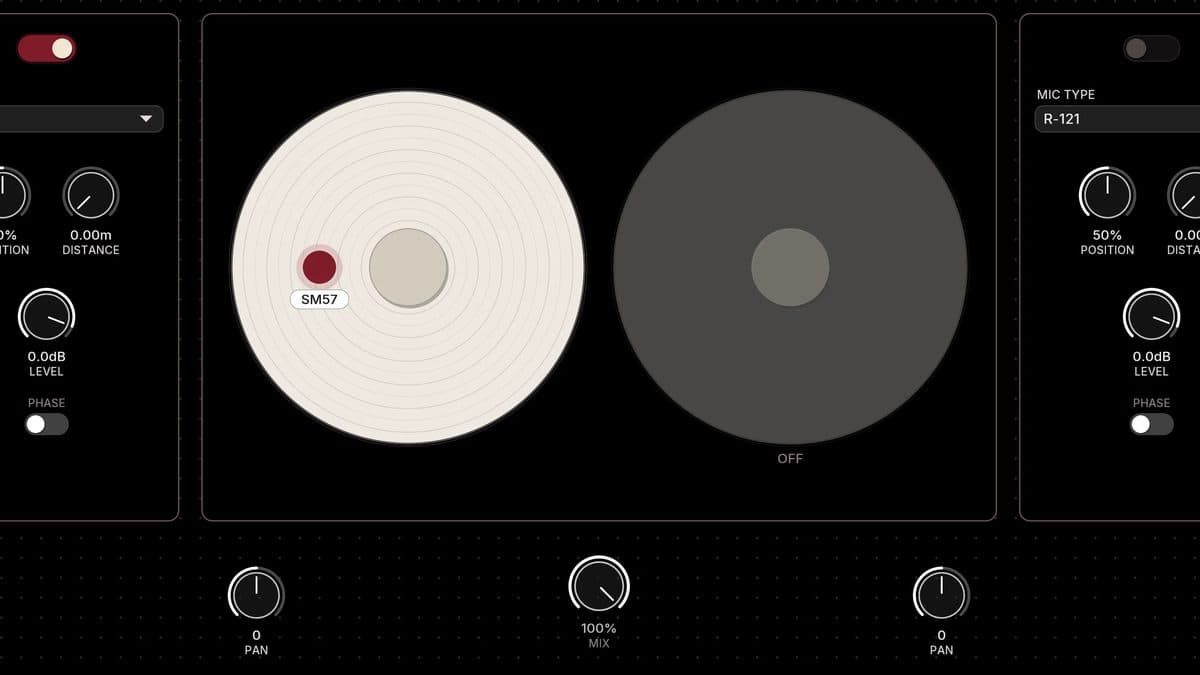
The cab section runs two independent cabinets and their impulse responses side by side. Each cab carries six mics. You can move them, pan them, blend the two cabs, or mute one and run a single mic. Custom IRs load as WAV files.
The official cab GUI shows the practical version: a mic channel with type, position, distance, level, and phase, a second channel that can sit off, and a pair of speaker-cone views with draggable mic pucks. Mix and left/right pan sit under the cones.
This is a recording-desk cab rather than a one-IR afterthought. Dual cabs with independent mics get you a close dynamic and a ribbon without leaving the plugin, and loading your own WAV IRs keeps the favourite 4x12 you already paid for. Full stereo is on the spec list, so a hard-panned pair is a native move instead of a second instance.
Ten pedals you can reorder
The studio rack ships ten pedals, already wired and modeled on real circuits. Put them in any order, before the amp or after it. Here's the published board:
- Boost with Gain, Level, Bass, and Treble. Push the amp, or lift a solo.
- Noise Gate, rackmount style. Threshold -100 to 0 dB, attack 0.01 to 50 ms, release 1 to 500 ms, hold 0 to 500 ms.
- Compressor with a Comp Mode switch covering Single, Low, Band, High, and Multi, so it works broadband or multiband. Comp, Attack, Level.
- Overdrive, a circuit-accurate TS808 with Drive, Tone, Mix, and Level. Mix runs the parallel path.
- Chorus, analog style, with Rate, Depth, Feedback, and Mix. Push feedback and it walks toward a flanger.
- Delay with Modern, Vintage Digital, and Diffusion engines, Normal, Wide, or Ping Pong routing, plus free, synced, or tap tempo.
- Reverb, studio algorithmic, decay 0.1 to 10 s, room-to-hall size, low and high cuts.
- Bitcrush with Crush 0 to 100%, Bits 2.0 to 16.0, Filter, and Mix.
- Phaser, 12-stage, with Rate, Depth, Feedback, and Mix.
- Flanger, analog-style jet sweep, with Rate, Depth, Feedback, and Mix.
AethisDSP's signal-flow map groups those into pre-FX (Boost, Gate, Comp, OD), tone shaping (EQ, Bitcrush, Phaser, Flanger), post-FX (Chorus, Delay, Reverb), and pitch (Transpose plus the harmonizer). Reorder is the part that matters. A TS808 into Ember is a different amp than Ember into a TS808, and the same goes for a gate before or after high-gain Noctis. The current first look is Orra Pump Pro.
Nine-band EQ and the smart harmonizer
The EQ gives you nine fully parametric bands, and the curve redraws live over a spectrum of what you're playing. It can sit before the amp or after it, so you can notch mud on the way in or fix the top on the way out. The useful takeaway: you don't need a third-party EQ to make these three amps sit in a mix.
The smart harmonizer stacks up to four voices on the DI. Quantize locks every voice to a key and scale, interval range runs ±15 semitones with cent-level detune, and each voice gets its own pan, level, and delay. Formants stay preserved, with a vowel path on the official feature list. MIDI mode is scale-aware, so you can drive the voices from a keyboard instead of hoping the detector guessed your chord.
That's a lot of pitch for $34.99. A separate harmonizer plugin plus an amp suite is the usual bill, and here the harmonizer is another unit in the same rack. Stack it on Lumina for choral clean parts. Use it lightly on Ember when a lead needs a third. Go easy on Noctis, because four high-gain voices will fill a mix whether you meant them to or not.
A built-in tuner is on the published feature list, and Transpose sits next to the harmonizer in the pitch stage.
Aethis specifications
| Spec | Detail |
|---|---|
| Type | Neural guitar amp sim + studio rack |
| Version | 1.0.0 |
| Amps | Lumina (clean), Ember (hot-rodded rock, 2 ch), Noctis (modern high gain, 2 ch) |
| Cabs | 2 independent IRs, 6 mics each, stereo, custom WAV IRs |
| Pedals | 10, reorderable, pre or post amp |
| EQ | 9-band fully parametric, pre or post amp, live spectrum |
| Pitch | Transpose + 4-voice smart harmonizer (±15 st, detune, per-voice pan/level/delay, scale/MIDI, formant) |
| Extra | Built-in tuner |
| Formats | AU, VST3, standalone |
| macOS | 12.0 or later, Apple Silicon and Intel |
| Windows | 10 or later, x64 |
| Price | $34.99 one-time |
| Trial | 14 days, fully featured |
| Subscription | None |
Aethis vs TONE3000 and Helix Native
| Aethis | TONE3000 Plugin | Helix Native | |
|---|---|---|---|
| Amp approach | 3 neural-captured heads | 700,000+ community NAM captures | Large Helix model library + block graph |
| Cabs | Dual IR, 6 mics each, custom WAV | IR library in-app | Helix cabs + IRs |
| Pedals / FX | 10 reorderable + 9-band EQ + harmonizer | Chains, stereo, pre/post EQ | Full HX effects blocks |
| Harmonizer | 4-voice, scale-aware | No dedicated harmonizer | Pitch blocks in the graph |
| Formats | AU, VST3, standalone | VST3, AU, AAX, CLAP, LV2, standalone | VST3, AU, AAX |
| Price | $34.99 one-time | Free | $399 typical |
Pick Aethis when you want a finished trio of amps, a real cab desk, a pedalboard, and a harmonizer for the price of a preset pack. Pick TONE3000 when the library is the product and you enjoy hunting captures. Pick Helix Native when you need the deep block graph, AAX, and a model count that covers every session, and you can pay for it.
Guitar Rig 7 is the modular rack in the middle, typically €199, with ICM models and a loop machine. AmpliTube 5 is the other large suite. Aethis isn't trying to out-catalog either of them. It's trying to be the $35 path you actually finish a song in.
Who Aethis is for
Aethis suits guitarists who record DI and want a clean, a crunch, and a high-gain head without stacking suites. Bedroom producers who need pedals, cab mics, and a harmonizer under one license are the obvious fit. The 14-day trial runs long enough to track a few real parts, and macOS 12+ and Windows 10 x64 cover current machines, Apple Silicon included.
Skip it if you need AAX, or if three amps won't carry your week. Skip it if you already live in Helix hardware and want preset compatibility. And skip it if a free capture player plus your own IRs gets you there already. Aethis is a designed trio, not an infinite shelf.
How much does Aethis cost?
Aethis costs $34.99 once, direct from AethisDSP. The 14-day trial is free and fully featured, and a paid license takes over after that. There's no subscription. Formats are AU, VST3, and standalone on macOS 12.0+ and Windows 10+ x64. You won't find it on Plugin Boutique, Thomann, or Best Service.
FAQ
What is Aethis?
Aethis is a neural guitar amp sim from AethisDSP with three captured heads (Lumina, Ember, Noctis), dual cabs with six mics each and custom WAV IRs, ten reorderable pedals, a nine-band parametric EQ, a four-voice smart harmonizer, and a tuner.
How much does Aethis cost?
$34.99 one-time, with a fully featured 14-day trial and no subscription.
Does Aethis work in Pro Tools?
Aethis ships AU, VST3, and standalone. AAX isn't on the official spec sheet, so Pro Tools isn't a native host.
Aethis vs TONE3000?
TONE3000 is a free NAM player with a huge capture library. Aethis is a $34.99 designed rig: three heads, a dual-cab desk, pedals, EQ, and a harmonizer. Choose TONE3000 for variety, and Aethis for a finished path you don't have to assemble.
What are the Aethis system requirements?
macOS 12.0 or later on Apple Silicon or Intel, or Windows 10 or later (x64). Plugin formats are AU, VST3, and standalone.
Verdict
Aethis is a small, complete guitar plugin: three neural heads that split the work sensibly, a cab desk that behaves like a session, a pedalboard you can reorder, and a harmonizer that's usually a second purchase. At $34.99 with a 14-day trial and no subscription, the price does most of the arguing. The catalog is the limit, and three amps with no AAX will send some players back to Helix or TONE3000. Everyone else gets a 1.0.0 rig that arrives already wired. Browse the rest of our amp sim coverage to see where a $35 trio sits next to the free library and the $399 graph.