Teletone Nora Builds Cinematic Beds Without Kontakt
Teletone Nora is an $89 cinematic texture instrument: 148 sounds, Mood, Movement, and Space macros, VST3/AU/AAX/standalone, plus a 7-day trial. No Kontakt.
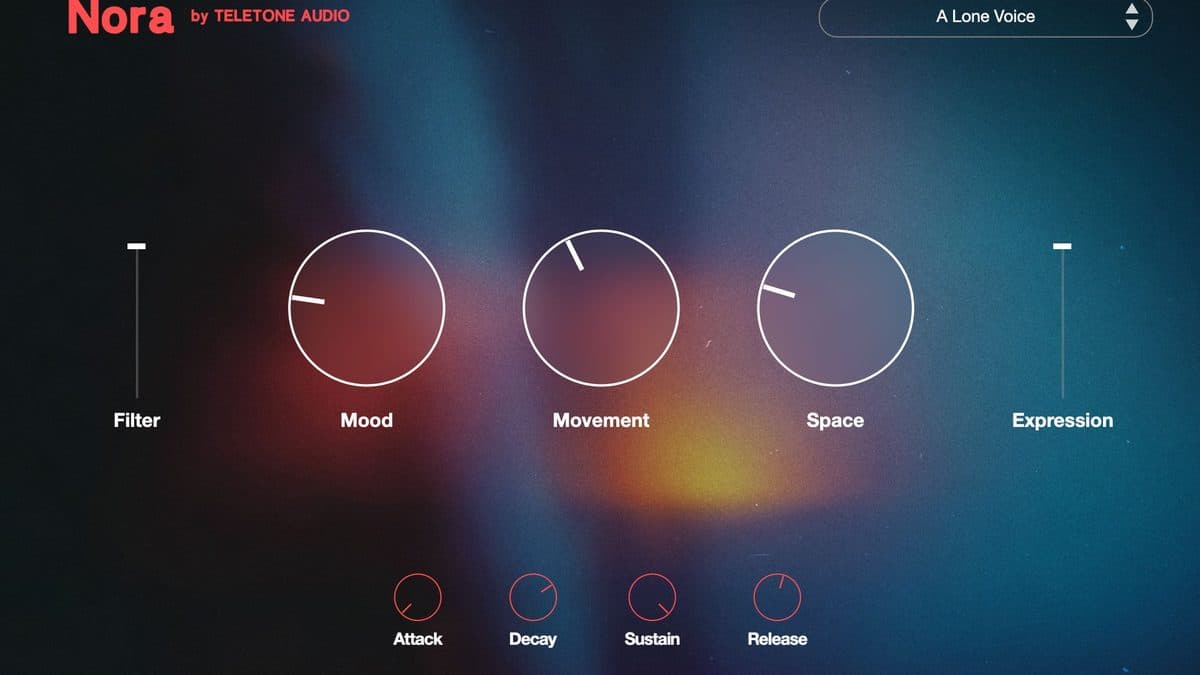
Teletone Audio has released Nora, a cinematic texture instrument that runs as its own plugin. The price is $89.00. A 7-day free trial is on the product page. Formats are VST3, AU, AAX, and standalone. Kontakt is not required.
At a glance: $89. 148 sounds in Ensemble, Shape, Voice, and Obscure. Three macros: Mood, Movement, and Space. Space uses Teletone's new algorithmic reverb, which the studio says will also ship as a standalone effect. About 600 MB to download and 840 MB installed. Sold direct from Teletone Audio.
This is a first look at the shipping instrument and the specs Teletone publishes. We have not had Nora open in a session yet.
What Nora is
Nora is a playable library of bent sources, not a construction kit of dry stems. Teletone lists the origins as strings, vocals, synths, woodwinds, and a fifth pile it calls the Obscure. The copy on the product page is the brief: strings become waves, voices become ghosts, woodwinds sit in a forest, synths open like portals. Co-founder Jeremy Larson calls it the studio's most cinematic library to date, built to put a sense of place under a cue.
That is a different job from a scoring-template orchestra. You are not writing a string arrangement. You are dropping a bed, a smear, or a ghost choir under something that already has a pulse.
It sits near other texture tools we already cover. Output Exhale is the modern vocal-instrument cousin. Output Movement is an insert that adds rhythm to whatever you already recorded. Baby Audio Spaced Out is a motion reverb, not a library. Nora is the instrument: 148 sounds and three macros, no host sampler required.
148 sounds across four worlds
The library is organized as Ensemble, Shape, Voice, and Obscure. Teletone's count is 148 sounds across those four worlds, spanning the source list above plus sound-design oddities. Ensemble is the place you go for a section that already feels arranged. Shape is the more processed, less literal material. Voice is the ghost choir and solo-voice lane. Obscure is the leftover that does not fit a source label.
The GUI matches that brief. A preset bar sits at the top (the official screenshot shows a patch called "A Lone Voice"). Filter and Expression are vertical sliders on the flanks. Mood, Movement, and Space are the three large knobs in the middle. Attack, Decay, Sustain, and Release sit along the bottom.
You will not get a Kontakt browser with six mic positions and a mixer page. The point is speed. Load a sound, turn the three macros, trim the envelope, and the bed is in the cue.
Mood, Movement, and Space
Teletone describes the macros in producer language, not DSP language.
Mood shapes character and color. That is the "what kind of room is this emotion" knob: brighter or duskier, more literal or more smeared. If a string patch still sounds like a recording session, Mood is the first turn.
Movement brings the sound to life. Pads that sit still get a pulse, a drift, or a swirl. This is the closest Nora comes to what Movement does as an insert, except the motion is mapped inside the patch instead of wrapped around a finished track.
Space is depth and atmosphere. The Nora manual names the engine: most of the reverb you hear is Moonverb, Teletone's latest algorithmic reverb. The product page says that engine will also ship as a standalone audio effect. Until then, Nora is the place to hear it. If you already live in Cinematic Rooms Pro or Spaced Out, treat Space as the in-instrument send, not a replacement for a dedicated hall.
Behind those three knobs Teletone says there is a web of modulation, effects, synthesis, and mapped parameters. The Nora manual is the deeper map after install.
Standalone, no Kontakt, and the trial
Nora runs as a standalone app or inside a DAW as VST3, AU, or AAX. Delivery is through the MyTeletone dashboard. There is no Kontakt Player install, no Native Access hop, and no extra library folder to manage beyond the 840 MB install.
The shop and the manual agree on the basics. macOS 10.13 or later (Intel or Apple Silicon), or Windows 10 or later, 64-bit, with Windows 11 recommended. RAM is 4 GB minimum and 8 GB recommended. An SSD is recommended. Download is about 600 MB. Installed size is 840 MB. An internet connection is required for download and registration.
MPE is a menu toggle. Default MIDI is Filter on the mod wheel (CC 1), Expression on CC 11, and sustain on CC 64. Right-click a control to learn a CC. Middle C is named C3. Zoom steps are 75%, 100%, 125%, and 150%. A voices readout and a safety limiter sit in the control bar. Samples land in a Teletone Audio/Nora folder you can move to another drive.
The 7-day free trial is a form on the product page. Teletone also prints a digital-product note: the shop does not accept refunds. The trial is the window. Use it.
Nora specifications
| Spec | Detail |
|---|---|
| Type | Cinematic texture instrument |
| Sounds | 148 across Ensemble, Shape, Voice, Obscure |
| Sources | Strings, vocals, synths, woodwinds, the Obscure |
| Macros | Mood, Movement, Space (Moonverb algorithmic reverb) |
| Other controls | Filter (CC 1), Expression (CC 11), ADSR, Tune, Pan, Vol |
| MPE | Menu toggle; per-note pitch, pressure, timbre |
| Formats | VST3, AU, AAX, standalone |
| System | macOS 10.13+ (Intel / Apple Silicon) or Windows 10+ 64-bit (Win 11 recommended) |
| RAM | 4 GB min / 8 GB recommended |
| Size | ~600 MB download / 840 MB installed |
| Sampler host | None (no Kontakt required) |
| Trial | 7 days |
| Price | $89.00 |
Nora vs Exhale, Movement, and Spaced Out
| Nora | Exhale | Movement | Spaced Out | |
|---|---|---|---|---|
| Job | Playable cinematic beds | Vocal instrument | Rhythm modulation insert | Motion reverb |
| Content | 148 sounds, 4 worlds | Vocal library | Effect, no library | Effect, no library |
| Kontakt | No | No (Output engine) | N/A | N/A |
| Formats | VST3, AU, AAX, standalone | VST, AU, AAX | VST, AU, AAX | VST, AU, AAX |
| Macros | Mood, Movement, Space | Output-style macros | XY over 152 parameters | Motion + space |
| Price | $89 | $199 | $149 | $69 |
Pick Nora when you want a self-contained texture instrument at a mid price and you do not want another Kontakt library. Pick Exhale when the cue is built around a modern vocal instrument and $199 is acceptable. Pick Movement when the sound already exists on the track and you want to add tempo-locked motion. Pick Spaced Out when you only need a creative reverb, not 148 sources.
Nora's Space knob will not retire a dedicated cinematic hall. It will get a bed into the picture without opening a second plugin.
Who Nora is for
Nora suits composers and producers who need an instant backdrop: trailer beds, song-under-the-verse pads, score cues that want place more than orchestration. The 7-day trial and the $89 price are aimed at that job, not at a full scoring template.
Skip it if you need mic-position mixing, articulations, or a writable string section. Skip it if you already own Exhale and only wanted more vowels. Skip it if you refuse digital purchases without a refund path; Teletone's shop is explicit about that, which is why the trial exists.
How much does Nora cost?
Nora is $89.00, one-time, from Teletone Audio. The 7-day trial is on the same page. Formats are VST3, AU, AAX, and standalone on macOS 10.13+ and Windows 10+ 64-bit.
Nora is not listed on Plugin Boutique, Thomann, or Best Service. Buy it on the Teletone shop.
FAQ
Does Nora require Kontakt?
No. It is a self-contained VST3, AU, AAX, and standalone instrument.
How much does Nora cost?
$89.00, with a 7-day free trial. The Teletone shop does not accept refunds on digital products.
What are the Nora system requirements?
macOS 10.13 or later, or Windows 10 or later (64-bit). About 600 MB to download and 840 MB installed.
What is the Space knob?
Space is Nora's depth and atmosphere control. The official manual says most of that reverb is Moonverb, Teletone's new algorithmic engine, which the shop says will also ship later as a standalone effect.
How many sounds are in Nora?
148 sounds across Ensemble, Shape, Voice, and Obscure.
Verdict
Nora is Teletone's cinematic texture instrument: 148 sounds, three macros, no Kontakt, $89. Mood, Movement, and Space are the whole playing surface. The upcoming standalone reverb is a reason to watch the shop after you buy, not a reason to wait if you need beds this week. It will not replace Exhale as a vocal instrument or Movement as a rhythmic insert. If the job is an instant backdrop, this is the $89 answer.