Martinic Prodigy Adds a Sequencer to the 1979 Moog
Martinic Prodigy ACE-models the 1979 Moog with a sequencer, Multidrive and spring reverb. Intro €38.99 / $38.99 at Best Service through 17 September 2026.
Black Friday 2026Moog Black Friday 2026: dates and deals →
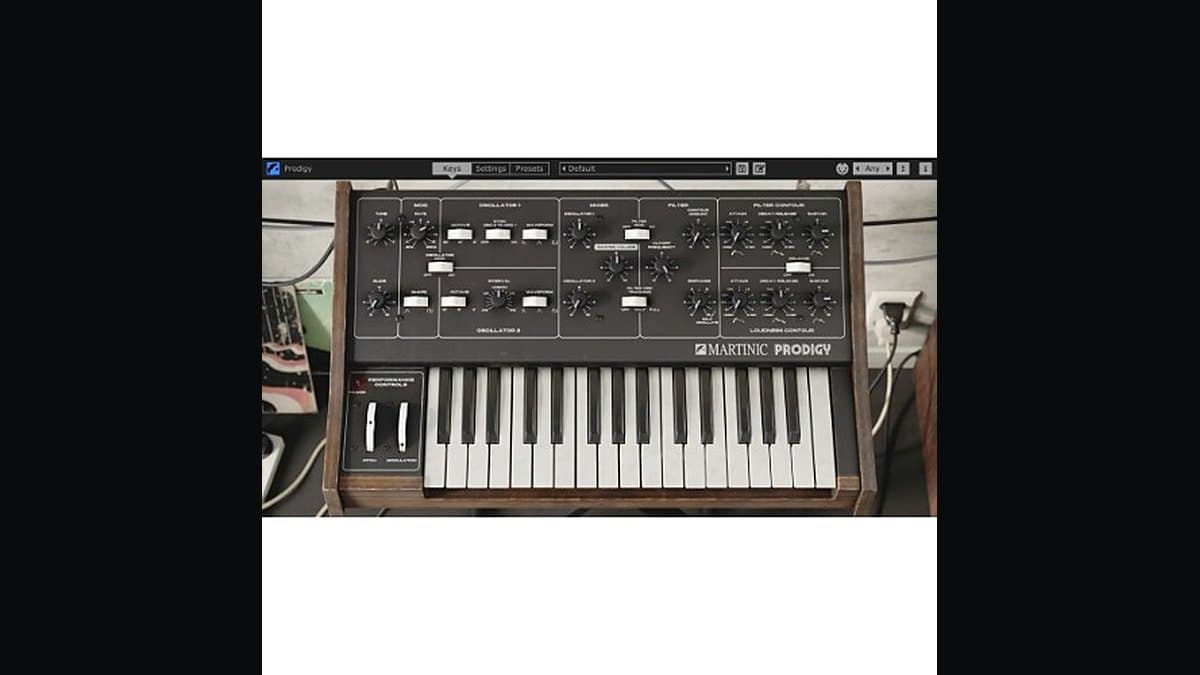
Martinic shipped Prodigy as version 1.0.0 on 3 September 2026. It's an Advanced Circuitry Emulation model of the 1979 Moog Prodigy: the original two-oscillator ladder voice, plus a sub-oscillator, noise, Multidrive, a Moog 905-style spring, and a built-in sequencer. Street price at Best Service is €38.99 / $38.99 excl. VAT through 17 September 2026.
At a glance: €38.99 / $38.99 intro excl. VAT through 17 September 2026. AAX, AU, CLAP, VST2, VST3. Windows 7+ (x86/x64); Windows 11+ on Arm64EC; macOS 10.9+ Intel and Apple Silicon. Mono, 6-voice unison, or 3-voice poly. 300+ factory presets. MPE. Buy it from Best Service.
This is a first look at the shipping instrument and its feature set. We haven't had Prodigy open in a session yet.
What Martinic Prodigy is
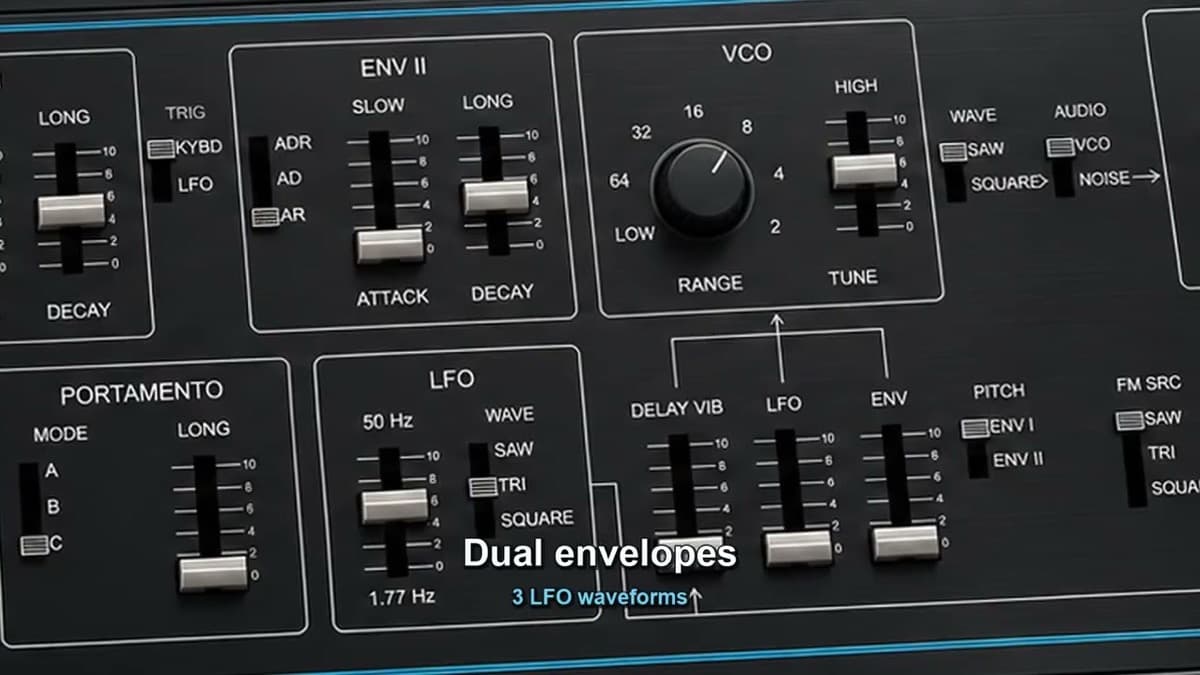
The hardware Prodigy was Moog's late-70s two-oscillator lead and bass machine: two VCOs, hard sync, glide, and a 24 dB/octave ladder. It was never a Minimoog. It was the smaller, cheaper sibling that still had the filter people bought Moogs for. Martinic models that circuit with its ACE engine rather than sampling it, then adds the extras a 1979 panel never had.
That split is the whole product. Everything from the original is present: two VCOs with three octave footages each, hard sync from oscillator 1 to 2, oscillator mix, and a 24 dB ladder with cutoff, emphasis and keyboard tracking feeding separate filter and loudness contours. Martinic's additions are a third and fourth sound source, an extended drive stage, a vintage spring, three voice modes, and a sequencer that runs as one 16-step chain or two parallel 8-step rows.
If you already live in Arturia Mini V or Native Instruments Monark, this is a different Moog. Both of those chase the Minimoog Model D. Prodigy chases the two-oscillator sibling, then spends its extra DSP on sequencing and grit instead of a third oscillator.
Two VCOs, then a sub and noise
Oscillator 1 and oscillator 2 are the original Prodigy pair, each with three octave footages. Martinic extends both to five wave types and adds a pulse-width control the hardware panel never printed. Hard sync is a switch on oscillator 1, locking it to oscillator 2 the way the 1979 circuit did. Oscillator 2 keeps its interval control, so you can park a fifth or an octave and leave it, or ride it for the classic sync scream.
The mixer is still the two-oscillator blend plus master volume, with two extra sources sitting beside that pair. The sub-oscillator is the third: reach for it when a single-oscillator bass needs weight and you'd rather not spend unison on it. The noise generator is the fourth, switchable between pink and white. That's the air under a lead, or the source you sequence into a filter sweep when nothing pitched belongs there. Sync plus sub is the everyday bass patch, while sync plus noise is where the effects work happens.
Ladder, contours, and Multidrive
The filter is a 24 dB/octave low-pass ladder with cutoff, emphasis, keyboard tracking, and a filter-modulation switch. A Filter Emphasis Boost adds bite when a stock ladder starts to feel polite. Contours on the filter and loudness paths run as ADSR or collapse toward ADS and ADR shapes, and a release on/off switch keeps the original Prodigy habit of deciding whether a note dies on the key or after it.
Multidrive is the extended overdrive circuit. The hardware Prodigy already had a sweet spot when you pushed the mixer, and Multidrive turns that into a dedicated stage rather than a happy accident. Park it after the oscillators when a patch needs dirt that isn't just filter scream.
Glide has three behaviors: normal, legato, and gated. That's a real production difference. Legato only glides when notes overlap, and gated ties the glide to the gate, so a sequenced line can slide on some steps and stay put on others.
The 905-style spring
The reverb is a vintage spring inspired by the Moog 905, not a hall algorithm wearing a spring label. It's mono in character, and that's the point. A Prodigy lead into a short tank sounds nothing like the same lead into a plate. Keep it short on bass so the low end doesn't smear.
There's one spring and it belongs to this voice, so it won't stand in for a send suite. Twangström is the specialist if you want a full tank with a deep parameter set. Building the spring into the instrument means a sequenced patch prints with space already on it.
Voice modes: mono, unison, poly
Prodigy runs in three voice modes: fully monophonic, 6-voice unison, and 3-voice polyphonic. The hardware was mono, and that stays the default character. Unison has a detune range. Mono and unison share note-priority handling plus separate loudness-envelope and filter-envelope triggering, so a held bass can retrigger the filter without restarting the amp, or the reverse.
Three-voice poly is enough for a triad, a locked fifth under a lead, or a short chord stab. It isn't a pad workstation. If you need ten voices and a dual layer, GForce Prophet~5 is the other vintage analog on this desk. Panning and keyboard width sit on the output, and they're how a mono Prodigy line occupies a stereo mix without reaching for a chorus plugin.
The sequencer is the modern half
The original Prodigy had no sequencer and no arpeggiator. Martinic added a sequencer module inspired by the Roland 182: two rows of eight steps, or one serial chain of up to 16. Length runs 1 to 16, and the rate is free or tempo-synced.
Each step can trigger the loudness envelope, the filter envelope, or both. Pitch is set per VCO and can be scale-quantized. The same rows also sequence filter level, sound-source mix, pulse width, volume, and panning, with looping, one-shot, and step-at-a-time trigger modes.
That's how a two-oscillator mono synth becomes a bassline machine. Write a 16-step pitch row, put filter moves on the second row, and leave Multidrive and the spring alone. Or run two parallel 8-step rows and let oscillator 1 and oscillator 2 walk different intervals. The hardware couldn't do any of that.
The LFO keeps the original 0.26 to 31 Hz range and adds five wave types, per-VCO levels, retrigger, tempo-sync, and destinations covering sound sources, pulse width, volume, and panning. Those destinations move a static lead without a dozen automation lanes.
MPE, MIDI, and presets
MPE covers pitch, velocity, and pressure. Every control is MIDI-learnable, and Prodigy supports Program Change, sustain on CC#64, and a volume pedal on CC#11. The keyboard spans C1 to C7 (73 notes) instead of the hardware's 32-key F-to-C panel, with the full velocity range.
Factory content is 300+ presets. Best Service lists the Insurgent Circuits collection as a separate preset pack at €10.25 / $10.25. Activation runs through a Martinic account and needs an internet connection.
Martinic Prodigy specifications
| Spec | Detail |
|---|---|
| Type | ACE-modeled 1979 Moog Prodigy virtual analog |
| Oscillators | 2 VCOs (5 wave types, pulse width, hard sync), sub-oscillator, pink/white noise |
| Filter | 24 dB/octave low-pass ladder; cutoff, emphasis, tracking, Emphasis Boost |
| Drive / space | Multidrive; Moog 905-style vintage spring |
| Voice modes | Mono; 6-voice unison with detune; 3-voice poly |
| Sequencer | 16-step serial or dual 8-step parallel; pitch, filter, PW, level, pan |
| Keyboard | C1 to C7 (73 notes); glide normal / legato / gated |
| MIDI / MPE | MPE pitch, velocity, pressure; MIDI Learn; Program Change; CC#64; CC#11 |
| Presets | 300+ factory |
| Formats | AAX, AU, CLAP, VST2, VST3 |
| Windows | 7+ x86/x64 (AAX, CLAP, VST2, VST3); 11+ Arm64EC (CLAP, VST2, VST3) |
| macOS | 10.9+ Intel and Apple Silicon (AAX, AU, CLAP, VST2, VST3) |
| Version | 1.0.0, 3 September 2026 |
| Price | €38.99 / $38.99 excl. VAT intro at Best Service through 17 September 2026 |
Martinic Prodigy vs Mini V and Monark
| Martinic Prodigy | Arturia Mini V | NI Monark | |
|---|---|---|---|
| Hardware target | 1979 Moog Prodigy (2 VCO) | Minimoog Model D (3 VCO) | Minimoog-style mono |
| Extra sources | Sub-osc + noise | Effects + arpeggiator | Focused mono voice |
| Sequencer | 16-step or dual 8-step | Arpeggiator | None built in |
| Voice modes | Mono, 6-voice unison, 3-voice poly | Up to 6-voice poly | Mono only |
| Formats | AAX, AU, CLAP, VST2, VST3 | Standalone, VST, VST3, AU, AAX, NKS | VST3, AU, AAX |
| Best for | Sequenced two-VCO leads and basses | Model D bass and leads with effects | Raw mono Mini inside Komplete |
Prodigy makes sense when you want the two-oscillator ladder with a sequencer attached and you're happy to buy at intro price. Mini V is the better call if a third oscillator and the Model D bass language matter more than step sequencing. Monark suits producers already inside Komplete who want a raw mono Mini with no extra modules. TAL-BassLine-101 covers similar cheap analog-style bass ground from a different circuit, while Prodigy stays narrower: two VCOs, a ladder, a spring, and a sequencer.
Who Martinic Prodigy is for
Prodigy suits producers who want a 1979 Moog lead and bass voice with a step sequencer in the same window. It's a strong fit for acid-adjacent lines, sync leads, unison basses, and short three-voice stabs. MPE players get pitch, velocity, and pressure on a circuit that started life as a two-octave mini-key mono. Anyone still running macOS 10.9 or Windows 7 can install it, which is rare in 2026.
Skip it if you need a three-oscillator Minimoog, a ten-voice dual-layer poly, or a visual wavetable desk. Three-voice poly won't replace Prophet~5, and the spring won't replace a dedicated reverb. Pro Tools users get AAX, so format isn't the gap. The gap is scale, because this is a focused analog instrument rather than a collection.
How much does Martinic Prodigy cost?
Prodigy is €38.99 / $38.99 excl. VAT at Best Service through 17 September 2026. That's the current intro street price. The intro offer page also lists the Insurgent Circuits preset collection at €10.25 / $10.25. Formats are AAX, AU, CLAP, VST2, and VST3 on Windows and macOS, and license activation goes through Martinic.
FAQ
What is Martinic Prodigy?
Martinic Prodigy is an ACE-modeled software version of the 1979 Moog Prodigy. It keeps the two-VCO ladder architecture and adds a sub-oscillator, noise, Multidrive, a 905-style spring, mono / 6-voice unison / 3-voice poly, a 16-step sequencer, MPE, and 300+ presets.
How much does Martinic Prodigy cost?
€38.99 / $38.99 excl. VAT at Best Service through 17 September 2026.
Does Martinic Prodigy have a sequencer?
Yes. It runs as one serial chain of up to 16 steps or two parallel 8-step chains. The rows sequence pitch with optional scale quantize, plus filter level, sound sources, pulse width, volume, and panning, and each step can retrigger the loudness and filter envelopes.
Martinic Prodigy vs Mini V?
Prodigy models the two-oscillator 1979 Prodigy and spends its extras on a sequencer, Multidrive, and a spring. Mini V models the three-oscillator Minimoog and spends its extras on effects and an arpeggiator. Choose Prodigy for sequenced two-oscillator lines at intro price, or Mini V for classic Model D bass and leads.
What are the Martinic Prodigy system requirements?
Windows 7 or newer for x86/x64 (AAX, CLAP, VST2, VST3), Windows 11 or newer for Arm64EC (CLAP, VST2, VST3), and macOS 10.9 or newer on Intel or Apple Silicon (AAX, AU, CLAP, VST2, VST3). A Martinic account is required to activate the license.
Verdict
Prodigy is a two-oscillator Moog voice with a sequencer bolted on in a way the hardware never allowed. The ACE model of the 1979 circuit is the reason to care, and the 16-step sequencer, Multidrive, and 905-style spring are what keep the plugin from feeling like a museum piece. At €38.99 / $38.99 through 17 September, the intro is a cheap way to find out whether this is your analog lane. It won't replace a three-oscillator Minimoog, and the three-voice poly is a bonus rather than a workstation. Browse our virtual analog coverage to see where it sits next to Mini V, Monark, and the other ladder-filter instruments on the shelf.