Hexant DSP Torsion: Pitch and Hertz on One Insert
Hexant DSP Torsion is a $49.99 intro multiband pitch and frequency shifter for VST3 and AU, no iLok. Morph, Diatonic, Sub-Anchor, and who should buy it.
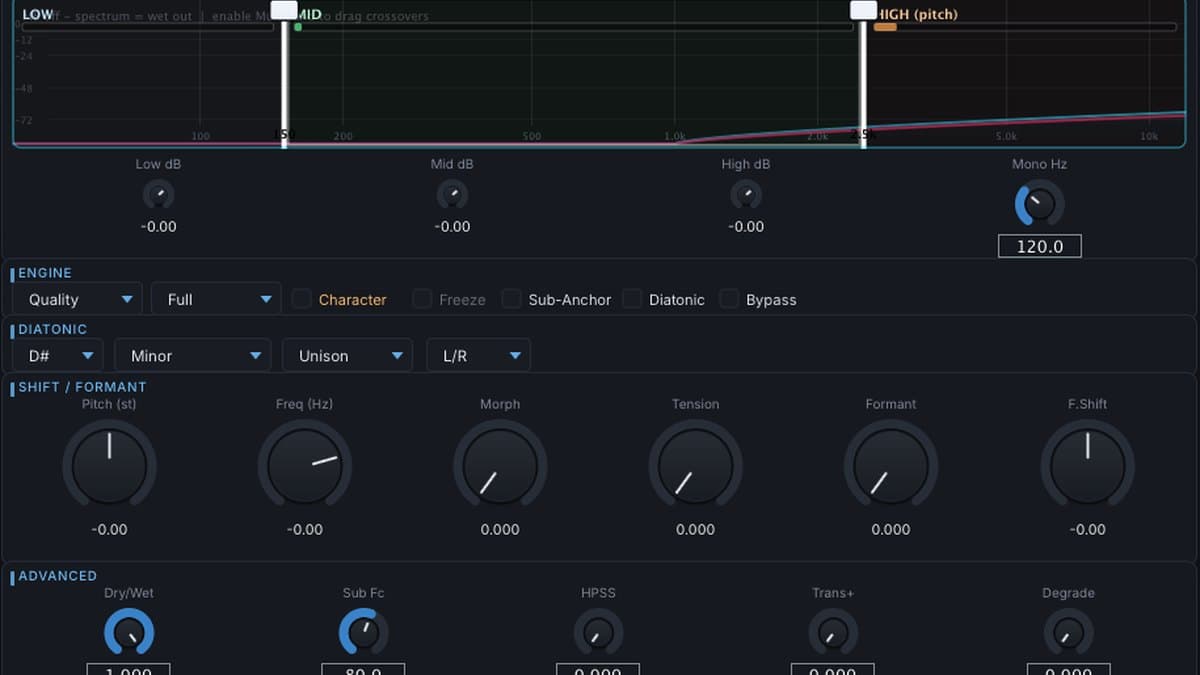
Hexant DSP shipped Torsion, a multiband insert that puts musical pitch shift and linear frequency shift on the same signal, with Morph to blend the two. You can hold the sub, stay in key, and keep hats sharp. The intro price is $49.99 against $79.99, and checkout runs on Lemon Squeezy on the manufacturer site. This is a first look at the shipping board. We have not used it in a session.
At a glance: $49.99 intro, $79.99 regular. VST3 and AU, on macOS 10.13+ and Windows 10 x64 or later. Perpetual license, three machines, offline keyfile, no iLok. Buy it from hexantdsp.com/torsion.
What Torsion is
A pitch shifter is musical. Plus 12 semitones is an octave, harmonic ratios stay put, and a saw is still a saw, just higher.
A frequency shifter is linear, so every partial moves by the same number of Hertz. A 50 Hz fundamental plus 50 Hz becomes 100 Hz, while its 100 Hz harmonic becomes 150 Hz. The ratios break, and you get bells, metal, growls, and "wrong" tuning.
Most plugins pick one of those jobs. Torsion gives you both plus Morph on one insert, and Low, Mid, and High can each carry their own Pitch, Freq, Morph, Tension, and Formant. The official one-liner doubles as the brief: lock the sub, stay in key, keep the hats sharp, morph between a fifth and metal.
It isn't a vocal tuner, and it isn't a harmonizer that voices chords. Diatonic can snap a monophonic line to a scale interval, but it won't build a choir, and formants here mean body size rather than vowel letters.
Little AlterBoy is the simple monophonic voice box with pitch, formant, and hard-tune. Portal is granular motion. Torsion is the shifter for bass, perc, and in-key intervals when you also want the metallic path available.
Hexant hosts a demo clip on the official Torsion page: the plugin on a Serum Init patch, with nothing else in the chain.
Pitch, Freq, and Morph
These six knobs are the instrument. With Multiband off they're global, and with Multiband on each band gets its own set.
Pitch runs -24 to +24 semitones. Harmonics stay in ratio, so a fifth stays a fifth.
Freq runs -2000 to +2000 Hz. Small values in the 5 to 40 Hz range beat and detune, while larger values go metallic or bell-like.
Morph is 0 to 1. Zero is pure pitch and one is pure frequency shift, and in between the fundamental can sit where Pitch put it while the overtones tear. That's the control other shifters skip. The official teaching patch is a static saw: Pitch +7 with Morph at 0 for a clean fifth, then raise Morph until the fifth becomes a weapon.
Tension stretches the upper partials for more bite. It fades out as Morph approaches 1, because frequency shift is already warping the spacing.
Formant amount holds or releases the spectral envelope while pitch moves. Zero is classic helium, and higher settings keep the same mouth or body at the new note.
Formant shift moves that preserved envelope -12 to +12 semitones, independent of Pitch. Negative is bigger and darker, positive is smaller and brighter.
Drag an LFO handle onto Pitch, Freq, Morph, Tension, Formant, or F.Shift, and the colored ring shows you the depth.
Multiband, Sub-Anchor, Natural Low
Multiband splits Low, Mid, and High. The first time you enable it, Torsion copies the global pitch onto Mid and sets Low to Natural, so you don't pitch the sub by accident.
Crossovers default to 150 Hz and 2500 Hz, and you can drag them without them crossing over each other. Click a zone to edit that band.
Natural Low keeps the sub dry, while Pitch Low sends the low band through its own shifter. High Mode offers Natural Top, Mute Top, or Pitch Top.
Sub-Anchor works independently of the multiband split, holding everything below a frequency (default 80 Hz, range 40 to 200 Hz) out of the shifter. The kick fundamental stays and everything above it can move. Turn it on for bass work and off for full-range FX. Character grain forces it off, because the grain engine uses a variable delay and a locked sub would drift.
Mono Below folds the signal to mono under Mono Hz, defaulting to 120 Hz. That's the phone and PA safety net, and it's separate from the Low crossover.
Here's the 808 patch: Bass profile, Sub-Anchor on, Mid Morph up, and High either feral or muted. The kick stays and the body growls.
Diatonic, hats, and the two engines
Diatonic tracks the incoming note and snaps the shift to a scale and interval, so a fifth in C minor stays in C minor. The pitch still moves, it just lands in the scale. Full and Vocal profiles assume one main pitch, which means chords, stacked basses, and wide unisons will confuse the tracker. A banner appears when the profile is making that monophonic assumption.
HPSS is the hat control, running a harmonic and percussive split on the Quality engine with multiband off. Higher values send more of the attack around the smear, and Trans+ pushes the hit back up after the shift. The official perc patch is Profile Perc with multiband off, HPSS raised, then a Transient boost.
HPSS is unavailable while Multiband is on, since the split already gives you somewhere to park transients.
Quality is the mix engine and it reports latency, so leave delay compensation on. Live is the low-latency path for tracking and monitoring. They're different algorithms rather than one process at two speeds, so a patch you love in Quality may need a retweak in Live.
Profiles retune the engine rather than EQ it: Bass, Full, Perc, Tonal Mid, and Vocal.
LFOs, Character, Degrade, width
Two tempo-sync LFOs, with LFO 1 in cyan and LFO 2 in yellow. Drag a handle onto a knob to assign it. Sync divisions run from 2 bars down to 1/32, plus triplets and dotted values. Unipolar is the default, Serum-style, running from the knob toward the ring, while bipolar swings both sides. Shapes cover sine, triangle, square, and saw. The LFOs keep running with the transport stopped, so a preview note still wobbles.
Character switches pitch to a time-domain grain engine with freeze, scatter, and pitching delay. It's punchier and looser, with different artifacts, and Sub-Anchor turns off while it's active. Morph, formant, and HPSS stay on the Quality path.
Degrade is bounce-down grit on the wet path only. Zero is clean, and one is a hard crush on the order of a 32x downsample. Blend it back with Dry/Wet.
M/S width includes Center Lock, Side HPF, and Mono Below, and the fold is designed to survive mono.
Factory presets on the official board include Init, Bass Protect, Neuro Reese, Octave Up/Down, Fifth Harmony, Inharmonic Metal, Freq Shift Bell, Live Monitor, Character Pad/Scatter, Multiband Split, Wide Phase-Safe, Diatonic 5th, LFO Wobble, HPSS Punch, Vocal Quality, Perc Live, and a row of Degrade starting points. Treat them as starting patches.
Torsion specifications
| Spec | Detail |
|---|---|
| Developer | Hexant DSP |
| Type | Multiband hybrid pitch and frequency shifter |
| Pitch | -24 to +24 semitones |
| Freq | -2000 to +2000 Hz |
| Morph | 0 (pitch) to 1 (frequency shift) |
| Bands | Low, Mid, High, with Natural Low / Pitch Low and High modes |
| Key tools | Diatonic, Sub-Anchor, HPSS, Trans+, Formant, dual LFOs |
| Engines | Quality (mix, latency reported) and Live (low latency) |
| Profiles | Bass, Full, Perc, Tonal Mid, Vocal |
| Extra | Character grain, Degrade, M/S width |
| Formats | VST3, AU |
| macOS | 10.13+ |
| Windows | 10+ x64 |
| Auth | Offline keyfile after first Lemon Squeezy activation |
| iLok | None |
| License | Perpetual, 3 machines |
| Intro price | $49.99 |
| Regular price | $79.99 |
| Buy | hexantdsp.com/torsion |
Torsion vs Little AlterBoy vs Portal
| Torsion | Little AlterBoy | Portal | |
|---|---|---|---|
| Job | Multiband pitch + Hz shift + Morph | Monophonic voice pitch / formant / hard-tune | Granular FX textures |
| Street / list | $49.99 intro / $79.99 | $99 on our Little AlterBoy card | $149 on our Portal card |
| Formats | VST3, AU | VST, VST3, AU, AAX | VST, VST3, AU, AAX |
| Auth | Offline keyfile, 3 machines, no iLok | Soundtoys license | Output license |
| Best for | Bass, perc, in-key intervals, metal | Fast vocal character | Pads, grains, transitions |
Which to pick. Torsion is the one when you want a fifth that can turn inharmonic and you need the sub to stay put. Little AlterBoy makes more sense when the track is a vocal and you want three knobs. Reach for Portal when the job is grains rather than a shifter.
Effectrix 2 sequences many effects, while Torsion is one shifter with a lot of routing. ShaperBox 3 draws LFO motion across effect types, and Torsion's LFOs only drive the shifter knobs.
Who Torsion is for
Consider it if you write bass music and you're tired of pitch plugins that lift the kick.
Consider it if you want in-key interval lines from Diatonic and metallic FX out of the same insert.
Consider it if hats and snares have to click after the shift, because Perc plus HPSS plus Trans+ is the intended patch.
Consider it if three machines, an offline keyfile, and no iLok is the kind of license you can live with.
Consider it if $49.99 is the price that finally gets a shifter onto the mix bus this week.
Skip it if you need AAX or Pro Tools, since Torsion is VST3 and AU.
Skip it if you wanted Autotune or a choir, because it won't tune a stack of vocals or voice a chord.
Skip it if you needed clip-based Elastique or Warp. Quality mode has latency, and this is an insert rather than a clip algorithm.
Skip it if Little AlterBoy already covers the vocal tricks you use and you don't need Hz shift.
How much Torsion costs
$49.99 intro against $79.99 regular, direct from hexantdsp.com/torsion through Lemon Squeezy checkout. The license is perpetual, covers three machines, and runs offline after the first activation. No iLok.
The plugin card lives at /plugins/hexant-dsp-torsion, and the on-site guide is hexantdsp.com/torsion/manual.
FAQ
Is Torsion a pitch plugin or a frequency shifter?
Both. Pitch is musical, Freq is linear Hz, and Morph blends them on the same signal.
Will it stay in key?
Diatonic mode tracks a monophonic line and snaps the interval to a scale. Chords and stacked unisons will confuse it.
Does Torsion need iLok?
No. It's an offline keyfile across three machines, issued against a Lemon Squeezy serial.
What are the system requirements?
VST3 and AU, on macOS 10.13 or later and Windows 10 x64 or later.
Quality or Live?
Quality for the mix, with delay compensation on, and Live for tracking. They don't sound identical.
The bottom line
Torsion is a multiband pitch-and-Hertz shifter with Morph, a locked sub, and a perc path that tries to keep the click. $49.99 intro against $79.99. We have not scored it.
Play the Serum Init demo on the official page, then put Torsion on a bass and a hat bus. If Sub-Anchor plus Morph replaces a pitch plugin and a separate frequency shifter, pay the intro. The storefront is hexantdsp.com/torsion.