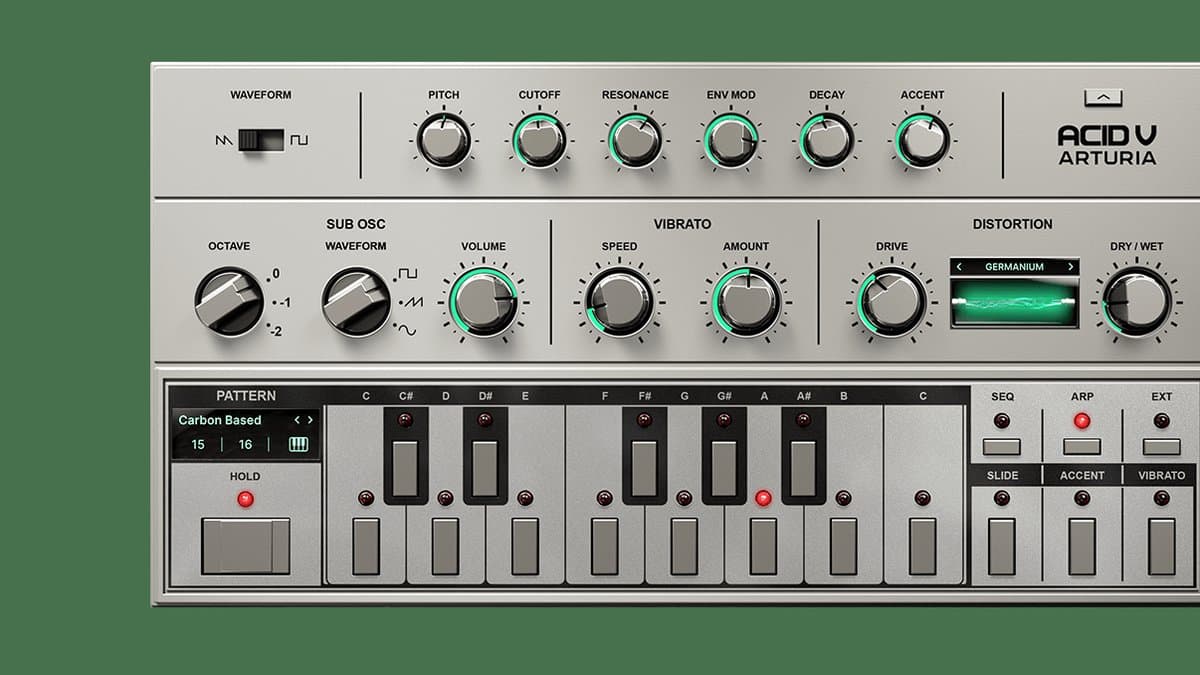
Arturia Acid V is a modern TB-303-inspired acid bassline synthesizer—built for the filter scream, slides, and accents that defined acid house, techno, and decades of electronic music. Arturia’s angle is not “hardware museum only.” It is authentic grit plus a 21st-century sequencer and FX rack: polymetric step sequencing up to 64 steps, modulation, multi-effects, and MIDI pattern export.
If you already know the 303 story—failed bass guitar substitute turned underground icon—you know the sound lives in the interaction of note length, slide, accent, and resonant low-pass filter. Acid V is designed around that interaction, then expands it.
What you are actually buying
The acid voice
A monophonic bassline engine optimized for:
- Resonant filter sweeps
- Accented notes that open the filter and level
- Slides between notes
- Drive/distortion that turns polite lines into corrosive rave energy
The sequencer (the real productivity unlock)
Arturia positions the sequencer as the part 303 fans always wanted:
- Up to 64 steps
- Polymetric sequencing
- Slide, accent, octave tools
- Transmutation (generate/alter sequences)
- Built-in scales
- Pattern shift tools
- Drag-and-drop MIDI export
- Large bank of sequence presets (Arturia advertises 350+)
That means Acid V is both a sound source and a pattern laboratory. Another mono synth with a 64-step sequencer on board is the Audio Blast V10F, modeled on the Kawai 100F.
Modulation and FX
Multiple modulators plus a multi-slot FX path with a large algorithm list turn static squelch into evolving phrases—delays, modulation FX, drive stages, and more without leaving the plugin.
How to use Acid V
Classic 16-step acid (start here)
- Load a basic acid preset or init.
- Sequence root–fifth–octave patterns with mixed gates.
- Put accents on notes you want to jump forward.
- Enable slides into destination notes for the liquid glue.
- Set resonance high, envelope modulation on cutoff moderate-to-high.
- Automate or hand-ride cutoff across 8–16 bars.
- Add light drive; stop before it becomes only noise.
Modern techno / peak-time
- Longer patterns (32–64) with polymetric accents.
- Use transmutation to mutate a good 8-bar idea instead of rewriting.
- FX: short delay + drive; high-pass the delay return in the DAW if mud builds.
- Sidechain the bass to the kick after Acid V if the DAW chain needs it.
Export patterns to other synths
- Build the groove in Acid V’s sequencer.
- Drag MIDI to a clip.
- Drive a different bass or lead while keeping Acid V as the 303 layer.
- Layer for hybrid “acid + modern mono” stacks.
Mix tips
- High-pass competing mid bass; leave the 303 its midrange scream
- Saturate in stages (plugin drive + gentle bus) rather than one nuclear clip
- Don’t bury accents with heavy bus compression—accents are the performance
- Reverb: short only; long halls wash the filter moves
Acid V vs alternatives
| Instrument | Role |
|---|---|
| TAL-BassLine-101 | SH-101 / acid-adjacent classic, often cheaper |
| D16 Phoscyon 2 | Another serious 303-class competitor (not in every DB yet) |
| Monark / Mini V | Analog mono classics, not 303 specialists |
| Hardware 303 / boutique clones | Physical performance; high cost |
Who should buy it
Buy Acid V if acid patterns are a regular part of your writing and you want sequencer + FX in one place. Skip if you already love another 303 and never miss Arturia workflow, or if you only need a simple square bass without slides.
Honest limitations
It is a specialist. It will not replace a full polyphonic analog. Sales culture means waiting can save money. And no plugin writes a good riff—accent placement still takes taste.
Verdict
Arturia Acid V is a strong modern acid workstation: 303-class voice, deep polymetric sequencing, modulation/FX, and MIDI export for hybrid workflows. Score 8.6.
Confirm price and demo on the official Arturia page. If the filter and sequencer click on a 16-bar loop, you will know within ten minutes.