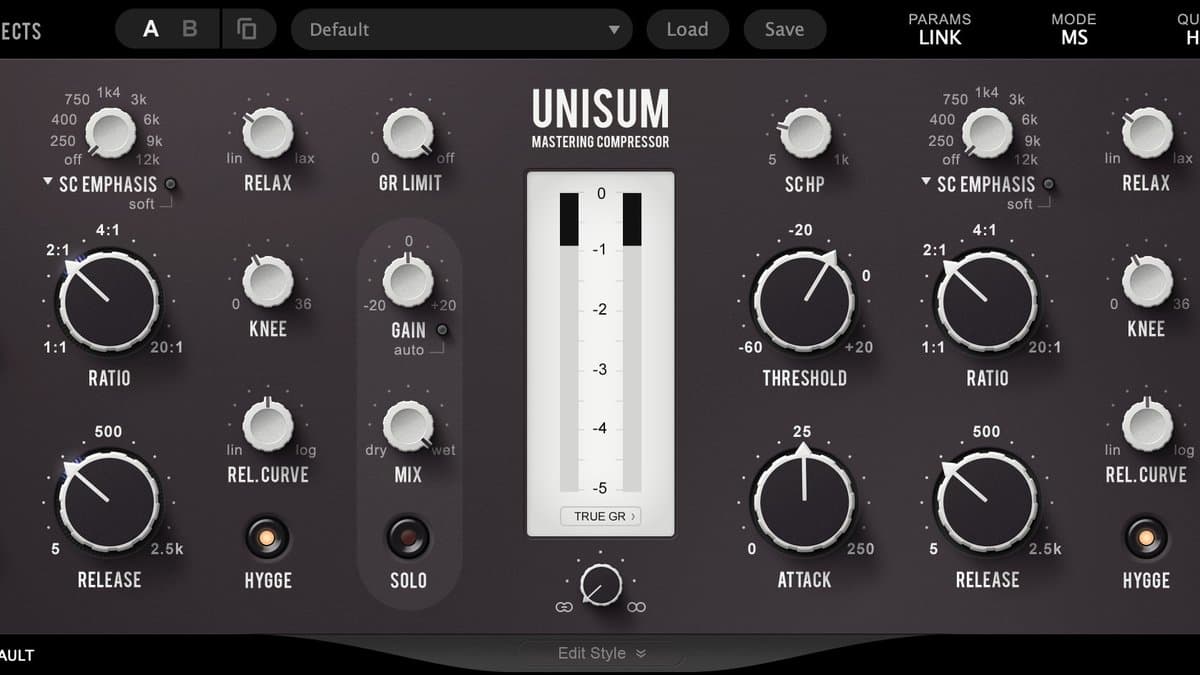
Tone Projects Unisum is a state-of-the-art digital mastering compressor built around a clear idea: keep gain reduction clean and wideband, but let the detector be sophisticated. Instead of forcing multi-band audio crossovers that can smear a master, Unisum uses a flexible multi-band detection scheme (plus parallel RMS/Peak thinking) so you can tailor what triggers compression while the audio path stays coherent.
That design, plus Hygge warmth, Memory Effect envelopes, Mid/Side, and serious transfer-curve control, is why Unisum shows up in “serious mastering compressor” conversations next to Weiss-class tools—without pretending to be an AI one-knob maximizer.
Why Unisum feels different
Clean wideband compression
Tone Projects emphasizes extremely low intermodulation distortion and careful anti-aliasing behavior. In practice, that means you can often apply more GR than expected before the master falls apart into digital grit. Clean does not mean lifeless—especially once Hygge or envelope shaping enters.
Multi-band detection without multi-band damage
You can bias threshold/ratio/envelope response by frequency region in the detector, not by splitting the audio into independent band compressors. This is the “change the character of the compressor” trick people chase: make lows trigger less, emphasize mid push, etc., while the program still compresses as one.
Hygge
Hygge is a switchable circuit of level- and frequency-dependent saturation and filtered feedback stages inspired by transformer/tube behavior. It is for weight and thickness, not metal distortion. Engage it when a master is technically fine but emotionally thin.
Envelope design that rewards attention
- Memory Effect — program dependency of attack/release (opto-like or inverted)
- Transient Override — different envelope behavior for loud hits
- Parallel secondary envelope — smooth without killing responsiveness
- Attack/release curve shaping — including release continuous between linear and logarithmic
This is where Unisum leaves “ratio + attack + release” toys behind.
Stereo / Mid-Side + linking
Full M/S mode with separate controls and continuously variable linking (with advanced link filters/limits) lets you design center vs side behavior instead of accepting fixed stereo linking forever.
How to use Unisum
Mastering: transparent glue
- Insert after corrective EQ (or as your primary dynamics after gentle EQ—order is material dependent).
- Start with a Style preset if you want a known-good baseline, then customize.
- Use low ratio and slow-ish attack so transients survive.
- Aim for ~0.5–2 dB GR on peaks for true mastering subtlety (more only when the mix needs it).
- Shape release so GR returns between phrases without pumping.
- Enable loudness-based Auto-Gain for fair A/B, or match manually.
- Try Hygge only after the compression motion is right.
Mastering: denser modern program
- Slightly higher ratio / lower threshold for more density.
- Use detector bias so kick energy does not own every GR wiggle (sidechain HPF / multi-band detect focus).
- Transient Override to keep drums from disappearing.
- Parallel dry/wet if full wet feels too small.
- Finish with a true-peak limiter (Pro-L 2, smart:limit, MM-1, etc.).
Mix bus polish
Light Unisum on the stereo bus can add “finished” cohesion. Keep GR modest. If you want SSL crack, use The Glue; if you want opto vocals, use CL 1B—Unisum is program polish, not every compressor job.
Mid/Side mastering moves
- Compress mid more than side to stabilize vocals/center
- Gentle side compression to calm wide splash without killing mono punch
- Variable linking so channels share motion without hard dual-mono weirdness
Always mono-check after M/S work.
Controls cheat sheet
| Area | What to touch | Why |
|---|---|---|
| Detector / sidechain filters | HPF, LPF, emphasis | Stop kick or air from mis-keying |
| Transfer curve | Knee, GR Limit, Linearity | Soft vs hard compression personality |
| Envelopes | Memory, Transient Override, curves | Musical motion vs pumping |
| Hygge | On/off + context | Weight without extra plugins |
| M/S + linking | Mode + link amount | Center vs width control |
| Quality modes | Real-time → Pristine | CPU vs fidelity (especially offline) |
| Dry/Wet | Parallel | Density without full clamp |
Unisum vs alternatives
Weiss DS1-MK3 — Broader dynamics suite heritage (limit/de-ess/band tools). Unisum is a focused modern mastering compressor with Hygge and detector design.
FabFilter Pro-C 2 — Flexible mix compressor with great UI. Unisum aims more squarely at mastering-grade cleanliness and transfer-curve depth.
Cytomic The Glue — SSL-style VCA bus character. Different flavor and job.
Tone Projects Michelangelo — Companion philosophy for EQ/tone sculpture; often paired in Tone Projects-centric chains.
Who should buy it
Buy Unisum if mastering (or mix finishing) is a real part of your work and you want a compressor that can be transparent or gently colored without leaving the clean digital tier. Ideal if you enjoy deep control and hate black-box AI-only tools.
Skip if you only need a vocal opto or a simple drum bus smash—those jobs have cheaper, more specialized answers.
Honest limitations
Depth means homework. Hygge will not fix a harsh mix. Unisum is not your final true-peak ceiling. And “clean” compressors still require gain-matched A/B—louder still lies.
Verdict
Tone Projects Unisum is a flagship mastering compressor for engineers who want clean wideband control, detector intelligence, Hygge weight, and Mid/Side flexibility without multi-band phase soup. Score 9.0.
Confirm current version, trial, and price on the official Unisum page. Trial it on a real master bus with Hygge off first—earn the color after the motion is right.