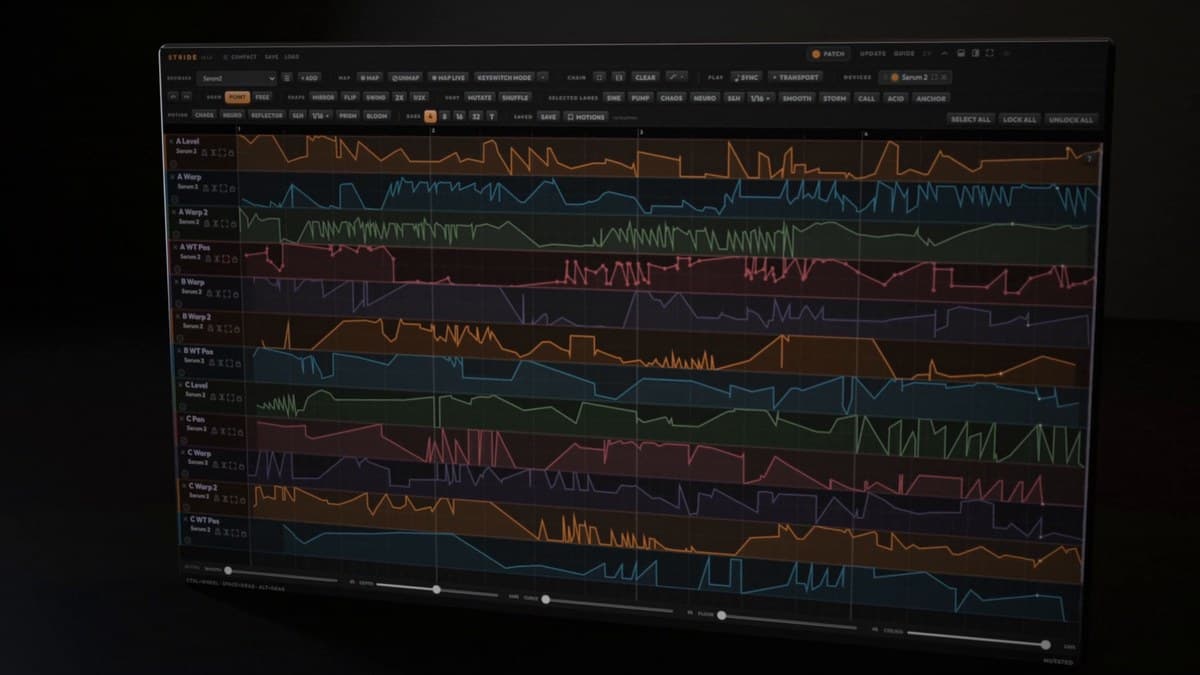
Stride is a sound design engine for the instruments and effects you already own. You load them inside Stride, arm Map and click the knobs you want moving, and each control becomes its own lane on a shared canvas. One click of a Motion tool writes a different evolving curve on every unlocked lane, in loops of 2 to 32 bars locked to your DAW's tempo. Lock the lanes that work, reroll the rest, then reshape any curve by hand with point and freehand drawing, mirror, flip, swing and time stretch.
The six Motion tools each have a clear character. Chaos writes organic, layered waves; Neuro writes chops, stutters and syncopated drops for bass music; Reflector mirrors pairs of lanes; Sample & Hold steps randomly per lane or on a grid; Prism and Bloom spread one lane's shape across the others. Keyswitch Mode fires eight tools from one octave of a MIDI keyboard, and note-triggered motion restarts the canvas with your playing. Stride FX adds Audio In, so a guitar or vocal can run through a hosted effects chain with every mapped knob moving.
The limits are formats. Stride runs as VST3 and, on macOS, AU; there is no AAX, and VST2 plugins cannot be hosted. Compared with Kilohearts Multipass, which has deep modular modulation but hosts only Kilohearts Snapins, Stride works with your third-party synths and effects. Blue Cat's PatchWork is the better pure host for routing and Pro Tools. Read our Stride Engine first look for the full feature breakdown, specs and pricing.