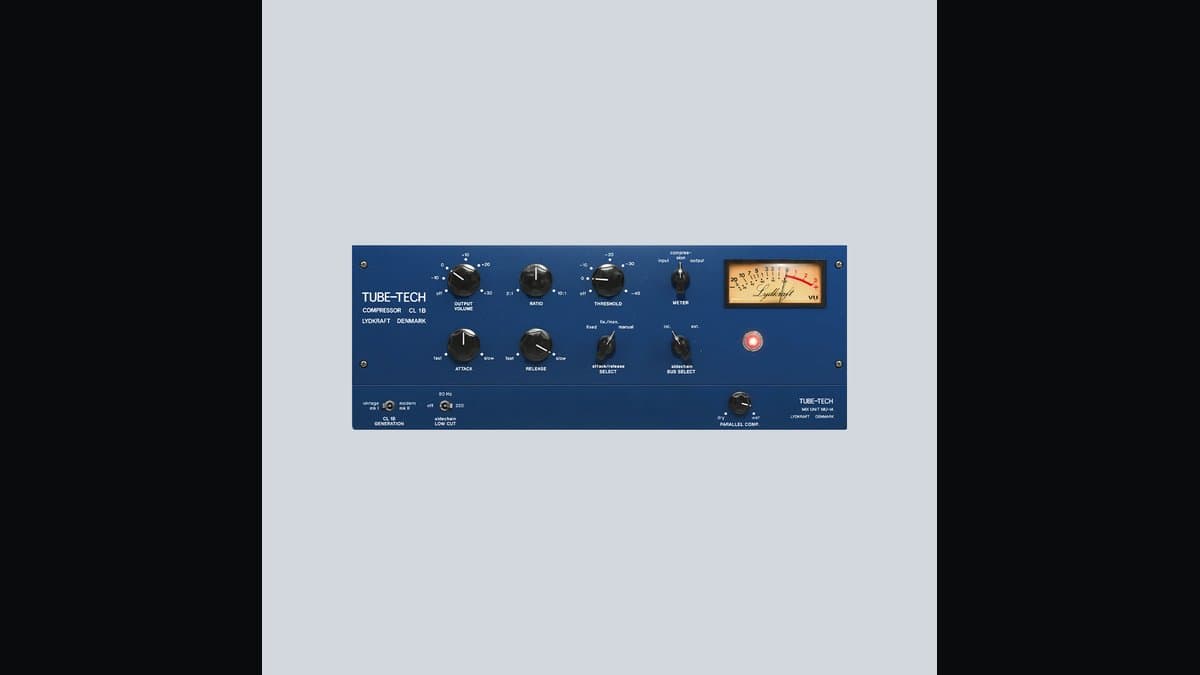
Softube’s Tube-Tech CL 1B Mk II is the modern native take on one of the most copied vocal compressors in popular music: the Tube-Tech CL 1B optical compressor. Softube’s package is explicitly two compressors in one UI—the legacy Mk I model and a ground-up Mk II remodel—with a Generation Switch so you can flip eras without loading two plugins.
People call it “the vocal compressor” for a reason. Optical gain reduction tends to feel smooth and musical on sung material: it can even levels without the snappy aggression of an 1176 or the clinical grab of some clean digital compressors. That same behavior is why it also lands on bass and guitars when you want control without sandpaper.
What optical compression is doing for you
CL 1B-style opto circuits don’t clamp like a FET peak stopper. The gain cell’s behavior has a program-dependent smoothness that many mixers describe as “can’t sound bad” when used with modest GR. That does not mean infinite GR is free. It means the distortion and envelope character often stay musical longer than hard digital limiters when riding a vocal.
Hardware CL 1B units are tube optical designs with a reputation across rock, pop, and hip-hop. Softube’s authorized modeling path has been the industry’s reference software version for years (including the long association with UAD-branded Tube-Tech plugins).
Mk I vs Mk II (how to choose)
| Mk I | Mk II | |
|---|---|---|
| Identity | Earlier Softube CL 1B many templates still use | Ground-up remodel with newer Softube tech |
| When people pick it | Familiar “classic plugin” vocal sound | Cleaner modern remodel, updated UI feel |
| How to decide | A/B on your vocal at equal loudness | Same—song dependent, not marketing dependent |
Do not assume Mk II always wins. Plenty of engineers still prefer Mk I on certain voices. The Generation Switch exists so you stop guessing and start comparing.
Software extras that matter
Sidechain low-cut filters low energy from the detector, not necessarily the main path. Practical result: kick or proximity bass on a vocal/bass track does not force the compressor as hard. Softube documents discrete low-cut options (commonly discussed around 80 Hz / 220 Hz style choices—confirm in your build’s UI).
Parallel mix lets you dig deeper and blend dry body back—critical when a vocal needs control but still wants air and consonants.
Console 1 readiness matters if you mix on Softube’s hardware/software system; otherwise ignore and use it as a normal insert.
How to use CL 1B (workflows)
Lead vocal (primary job)
- Gain-stage the clip so peaks are healthy before the compressor.
- Insert CL 1B early-ish in the vocal chain (after cleanup EQ/pitch as your template prefers).
- Start with moderate ratio and attack/release that follow the phrase speed.
- Aim for a few dB on loud words, less on quiet phrases—automate threshold/gain if the performance is wild.
- Try sidechain low-cut if plosives/lows are pumping the GR.
- If it feels small, raise parallel wet/dry instead of slamming threshold.
- Flip Generation Switch and keep the winner.
Background vocals
Faster control, sometimes higher ratio, often more parallel. Stacks of BVs love opto glue as long as sibilance is handled elsewhere (de-esser after or before depending on chain).
Bass
Medium-slow attack to keep the note front; release timed to tempo. Sidechain low-cut can help if you only want the mid harmonic content to drive GR. Opto on bass is about evenness and note length, not 808 click design.
Parallel drum bus (secondary)
Not its most famous job, but a gentle opto parallel can thicken roomy kits. If you want crack and punch, use a bus VCA (The Glue / SSL) instead.
Settings starting points
| Source | GR target | Attack feel | Release feel | Notes |
|---|---|---|---|---|
| Pop lead vocal | 2–6 dB peaks | Medium | Song-tempo | A/B Mk I/II always |
| Aggressive rap vocal | 3–8 dB | Medium-fast | Medium | Watch consonants; de-ess nearby |
| Bass DI | 2–5 dB | Medium-slow | Medium | Sidechain HPF if needed |
| Acoustic guitar | 1–4 dB | Medium | Medium | Parallel if it shrinks |
These are starting points. Match output loudness when comparing.
CL 1B vs alternatives
UAD LA-2A collections — Simpler opto peak reduction vibe. Choose LA-2A for fixed-classic flavor; CL 1B when you want more adjustable control.
Analog Obsession LALA — Free LA-2A-style path. Great budget opto; CL 1B is the paid Tube-Tech reference many pros standardize on.
FabFilter Pro-C 2 — Clean modern flexibility. Use Pro-C when you need styles/M-S precision; CL 1B when you want opto character.
Cytomic The Glue — Bus VCA glue, not vocal opto. Different job.
Who should buy it
Buy CL 1B Mk II if vocals are central to your work and you want a default optical insert that industry ears recognize. Especially strong if you already use Softube/iLok or Console 1.
Skip if you already own a CL 1B you love (UAD or older Softube) and hear no gap, or if your music rarely needs opto vocal control.
Honest limitations
It will not replace pitch correction, clip gain, or a good take. It is not a mastering bus transparent compressor. Heavy GR still flattens emotion. And “hip-hop hero” reputation does not mean every modern vocal chain should start here by default—sometimes a clean compressor + clip gain wins.
Verdict
Softube Tube-Tech CL 1B Mk II remains a top-tier vocal compressor plugin: official Tube-Tech modeling lineage, dual-generation A/B, and practical sidechain/parallel extras for real sessions. Score 9.0.
Confirm price, trial, and system requirements on the official Softube page. Trial it on a real lead vocal with Constant-level A/B—if the vocal sits without fighting you, you have found your default opto.