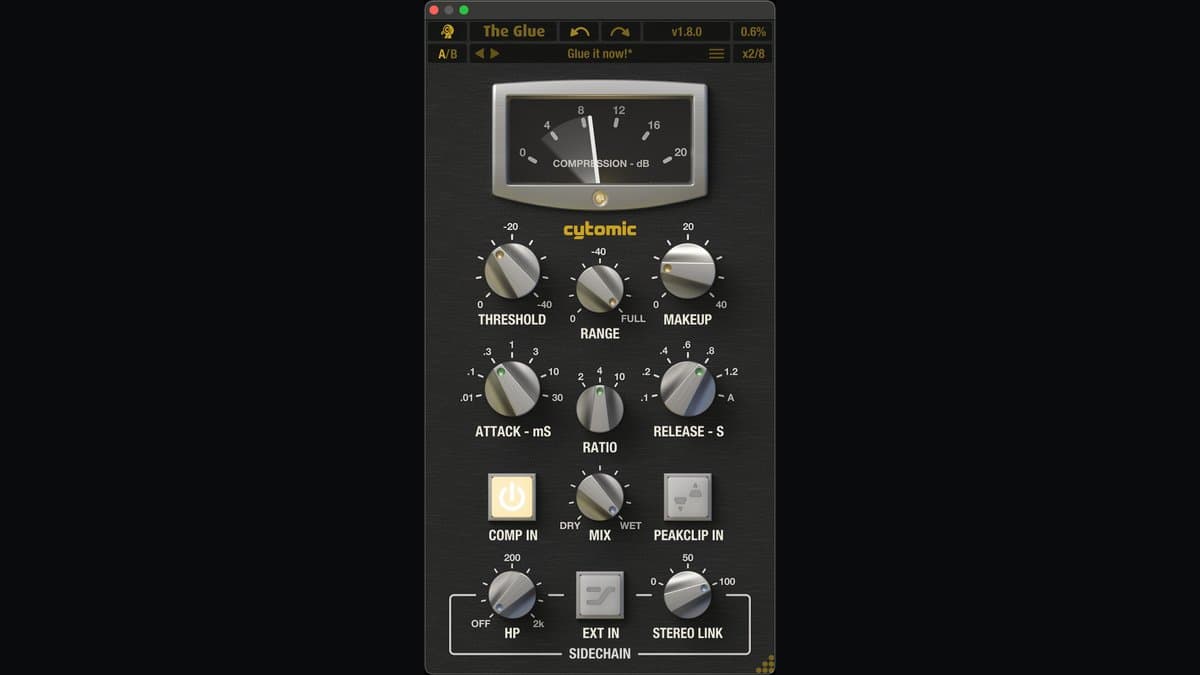
Cytomic The Glue is an analog-modelled VCA bus compressor inspired by the classic 1980s British large-console stereo bus compressor—the circuit engineers mean when they say “SSL bus glue.” Cytomic built it with the same class of circuit-simulation thinking used in serious component modelling, then optimised it to run as a realtime plugin. The result is not a one-knob “vibe” processor. It is a feedback compressor with a dual-diode envelope follower, stereo linking you can open down toward dual mono, and several extras the original hardware never had: Mix, Range, a soft sidechain high-pass, external sidechain, a peak clipper, and high-quality oversampling with separate realtime and offline choices.
If you only know bus compression as “squash until it pumps,” The Glue is the opposite education. Used gently on a stereo bus it can feel almost invisible while still making a mix move as one. Used harder on drums it produces the classic attack “crack” and level control that made console bus comps studio folklore. That dual personality—transparent glue versus punchy drum clamp—is why it has stayed a default recommendation for more than a decade.
What The Glue actually models
The core story is feedback VCA compression with a dual-diode detector. The sidechain detector is not a simple peak follower bolted onto a gain cell. It is a smoothed, diode-based envelope system solved with optimised nodal analysis. Small signals attack slowly; large signals open the diodes fully and reach the programmed attack time. That soft transition is a big reason people describe The Glue as musical rather than surgical.
Stereo linking uses a soft maximum of left and right detection so both channels share the same control voltage when fully linked—image stays stable. You can also step linking down in 25% increments toward dual-mono behaviour when a wide source needs independent channel motion. That is a real production control, not a marketing checkbox.
Ratio behaviour tracks the classic stepped console feel: 2:1 is relatively soft-knee and subtle, 4:1 is the everyday glue ratio, and 10:1 pushes into hard peak-control / limiter territory. Attack spans 0.01 ms to 30 ms—including faster times than the original hardware—so you can either let transients through or grab them early. Release runs 0.1–1.2 s with the famous Auto position that still works for many people as a “set and leave” choice on buses.
Controls that matter beyond Threshold and Ratio
Mix crossfades dry and compressed audio with phase-accurate blending. Units read in decibels-style control language rather than a vague percentage theatre. It is the fast path to parallel compression on a single insert: dig harder, then blend back body and transient life.
Range is the feature many engineers end up defending in A/B tests. It limits how far gain reduction can swing even when peaks would otherwise pin the detector. Full Range preserves the cleanest analog-style behaviour. Pulling Range down emulates slewed / older units or simply stops the compressor from destroying a chorus when the singer gets loud. Treat it as a safety ceiling, not a gimmick.
Sidechain high-pass is a gentle 6 dB/octave filter from effectively open up to about 2 kHz on the detector path. On a full mix, set it so the kick does not dictate every gain-reduction wiggle. On a drum bus, it keeps the compressor from breathing only with the low end while the cymbals get ignored.
Peak Clip is an optional soft-clip style peak controller after the compressor. Drive it carefully. Heavy clipping without oversampling invites aliasing; Cytomic’s oversampling stack is there specifically so non-linear stages can stay clean when you push them.
Oversampling can be disabled for true zero-latency tracking, or raised for quality. Cytomic recommends thinking in two layers: something like 2× for realtime and higher (often 8×) for offline bounce, with phase-mode choices (minimum / intermediate / linear) trading latency against high-frequency alignment. Report delay to the DAW is handled so PDC can compensate, but linear-phase modes still cost more latency at the top end of the spectrum.
Meters matter operationally. The main white needle is RMS-oriented gain reduction for musical reading. Click the VU area for a yellow peak needle with hold so makeup gain does not quietly create new peak problems. Hovering can show numeric RMS and peak compression values—use them when you are matching loudness for honest A/B tests.
How to use The Glue (practical workflows)
Stereo mix bus (subtle glue)
- Insert The Glue near the end of the mix bus chain—after broad tonal balance, before final limiting/clipping if you master in the box.
- Start 4:1, attack 10–30 ms, Auto release.
- Lower threshold until you see about 1–3 dB GR on the loudest chorus sections, not constant heavy pumping.
- Set sidechain HPF roughly 60–120 Hz so low end does not own the detector.
- Match makeup gain so bypassed vs engaged feels equal loudness, then decide with ears—not louder-wins bias.
- If choruses still over-compress, raise Range ceiling behaviour by reducing Range so peaks cannot force deeper GR, or ease threshold.
This is the “glue” people mean: the whole mix starts to move together without obvious pumping.
Drum bus (punch and crack)
- Try 4:1 first; move to 10:1 if you want aggressive clamp.
- Faster attack grabs more; slower attack preserves stick and beater click.
- Auto release is a strong default; fixed faster release can add groove on electronic kits.
- Sidechain HPF keeps the kick from over-keying.
- Use Mix around 50–80% if full wet feels too small or lifeless.
- Optional Peak Clip for peak control on heavily programmed drums—enable oversampling if you hear grit that is not musical.
Vocals, bass, and instruments
Official demos and long-term user practice agree The Glue is not only a bus tool. On vocals it can even out quiet/loud phrases while adding a touch of forward clarity. On bass it can sit a performance into a pocket without the squashed flatness of a crude limiter. On acoustic guitars and layered groups it often works better as gentle 2:1–4:1 control than as a character saturator—if you want heavy color, look to tape, transformers, or dedicated saturation, not this circuit.
Parallel and “Range as parallel”
Two different philosophies live in the plugin:
- Mix knob parallel: compress harder than you would 100% wet, then blend.
- Range limiting: keep full wet, but stop GR from going nuclear on peaks.
Many sessions use both lightly: Range as a safety net, Mix as taste.
Settings cheat sheet
| Job | Ratio | Attack | Release | HPF (sidechain) | Notes |
|---|---|---|---|---|---|
| Mix bus glue | 4:1 | 10–30 ms | Auto | 60–120 Hz | 1–3 dB GR target |
| Pop drum bus | 4:1–10:1 | 1–10 ms | Auto / medium | 80–150 Hz | Preserve snare crack |
| Electronic pump | 10:1 | medium-fast | tempo-aware feel via release | lower if needed | Let kick drive intentional pump |
| Vocal control | 2:1–4:1 | medium | Auto | optional | Prefer Range over brutal threshold |
| Bass sit | 4:1 | medium-slow | medium | 30–80 Hz | Watch low-end breathing |
These are starting points, not laws. Always A/B at matched loudness.
The Glue vs common alternatives
SSL Native Bus Compressor 2 is the official brand path. Buy it when you want SSL’s current product lineage, ecosystem marketing, and whatever unique extras that version ships with—and you accept a higher typical list price.
Waves SSL G-Master is the mass-market clone many engineers grew up with. It often wins on sale price and preset familiarity. Some mixers still prefer The Glue’s motion and extras; others cannot hear a practical difference in their genre and keep G-Master for template inertia.
FabFilter Pro-C 2 is a different philosophy: modern feed-forward flexibility, styles, mid/side, deep metering. Choose Pro-C 2 when you need surgical dynamics design. Choose The Glue when you want a specific console-bus feel with fewer decisions.
TDR Kotelnikov (especially free GE) is the transparent-dynamics counterargument. If your session wants invisible level control without SSL heritage, Kotelnikov is often enough. The Glue still wins when you specifically want that British bus compressor groove and attack crack.
Ableton Live Glue Compressor is free if you already live in Live. Many Live users stay on stock until they need Cytomic’s Range/oversampling/peak-clip workflow as a dedicated insert elsewhere.
Who should buy it
Buy The Glue if you mix in the box and want a dedicated SSL-style bus compressor that is honest, flexible, and paid once. It is especially strong if you:
- Build drum buses and stereo buses as part of every template
- Prefer feedback VCA glue over multiband “fixing”
- Want Mix and Range without building parallel racks every time
- Already like Live’s Glue and want the full Cytomic product under your control
Skip or deprioritize it if you already own an SSL bus you love, if your genre never wants console bus motion, or if you only need a transparent limiter/maximizer chain (different tool class).
Honest limitations
The Glue will not replace a mastering limiter, a multiband compressor, or a vocal ride automation pass. It will not give you transformer saturation as a primary color (though Peak Clip and heavy compression create their own non-linearities). The interface will not impress clients looking for sci-fi GUIs. In a market full of SSL-inspired plugins, “best” is ear-dependent—so trust extended A/Bs on your material, not forum lore.
Verdict
At $99 with a free trial, The Glue remains one of the highest-value bus compressors in production. The modelling story is specific (dual-diode feedback VCA), the extras are practical (Mix, Range, HPF, oversampling), and the sonic reputation has survived long enough that both stock Ableton integration and third-party mixing culture still orbit it. Score 8.8: not because it is the only SSL-style option, but because it is still one of the most usable.
Confirm formats, OS requirements, and street price on the official Cytomic product page before you buy. Start with the trial on a real drum bus and a finished mix—those two tests usually tell you everything.