Audio Damage Sandbender: 4-Operator FM Made Playable
Audio Damage Sandbender is a four-operator FM synth that makes FM easy to program, with drag-and-drop mod, a genetic preset generator and iOS support. Full review and how it compares to FM8.
Dubspot's best Black Friday dealsDubspot Tracker Pro: $15, was $24.99 ↗Drum Programming and Groove Production Course: $19, was $99 ↗
See full specs, price, and alternatives in the plugin database →
FM synthesis has always carried an image problem. Everyone loves the sound, yet almost no one wants to program it. Sandbender, released in November 2026 by Audio Damage, is built to fix exactly that. It is a four-operator FM synth that keeps the classic tones within reach while making the patching process feel like play rather than homework. This review walks through the engine, the workflow tricks, and how it stacks up against the FM benchmark.
At a glance: a four-operator FM synthesizer plugin for macOS, Windows, Linux and iOS, in CLAP, VST3, AU, AAX and AUV3 formats. It offers ten factory algorithms plus a custom algorithm designer, per-operator wave shaping, a wavefolder, a sub oscillator, six noise types, eleven filter types, drag-and-drop modulation, a genetic preset generator and over 260 presets. There is no DRM, no dongle and no subscription. Price is €90.95.
What is Sandbender?
Sandbender is Audio Damage's take on four-operator FM, and the whole design answers the oldest complaint about the format. Most of the FM sounds people have heard over the years were factory presets nobody dared to edit, because one wrong move turned an electric piano into a fax machine. Sandbender treats the four operators as the start of a sound rather than a locked bank. It surrounds them with tools that make exploration safe and fast.
It sits in the same family as classic digital FM instruments, but it aims squarely at playability and modern workflow. The operators run through a proper filter and a low-pass gate. There is a full modulation system, a step sequencer, a performance surface and a stack of effects. It is also platform-agnostic in a way few deep synths are, covering desktop and iOS from a single design, with Audio Damage's long-standing no-copy-protection stance intact.
What's new in Sandbender
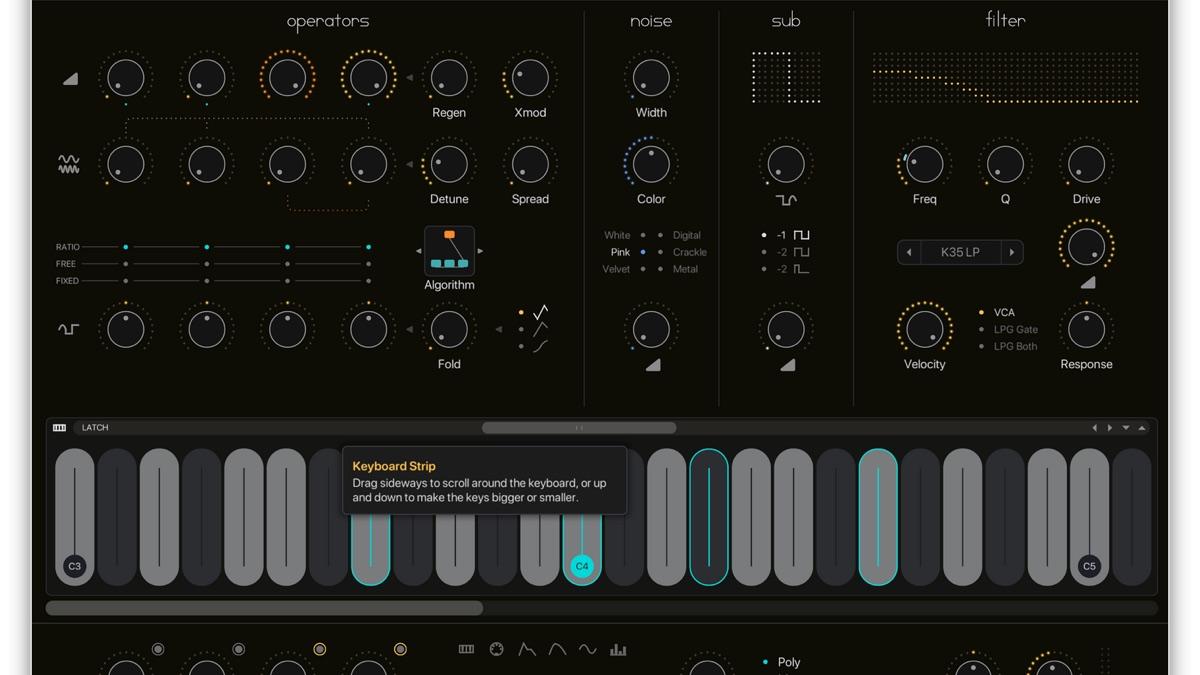
The four operators are far more than sine sources. Each has its own wave shaper that morphs from triangle through sine to pulse with a single knob, and any operator can both sound and modulate at the same time. You get ten factory algorithms plus an algorithm designer for drawing your own routings. Stack-wide controls cover cross-modulation, regeneration, detune, spread and an octave range from 32' to 2'. A wavefolder adds harmonics without rearranging the sidebands, which keeps folded tones musical.
Beyond the operators sit a divider sub oscillator clocked by operator one, and six noise types: White, Pink, Velvet, Digital, Crackle and Metal, each with color and stereo width. The filter section is unusually generous for an FM synth. It carries eleven filter types spanning state-variable, ladder, diode and Sallen-Key designs, each running in stereo per voice. Every voice ends in a plain VCA or a modeled low-pass gate, and that gate ties brightness to loudness for a woody, plucked decay.
Programming is where Sandbender earns its name. Modulation is drag-and-drop. Grab a source from the rail, which holds two ADSR envelopes, two LFOs, two function generators, a sixteen-step sequencer, four macros and all the MIDI and MPE data, then drop it onto almost any knob with a bipolar depth. Prefer not to patch at all? The GENETICS page breeds a family tree of variants from the current sound, so you click to audition and double-click to breed from a direction you like. The PERFORM page gives you two draggable nodes plus a gesture recorder that captures a tempo-synced loop of your movements. Six effects sit at the end in any order you choose: multiband compression, delay, reverb, modulation, distortion and a dual phaser.
Sandbender specifications
| Spec | Detail |
|---|---|
| Synthesis | Four-operator FM, ten algorithms plus a custom algorithm designer |
| Per operator | Wave shaper, harmonic/free/fixed tuning, simultaneous sound and modulation |
| Extras | Wavefolder, divider sub oscillator, six noise types |
| Filters | Eleven types (state-variable, ladder, diode, Sallen-Key), stereo per voice |
| Output stage | VCA or modeled low-pass gate per voice |
| Modulation | 2 envelopes, 2 LFOs, 2 function generators, 16-step sequencer, 4 macros, drag-and-drop |
| Extras | GENETICS preset breeder, PERFORM surface with gesture recorder |
| Voices | 8, poly/mono/retriggered mono, 1x to 8x oversampling |
| Tuning | Full MPE and MTS-ESP microtuning |
| Presets | Over 260, in nine categories |
| Effects | Six, reorderable |
| Formats | CLAP, VST3, AU, AAX (desktop); AUV3 (iOS) |
| Platforms | macOS 10.15+, Windows 10+, Ubuntu 22+, iOS 16+ |
| Copy protection | None (no DRM, no dongle, no subscription) |
| Price | €90.95 |
Sandbender vs FM8
The benchmark for approachable FM is Native Instruments FM8, the synth that first made operator routing legible with a visual matrix. Sandbender chases the same goal from a different angle. It replaces matrix study with drag-and-drop modulation and a genetic breeder.
| Sandbender | FM8 | |
|---|---|---|
| Operators | 4, each with a wave shaper | 6, matrix routing |
| Programming aid | Drag-and-drop mod, GENETICS breeder | Visual operator matrix |
| Filters | 11 types, stereo per voice | Multimode filter |
| Platforms | Mac, Windows, Linux, iOS | Mac, Windows |
| Copy protection | None | Native Access ecosystem |
| Price | €90.95 | $99 |
FM8 remains the deeper library and the classic DX7 import path, and it is still the reference for pure digital FM. Sandbender is the more modern, more playable instrument, and the only one of the two you can run on an iPad or on Linux. If matrix-style FM is not your thing, it is the easier door in. For a broader look at the field, see our best synth VST plugins guide. For classic DX territory, the free Dexed is worth a look.
Who Sandbender is for
Sandbender is for producers who love FM tones, the glassy pianos, metallic bells, punchy basses and bright evolving pads, but who have bounced off the genre's reputation for painful programming. It is also a natural pick for anyone working across devices, since a single purchase covers desktop and iPad with no copy protection to manage. Sound designers who enjoy happy accidents will get a lot out of the GENETICS and PERFORM pages.
It is less essential if you only need the occasional FM bell and already own a capable synth that does FM on the side. The engine is deep, and building intricate patches by hand still asks for patience, even with the workflow aids. This is a synth to live in, not a one-trick utility.
How much does Sandbender cost?
Sandbender is €90.95 as a single perpetual purchase, with no subscription and no dongle. That covers desktop formats in CLAP, VST3, AU and AAX, plus an AUV3 build for iPhone and iPad. A fully functional demo with a twenty-minute session timer is available, so you can audition the engine before buying. You can get it from the official Audio Damage product page. Producers already invested in the Native Instruments world can compare it against the FM synth inside Komplete 26.
FAQ
Is Sandbender good for beginners?
Yes, more than most FM synths. The drag-and-drop modulation and the GENETICS preset breeder let you explore great sounds without understanding operator math, while the depth is there when you want to dig in.
Sandbender vs FM8, which should I choose?
Choose FM8 for its larger preset library and DX7 SysEx import. Choose Sandbender for a more playable workflow, eleven stereo filter types, Linux and iOS support, and no copy protection.
Does Sandbender work on iPad and Linux?
Yes. It ships as an AUV3 app for iPhone and iPad on iOS 16 or later, and as CLAP and VST3 on Ubuntu 22 or later, alongside the Mac and Windows builds.
Does Sandbender use iLok or a subscription?
No. Audio Damage ships Sandbender with no DRM, no dongle and no subscription, as a perpetual license.