Teenage Engineering EP-136 K.O. Sidekick: The Pocket Mixer the EP Family Was Waiting For
Teenage Engineering's EP-136 K.O. Sidekick is a $179 two-channel mixer, USB interface, and performance FX unit that snaps onto the EP-133 and EP-1320.
Black Friday 2026Teenage Engineering Black Friday 2026: dates and deals →
A pair of EP-133 samplers and a phone loaded with loops left a lot of Teenage Engineering owners hunting for a sensible way to combine them. The EP-136 K.O. Sidekick fills that gap. It is a two-channel stereo mixer, a USB audio interface, and a performance effects engine in a 300-gram slab that fits in a jacket pocket. At $179 it lands well below the price of the samplers it was built to serve.
What it actually is
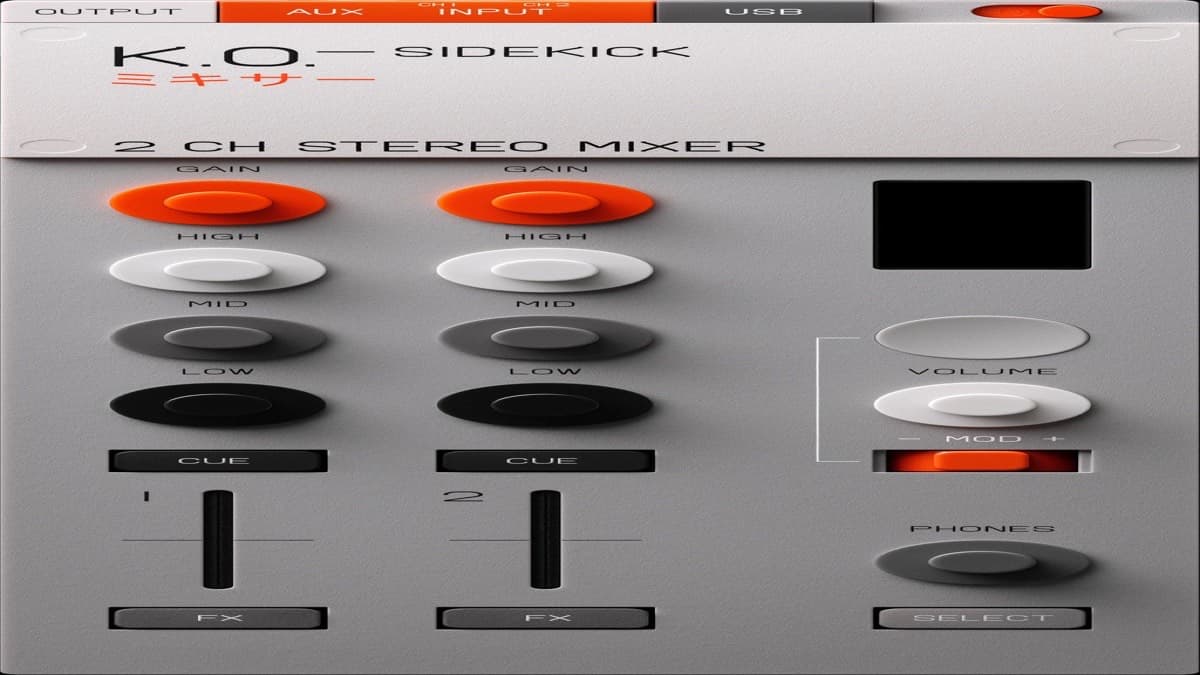
Teenage Engineering first sketched the Sidekick as a basic mixer for the EP-133 K.O. II. The shipping product is a lot more than that. It is a two-channel mixing console with individual gain, three-mode compression, switchable EQ styles, full beat-match per channel, and a six-effect performance section driven by a pressure-sensitive pad and a high-resolution mod stick. Built into the same chassis is a USB-C audio interface that streams eight inputs and four outputs to a host, plus bidirectional MIDI.
You can use it three ways without changing cables. As a standalone mixer for a small live setup. As an effects box that sits between any two stereo sources. As a soundcard for a laptop or iPhone bag-and-go session. None of those modes feels bolted on.
The channel strip
Each stereo channel includes a fader, a gain stage, a three-band EQ, and a compressor. All of those are programmable. The EQ offers three modes (DJ, parametric, and studio) that adjust curves and frequency bands, so the same hardware reads either as broad club-style cuts or as more surgical mixing. The compressor offers three modes too, taking you from tight transient control on a drum bus to gentle glue on a vocal channel.
A dedicated cue button on each channel sends a separate stereo feed to the headphone output. That setup lets you pre-listen and beat-match without disturbing the main mix. The level of channel-strip flexibility on offer here exceeds what most $179 mixers deliver at any size, let alone one this small.
Six effects, one pad, one mod stick
The performance side is where Teenage Engineering's design language shows up most clearly. Six effects sit under a single force-sensitive pad: filter, loop, delay, tape, tremolo, and siren. Pressure changes the depth or wet/dry balance, the mod stick steers a second parameter, and the Tap FX Sequencer locks the whole thing to your track tempo so a tap-stutter or a quarter-note filter sweep falls cleanly on the grid.
A two-bar motion-recording layer captures FX automation and loops it back, the way a club-style remix automator works. It is the kind of FX section that rewards both careful programming and spontaneous play. You can sit down and sequence a precise filter ramp. You can also just mash the pad and let the tempo lock keep you honest.
Audio interface and connectivity
The rear panel keeps things straightforward. Two stereo 3.5mm line inputs serve channels one and two. A third 3.5mm jack takes a stereo aux or "session" feed for a phone, a laptop, or a guest. A main 3.5mm output goes to monitors or a PA, and a separate cue 3.5mm output handles headphones. Everything runs at 48 kHz / 24-bit, with 105 dBA SNR on the inputs and 108 dBA on the outputs, which are clean numbers for a battery-powered pocket device.
The USB-C port carries an eight-in / four-out USB Audio 2.0 stream and a MIDI link in both directions, so the same cable that powers the Sidekick can also patch it into Ableton Live, Logic, or an iPad. Power runs from USB-C or two AAA batteries, which is the part you appreciate when the venue's outlet is twelve feet from where you wanted to set up.
EP Pegs, a mixer that snaps onto your sampler
The most Teenage-Engineering-shaped thing about the Sidekick is the EP Pegs system. The unit ships with small physical pegs that slot into the side openings of any EP-series device (the EP-133 K.O. II, the EP-1320 Medieval, the new Sidekick itself) and lock two units together at the seams. The pegs are LEGO-compatible, which is funny in a press shot and useful in practice, because it means you can build a deliberately rigid two- or three-unit rig that travels as one object. A Sidekick happily sits between two K.O. IIs, taking line-in feeds from each and mixing them into a single stereo bus.
It is a small idea with a real workflow payoff. The boring cable-bundle problem of a multi-sampler setup gets replaced by something closer to a stompbox pedalboard, only smaller and without the screws.
Where it fits
For an existing EP-133 owner, the Sidekick is the obvious next purchase. It gives you a dedicated stereo bus, real EQ and compression on the sampler's output, and a performance FX layer the K.O. II does not have on its own. For a producer who already has a synth and a drum machine on a desk, it is a credible compact mixer with a proper audio interface attached, small enough to leave permanently slung in a laptop bag. For a live electronic act that wants expressive FX automation without dragging out a full DJ mixer, it is the cheapest serious option on the market today.
The thing it is not is a full-sized DJ mixer. There is no crossfader, no phono input, no booth output. Treat it as what it is, a performance and routing tool for compact stereo gear, and it is hard to find anything in its price range that does as much.
Pricing and availability
The EP-136 K.O. Sidekick is shipping now from Teenage Engineering and authorized retailers at €189 / £189 / $179. The companion EP-133 K.O. II sampler sits at $329, and the two together still come in under the price of a single mid-range groovebox, which is the framing Teenage Engineering clearly wants you to see.
If you have been waiting for the EP-series to grow up into something you can actually gig with, this is the piece that makes the rest of the family make sense.