Buchla Ziggy: A Sub-$1,000 West Coast Synth From the Originators
Buchla Ziggy is a $999 desktop analog monosynth built around a complex oscillator, low-pass gate, and the Cycler — announced ahead of Superbooth 2026.
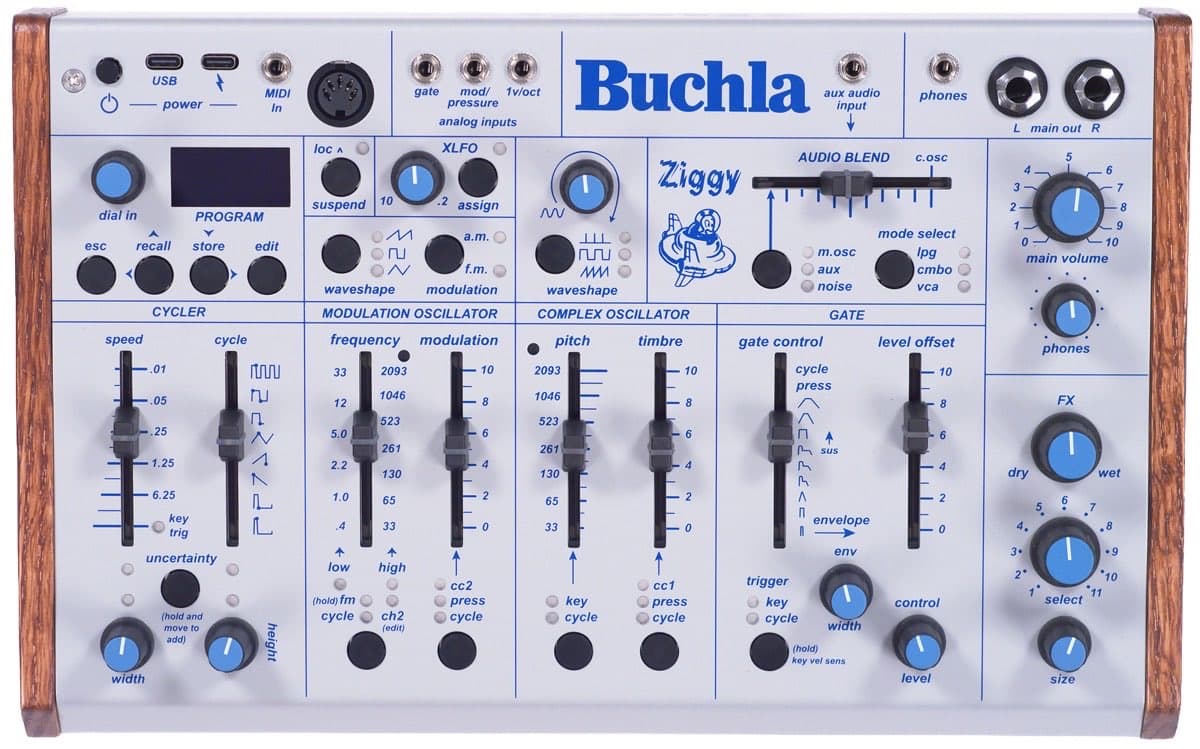
For decades, owning a Buchla has meant clearing serious bench space and committing a five-figure budget. The Ziggy changes the equation. Announced ahead of Superbooth 2026, this compact desktop monosynth brings the brand's signature West Coast sound to a much wider audience at $999. It runs on USB-C bus power and fits easily on any workspace.
Buchla positions it as an instrument more than a traditional synthesizer. Patch cables are absent. You assign modulation with simple gestures — hold a destination, twist a source, and the routing is made on the fly. The classic complex-oscillator signal flow lives inside, but the surface is built for fast moves and live playing.
Check Buchla Ziggy price at ThomannA complex oscillator at the heart
The Ziggy centers on a classic Buchla complex oscillator. An analog sine wave receives frequency and amplitude modulation from a second oscillator, which operates at audio or sub-audio rates and supplies sawtooth, square, and triangle shapes. A wavefolder layers harmonics on top, and you can blend in spike, square, and sawtooth waveforms for more biting textures. The outcome feels instantly familiar to West Coast players — tones emerge bell-like and harmonically alive, evolving through timbral shifts rather than conventional filter sweeps.
Instead of a traditional VCF and VCA, the signal hits a Low Pass Gate built around a Sallen-Key topology. The LPG behaves as filter, amplifier, or both at once, and its envelope shapes are blended rather than carved into ADSR stages. It is the percussive, plucky, woody response that defines the Buchla character — the one ingredient almost no other manufacturer captures the same way.
The Cycler does most of the heavy lifting
The Cycler is where the Ziggy reveals its lineage most clearly. A single module behaves as a clock, an envelope generator, an LFO, and a random source, with an "uncertainty" amount that injects controlled chaos into whatever it controls. An XLFO sits alongside it for slow triangle-wave movement, and external MIDI can drive parameters from a sequencer or controller.
Pair the Cycler's uncertainty with the wavefolder and the LPG and you get patches that breathe and drift on their own. They develop over time without writing a sequence at all. That is the West Coast philosophy in one knob.
Digital control, analog signal path
Analog circuits handle the oscillators, modulation, and low-pass gate. Digital technology manages only the control surface. That combination is how Ziggy gets patch memory — over a hundred slots covering factory presets and your own work — along with a small screen for visual reference and LED indicators for live modulation routing.
Buchla also added a stereo digital effects section: reverbs, delays, chorus, pitch shift, and flanger variations, with wet/dry control and a single macro "size" parameter that scales the effect in one move. Custom tuning and quantization are built in, including non-Western scales, and patches can be edited and archived from a web browser via WebMIDI. Firmware updates flow through the same path. None of this is unusual on a 2026 synth, but it is genuinely unusual for Buchla, who have historically left convenience features out of the architecture.
Ports, power, and where it fits
Connectivity is generous for the form factor. The Ziggy accepts 1V/oct pitch CV, gate, and a modulation CV input on the back, which makes it Eurorack-friendly out of the box. MIDI arrives over USB-C, 5-pin DIN, and TRS mini, so it slots into a hardware rig or a laptop session without an interface. Audio I/O covers a mono 3.5mm aux input for routing external sound through the LPG and effects, two ¼" stereo outputs, and a 3.5mm headphone jack. Power is USB-C, with two ports for redundancy — wall adapter, computer, or power bank all work.
The Ziggy is monophonic, and that is the obvious caveat. If you came here expecting paraphony or four voices for the price, this is not that synth. What you are getting is the Buchla voice — the complex oscillator, the LPG, the Cycler — distilled into the smallest, cheapest box the company has ever made.
Pricing and availability
The Ziggy is up for preorder now at $999 USD direct from Buchla. A bundled package with the LEM218 touch keyboard controller is $1,999, which is a meaningful discount over buying both separately. First units are scheduled to ship in late summer 2026. European buyers can also order the Buchla Ziggy through Thomann, which currently shows a multi-month lead time ahead of those first shipments.
For anyone who has watched Buchla from a distance and never quite been ready to spend Easel Command money, the Ziggy is the easiest yes the brand has ever offered. It is small, it runs off a power bank, it sounds like a Buchla, and it costs less than most boutique Eurorack voices. Whether it earns a permanent place in your studio depends on what you want from a monosynth — but as a way into the West Coast world, it is hard to argue with the value. To see where it sits among this year's standouts, read our guide to the best hardware synthesizers in 2026.